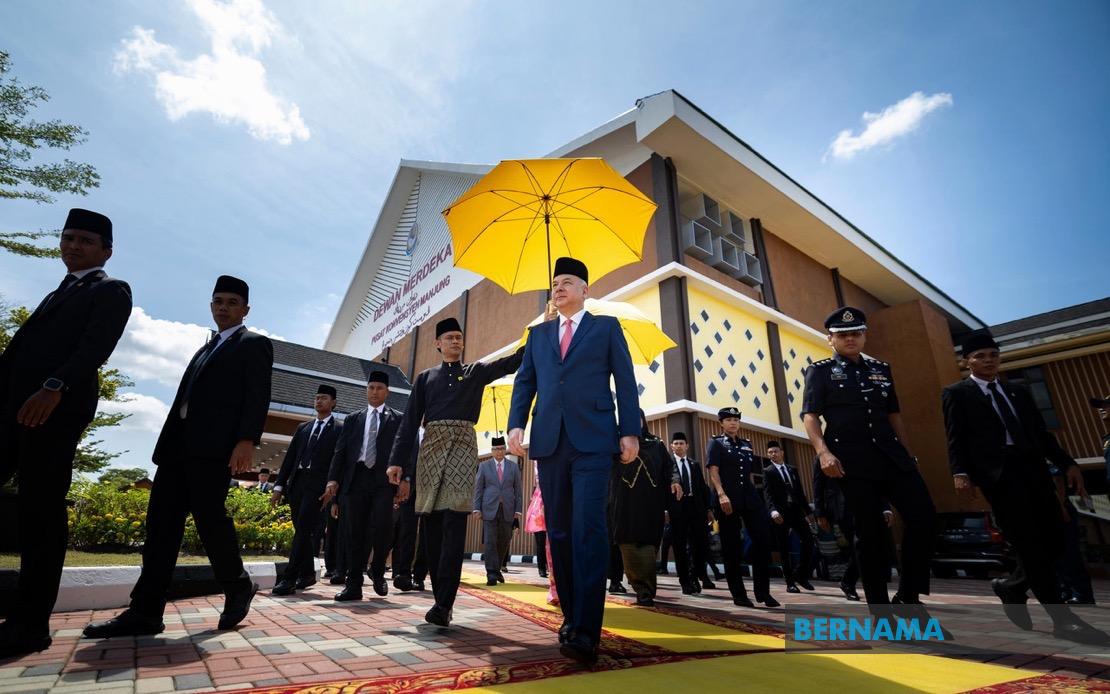
Sultan Nazrin Shah, the reigning Sultan of Perak, has formally inaugurated the Merdeka Hall of the Manjung Municipal Council in Lumut, marking a significant milestone for the northern Perak coastal district. The opening ceremony brought together prominent state and federal figures, including Tuanku Zara Salim, the Raja Permaisuri of Perak, and Raja Iskandar Dzurkarnain Sultan Idris Shah, the Raja Di Hilir of Perak. The event also drew attendance from Perak Menteri Besar Datuk Seri Saarani Mohamad and Higher Education Minister Datuk Seri Dr Zambry Abd Kadir, underscoring the facility's importance to both state and national development priorities.
Constructed at an investment of RM12.7 million, the new Merdeka Hall represents a substantial infrastructure commitment to the Manjung district. The venue accommodates up to 2,500 attendees, positioning it as a major assembly point for the region. Beyond its immediate capacity, the facility serves multiple functions as a multipurpose venue capable of hosting government functions, business conferences, and community gatherings. For a coastal district in Perak, such infrastructure supports not only administrative operations but also opens pathways for commercial conferences and tourism-related events that increasingly characterise Malaysia's regional development strategies.
The timing of the opening holds particular significance, as it coincides with the Manjung Municipal Council's silver jubilee milestone. The council was initially established as a district authority on January 1, 1980, before being elevated to municipal status on August 1, 2001. This 25-year span of municipal governance reflects the district's evolution from a smaller administrative body into a more complex urban entity requiring expanded facilities and services. The Merdeka Hall thus symbolises the council's institutional maturation and readiness to manage contemporary municipal challenges.
Perak's Menteri Besar contextualised the opening within a broader development trajectory that began in 2016, when the previous administration initiated plans to rebuild the facility. The lengthy process between conception and completion reflects the complexities of securing federal funding allocations and managing large-scale construction projects in Malaysia's federal system. Saarani emphasised that the project's realisation demonstrated continuity in governance priorities and productive cooperation between state and federal authorities, a message particularly relevant given Malaysia's multi-level governance structure and the sometimes contentious allocation of development resources between levels of government.
Manjung's transformation towards becoming a Tourism and Maritime City by 2030 forms the strategic backdrop for this investment. The district's coastal location along the Strait of Malacca positions it advantageously for maritime commerce and leisure tourism development. A modern convention and community facility like the Merdeka Hall strengthens the district's ability to attract conferences, trade exhibitions, and cultural events that typically drive tourism revenue and create employment opportunities. For Southeast Asian readers, this reflects a broader regional trend of secondary cities investing in event infrastructure to diversify economic bases beyond traditional industries.
The nomenclature of the facility carries deliberate patriotic messaging. By naming it the Merdeka Hall, authorities tied the physical structure to Malaysia's independence narrative, embedding national symbolism into local infrastructure. During his remarks, Saarani articulated that the name serves as a continuing reminder that independence represents a collective trust requiring ongoing stewardship and commitment to societal values. This rhetorical approach reflects how Malaysian governance frequently intertwines national historical narratives with contemporary development projects, reinforcing civic identity and social cohesion at the local level.
Saarani's vision for the Merdeka Hall extends beyond its immediate physical functions. He envisioned the space as an incubator for knowledge development, mutual understanding, and consensus-building—concepts central to Malaysia's deliberative governance model. By characterising the hall as a place where community initiatives flourish, he positioned it as instrumental in advancing both economic and social development objectives. This framing aligns with contemporary Malaysian thinking about inclusive development that balances infrastructure investment with community engagement and social benefits.
The opening ceremony itself constituted a multilayered event with significance beyond the immediate ribbon-cutting ceremony. The presence of royal patrons, the Menteri Besar, and a federal minister created a layered governance representation that underscored the project's importance across administrative tiers. For Malaysian audiences familiar with governance hierarchies, such attendance patterns communicate institutional priorities and resource commitments. The convergence of these figures in Lumut signalled that Manjung occupies a meaningful position within Perak's development strategy and federal considerations.
For the Manjung Municipal Council operationally, the new facility addresses long-standing venue constraints that likely characterised the district's previous administrative period. A 2,500-capacity modern hall substantially expands the council's capacity to convene stakeholders, conduct public consultations, and host municipal events. In Malaysia's context of participatory governance, such facilities become essential infrastructure for public engagement, particularly as councils attempt to manage increasingly complex urban issues involving diverse stakeholder communities. The Merdeka Hall thus represents not merely architectural addition but operational enablement for more sophisticated municipal administration.
The RM12.7 million investment requires contextualisation within broader Perak development spending and Malaysian municipal infrastructure generally. This expenditure level places the project within the category of significant municipal investments, comparable to similar facilities developed in other Malaysian urban centres. For Lumut specifically, a town historically dominated by naval establishments and fishing industries, the Merdeka Hall represents diversification of local economic infrastructure, potentially attracting new categories of visitors and economic activities beyond traditional maritime employment.
Looking forward, the Merdeka Hall's success will largely depend on municipal marketing and programming that transforms physical capacity into sustained utilisation. Many such facilities in Malaysian cities face utilisation challenges if programming remains sporadic or disconnected from community interests. The Manjung Municipal Council's ability to populate the calendar with events, conferences, and community activities will determine whether the facility becomes a vibrant hub or underutilised asset. Strategic programming aligned with the Tourism and Maritime City 2030 vision would position the hall as integral to that larger transformation rather than standalone infrastructure.

