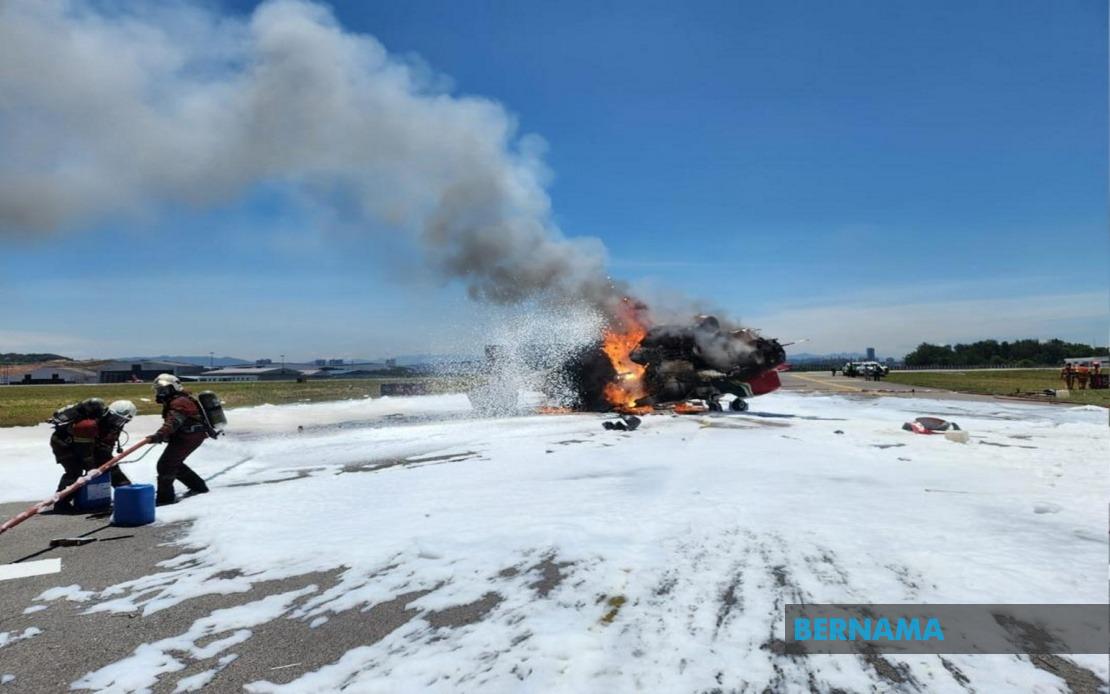
Operations at Sultan Abdul Aziz Shah Airport resumed on Thursday afternoon after aviation authorities temporarily shut down the runway following an explosive incident involving a cargo helicopter conducting routine maintenance. The aircraft, a Kamov KaV-32S registered to a Ukrainian company, ignited during an engine run-up test at approximately 12.28 pm, prompting swift emergency response measures and the diversion of multiple flights to alternative airports across the region.
Captain Datuk Norazman Mahmud, chief executive of the Malaysian Civil Aviation Authority (CAAM), confirmed that the runway reopened to traffic at 2.57 pm, roughly two and a half hours after the initial incident. The fire broke out at Taxiway Victor as a four-member Ukrainian crew—comprising the pilot, co-pilot, and two additional maintenance technicians—conducted standard maintenance procedures on the aircraft. One crew member sustained minor injuries when flying debris struck him during the incident, though no fatalities were reported.
The unexpected closure created considerable disruption to flight schedules at Malaysia's second-busiest airport serving the Klang Valley and surrounding regions. Eight inbound flights destined for Subang were diverted to neighbouring airports, while three scheduled departures experienced delays as air traffic controllers halted all runway movements. The CAAM had initially announced an indefinite suspension of both arrivals and departures pending investigation and clearance of the incident scene, necessitating immediate coordination between ground services and airline operations teams.
Airport authorities moved swiftly to restore normalcy once investigators cleared the runway and confirmed the incident posed no ongoing risk to airport infrastructure. Flight information displays throughout the terminal building reflected the revised schedules, allowing passengers and airport staff to track updated departure and arrival times. Airlines began notifying affected passengers of schedule changes and rebooking options, though the relatively short closure period meant most disruption remained manageable compared to extended airfield shutdowns.
Sultan Abdul Aziz Shah Airport, commonly known as Subang Airport, handles significant regional traffic and serves as a major maintenance and logistics hub for aviation operations across Southeast Asia. The presence of Ukrainian-registered aircraft conducting maintenance operations at the facility reflects the airport's status as a regional centre for technical aviation services. Ground maintenance activities on helicopters and fixed-wing aircraft are routine operations, yet incidents such as engine fires during static testing, while uncommon, underscore the importance of rigorous safety protocols and crew training in hazardous maintenance environments.
The incident raises broader questions about maintenance oversight and safety procedures at regional aviation facilities. While preliminary details suggest the fire occurred during standard engine run-up testing—a procedure designed to verify mechanical integrity before flight operations—the sequence of events that led to ignition would likely form the core of CAAM's formal investigation. Such investigations typically examine maintenance records, crew qualifications, equipment condition, and adherence to manufacturer specifications and regulatory guidelines.
For Malaysian aviation stakeholders and regional operators, the incident demonstrates the resilience of airport response systems and the capacity of ground staff to manage emergencies with minimal passenger impact. However, it also highlights the continued importance of maintenance facility safety standards, particularly for the growing number of international operators conducting technical work at Malaysian airports. The swift resolution and rapid runway reopening reflected well on airport emergency protocols and inter-agency coordination.
The helicopter involved, a Kamov KaV-32S model, is a Soviet-era twin-rotor aircraft commonly used for cargo transport and heavy-lift operations throughout Eastern Europe and Central Asia. The aircraft type has maintained a presence in regional operations despite its age, though aging airframes require increasingly frequent and comprehensive maintenance regimens. The presence of such aircraft at Malaysian facilities demonstrates the country's role as a maintenance and repair hub for a diverse international fleet.
CAAM's communication regarding the incident and runway reopening provided transparency that helped manage passenger expectations during the disruption. The authority's immediate confirmation of reopening at 2.57 pm, coupled with guidance for passengers to contact their respective airlines, ensured that affected travellers could make informed decisions about their journeys. This communication approach, while standard, remains essential for maintaining confidence in airport safety and operational management during disruptions.
Looking ahead, the incident will likely prompt a comprehensive review of maintenance procedures for similar operations at Subang and potentially across Malaysian aviation facilities. Regulatory bodies typically use such events as opportunities to reinforce safety standards and identify any gaps in existing protocols. The minor injury sustained by the crew member, while fortunate, serves as a reminder of the inherent risks associated with engine maintenance on high-powered aircraft and the critical importance of personal protective equipment and safety positioning during such operations.
The swift restoration of normal operations at Sultan Abdul Aziz Shah Airport underscores the facility's operational flexibility and the professionalism of Malaysia's aviation authorities. Passengers and operators can take reassurance that despite the afternoon's disruption, systems functioned as designed to manage the emergency, protect human life, and restore services efficiently. As investigations continue, the aviation industry will monitor findings to ensure that lessons learned contribute to further enhancing safety standards across the region.

