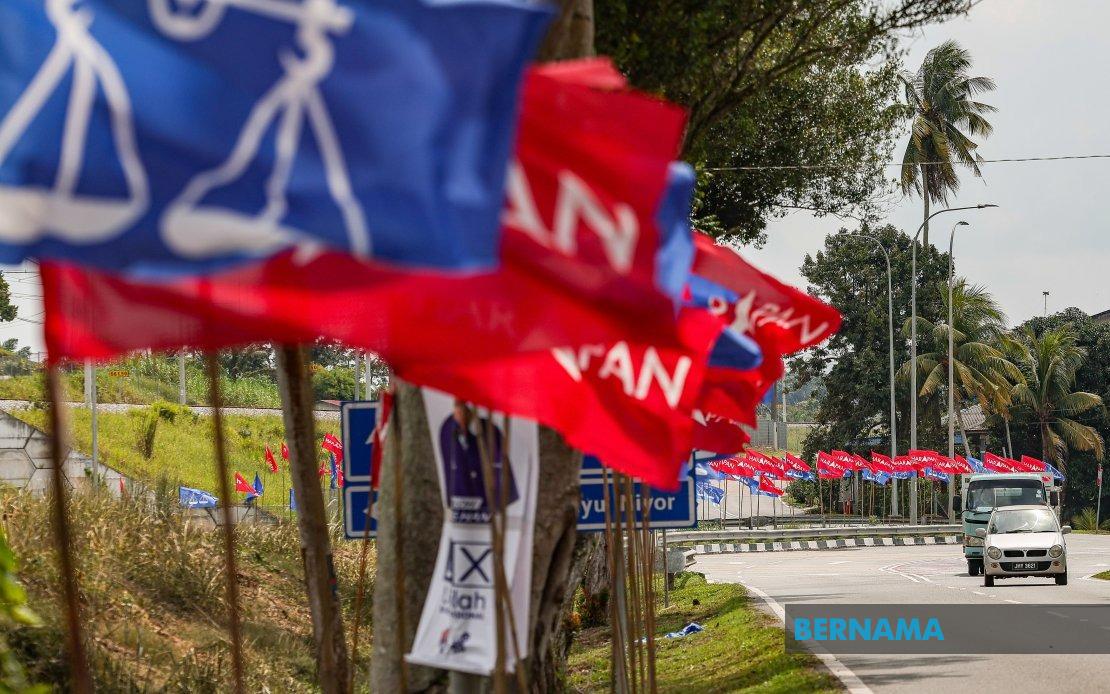
Pakatan Harapan candidate Suhaizan Kaiat has expressed confidence that his coalition can wrestle back the Larkin state seat from incumbent Barisan Nasional representative Mohd Hairi Mad Shah, provided that voter participation in the upcoming 16th Johor state election reaches substantially higher levels than in previous contests. Speaking to journalists after meeting with constituents in the Johor Bahru constituency, the Pulai Member of Parliament anchored his optimism on historical voting data, particularly the outcome of the 14th General Election when the seat was won by a PH-aligned candidate despite BN's subsequent recapture.
Suhaizan's strategic analysis hinges on a critical interpretation of recent electoral history in Larkin. He contends that the 2022 Johor state election result, which saw Mohd Hairi secure the seat with a majority of 6,178 votes, should not be taken as an accurate reflection of voter preferences in the constituency. The relatively low turnout of just 51 per cent during that election, attributable to COVID-19 pandemic-related restrictions and logistical challenges, artificially depressed overall participation figures and may have skewed the outcome in BN's favour. In contrast, the 14th General Election demonstrated that when constituents turned out in larger numbers, they displayed a willingness to support opposition candidates, suggesting underlying support for change that remains latent in the electorate.
This distinction between general elections and state-level contests carries particular significance for Malaysian observers. State elections frequently experience lower voter engagement compared to federal polls, a phenomenon that typically favours incumbent administrations and established coalitions with superior grassroots machinery. Suhaizan's implicit argument is that Larkin's electorate contains sufficient reform-minded voters to swing the seat, but only if those voters can be mobilised effectively. The challenge facing PH operatives lies in replicating the turnout conditions seen during GE14, now more than a decade past, when the broader anti-establishment sentiment and calls for change resonated more powerfully across the country.
Another dimension of Suhaizan's strategy involves capitalising on the fractured relationship between Bersatu and PAS within the ruling Perikatan Nasional coalition. He anticipates that supporters of Bersatu, whose party has declined to field a candidate in Larkin for this election, may be willing to lend their votes to PH given the historical cooperation between the two parties during the 2018 election cycle and subsequent political alignment. This calculation reflects broader fluid dynamics within Malaysian electoral politics, where voter loyalties are increasingly pragmatic and contingent on coalitional arrangements rather than fixed to single parties. The absence of a Bersatu candidate in Larkin theoretically removes a potential vote-splitter that might otherwise siphon support from the opposition in a multi-cornered contest.
The three-cornered fight that will actually unfold in Larkin pits Suhaizan against Mohd Hairi and Bersama candidate Norsinah Abu. While Bersama remains a marginal political force compared to the major coalitions, the party's presence adds unpredictability to the contest, particularly if it attracts protest votes or draws support from specific demographic segments within the constituency. Suhaizan's path to victory requires not only consolidating PH's core support base but also persuading swing voters and potentially disaffected BN supporters that change is warranted. The historical precedent of GE14, when Datuk Mohd Izhar Ahmad won the seat under the PH-Bersatu banner, suggests that Larkin voters are not inherently hostile to opposition politics.
The broader context of the 16th Johor state election involves 172 candidates contesting across 56 state seats, with polling scheduled for July 11 and early voting on July 7. This represents another significant electoral exercise that will test whether the political configurations evident at the federal level translate into state-level success for respective coalitions. Johor, as Malaysia's second-largest state by population and a crucial economic region hosting the port of Tanjung Pelepas and industrial manufacturing clusters, carries disproportionate political weight. The state has historically been a BN stronghold, though recent federal-level shifts and intra-coalition tensions have created openings for opposition advances.
Voter turnout emerges as the critical variable in Suhaizan's calculations, a factor that extends beyond simple arithmetic of vote counting. Higher participation typically signals greater civic engagement and a desire for electoral accountability, conditions that generally advantage challengers and parties seeking to effect change. Conversely, lower turnout can entrench existing power structures by allowing well-organised ruling coalitions to mobilise their core supporters while reform-minded voters remain disengaged. The 51 per cent turnout in the 2022 Johor state election fell well short of typical participation rates in general elections, suggesting that many voters perceived the state poll as less consequential or were simply fatigued by frequent electoral cycles.
Suhaizan's emphasis on GE14 performance, where he notes that BN could be defeated when turnout was high, implicitly calls for a comprehensive mobilisation campaign to bring voters back to the ballot box. This requires not only persuading existing PH supporters to cast votes but also convincing dormant or occasional voters that their participation matters. In the Malaysian context, where many voters fluctuate between contests based on perceived salience and available campaign messaging, this mobilisation challenge represents a genuine strategic hurdle for opposition parties constrained by fewer financial resources and institutional advantages than their ruling counterparts.
The underlying assumption in Suhaizan's strategy—that voter preferences revealed during GE14 remain substantially unchanged today—requires careful examination. More than six years have elapsed since the 14th General Election, during which time several intervening political developments have reshaped the electoral landscape. The collapse of the original Pakatan Harapan government, the realignment under Perikatan Nasional, and subsequent shifts in coalition membership and public sentiment may have altered voter calculations in ways not fully captured by invoking a single historical precedent. Nonetheless, persistent structural factors such as economic conditions, service delivery performance, and local constituency issues continue to shape voter behaviour in ways that may favour either continuity or change.
For Malaysian observers tracking regional political developments, the Larkin contest exemplifies the increasingly granular nature of electoral competition, where state-level and parliamentary seat results depend heavily on specific local conditions, candidate appeal, and turnout dynamics rather than uniform national swings. The outcome in Larkin will provide data on whether PH has successfully rebuilt voter confidence in Johor, a state where it performed weakly in recent contests, and whether Bersatu's withdrawal from selected contests represents a genuine strategic calculation by the coalition or a sign of diminished electoral competitiveness.

