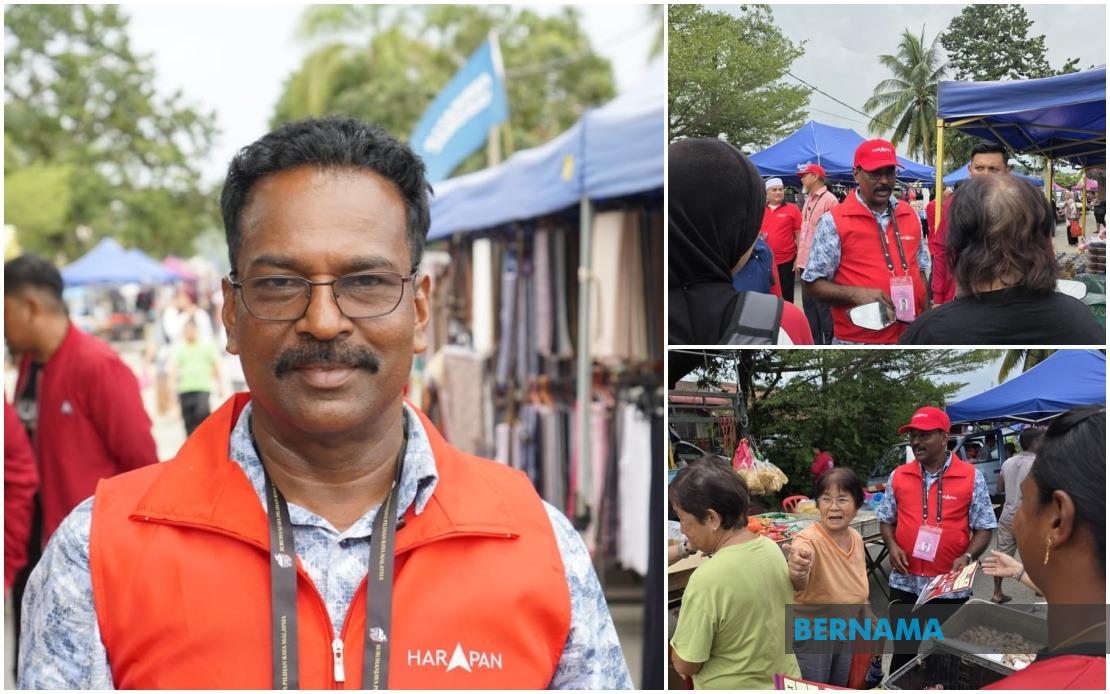
The Pakatan Harapan campaign in Bukit Kepong has coalesced around C. Subramani, a candidate projecting confidence despite facing entrenched competition in what figures as a three-way fight. Subramani, who previously contested the Buloh Kasap seat during the 2022 Johor state election, is banking on widespread sentiment for political renewal among voters in the constituency. His optimism reflects feedback gathered during extensive ground engagement, where he has cultivated relationships across diverse community segments including indigenous settlements, positioning himself as responsive to grassroots concerns that establishment candidates have allegedly overlooked.
As a Pagoh native and PKR chief for the area, Subramani brings localized knowledge to his candidacy, leveraging familiarity with the electorate's lived experience. His campaign message emphasizes the transformative potential of alignment between state and federal governments controlled by compatible political factions. This emphasis carries particular resonance in Malaysia's current governance landscape, where administrative fragmentation between different political administrations frequently creates bottlenecks in policy implementation and resource allocation. Subramani articulates how synchronized governance could streamline resolution of issues requiring federal agency involvement, from educational infrastructure to water management systems.
During his constituency tours, Subramani identified specific infrastructure deficits affecting the Bukit Kepong population. Poor street illumination, substandard bridge infrastructure, and scarcity of affordable housing for lower-income households emerged as priority concerns. Beyond these tangible issues, his visits to Orang Asli communities revealed broader socioeconomic vulnerabilities within these historically marginalized populations. The indigenous groups in the constituency face distinctive development challenges that require targeted intervention, yet have historically received limited political attention compared to urban commercial interests. Subramani's focus on these communities suggests a campaign strategy anchored in inclusivity and recognition of constituencies often neglected by mainstream political narratives.
Economic regeneration forms another cornerstone of his platform. Subramani proposes transforming the Bukit Kepong Gallery into a heritage tourism destination, a modest but pragmatic approach to stimulating local economic activity. This initiative reflects understanding that rural constituencies require revenue-generating mechanisms beyond conventional agriculture or commerce. Heritage-based tourism offers opportunities for employment and business creation while preserving cultural identity, a model increasingly pursued across Southeast Asian regions seeking sustainable development pathways.
The three-cornered contest configuration shapes Subramani's strategic positioning. Barisan Nasional and Perikatan Nasional candidates represent the incumbent establishment forces, while Subramani embodies the opposition coalition seeking to consolidate support among voters fatigued by incumbent performance. In Malaysian elections, three-way splits often create unpredictable outcomes where fragmented opposition voting can deliver surprising results if one candidate successfully mobilizes core constituencies while splitting rival support. Subramani's confidence in securing a surprise victory appears anchored in this mathematical possibility rather than demonstrable polling data.
The broader Johor electoral context features 172 candidates competing across 56 state assembly constituencies, with approximately 2.7 million eligible voters participating. This scale generates significant media attention and resource commitment from all major coalitions. Johor's political dynamics carry national implications given the state's size, economic importance, and historical role as a bellwether for Malaysian electoral trends. The composition of the resultant state assembly will influence coalition balance within the country's federalist structure and potentially affect resource allocation to the state.
Subramani's emphasis on cooperation between tiers of government reflects pragmatic governance understanding. Malaysia's federal system frequently generates administrative inefficiencies when state and federal authorities operate under competing political control. Alignment between these levels facilitates faster project execution, clearer budgetary processes, and more coherent service delivery. For rural constituencies like Bukit Kepong, such synchronization translates directly into improved infrastructure development and social service provisioning, concrete benefits that resonate with voters prioritizing tangible improvements over rhetorical promises.
The irrigation and drainage concerns Subramani highlighted reflect particular vulnerabilities in agricultural constituencies. Effective water management systems are foundational to agricultural productivity and also prevent flooding that devastates rural communities during monsoon seasons. Federal involvement through agricultural ministries and water authorities proves essential for implementing systemic solutions that exceed state-level budgetary capacity. Subramani's willingness to channel local issues through direct ministerial engagement signals a networked governance approach where political connections facilitate expedited problem-resolution.
Education infrastructure mentioned in Subramani's agenda addresses long-standing rural disparities in school facilities and teaching resources. Malaysian education policy has historically concentrated development resources in urban centers, leaving rural schools undersupplied and understaffed. State-level intervention, coordinated with federal curriculum and funding frameworks, could address these inequities. For constituencies like Bukit Kepong, educational quality directly influences youth retention and economic opportunity, determining whether younger generations remain within their communities or migrate toward urban employment centers.
Subramani's political trajectory demonstrates the evolving landscape within Malaysian opposition politics. PKR representation in rural constituencies indicates the party's expansion beyond its urban strongholds into traditionally Barisan Nasional territory. This territorial expansion, replicated across multiple parties, reflects broader realignment of Malaysian political competition where established patterns of support have become less durable. Voter behavior increasingly responds to governance performance and perceived responsiveness rather than inherited political loyalties, a shift that creates openings for candidates positioned as agents of meaningful change.
The Orang Asli communities within Bukit Kepong represent a particularly strategic constituency given their historical political neglect and concentrated geographic presence. These communities control significant voting blocs in rural areas yet frequently operate outside mainstream political discourse. Subramani's dedicated engagement with indigenous settlements acknowledges their numerical importance while addressing substantive concerns regarding land rights, economic participation, and cultural preservation. Success in mobilizing indigenous voter support could prove decisive in fragmented electoral contests where aggregate margins prove narrow.

