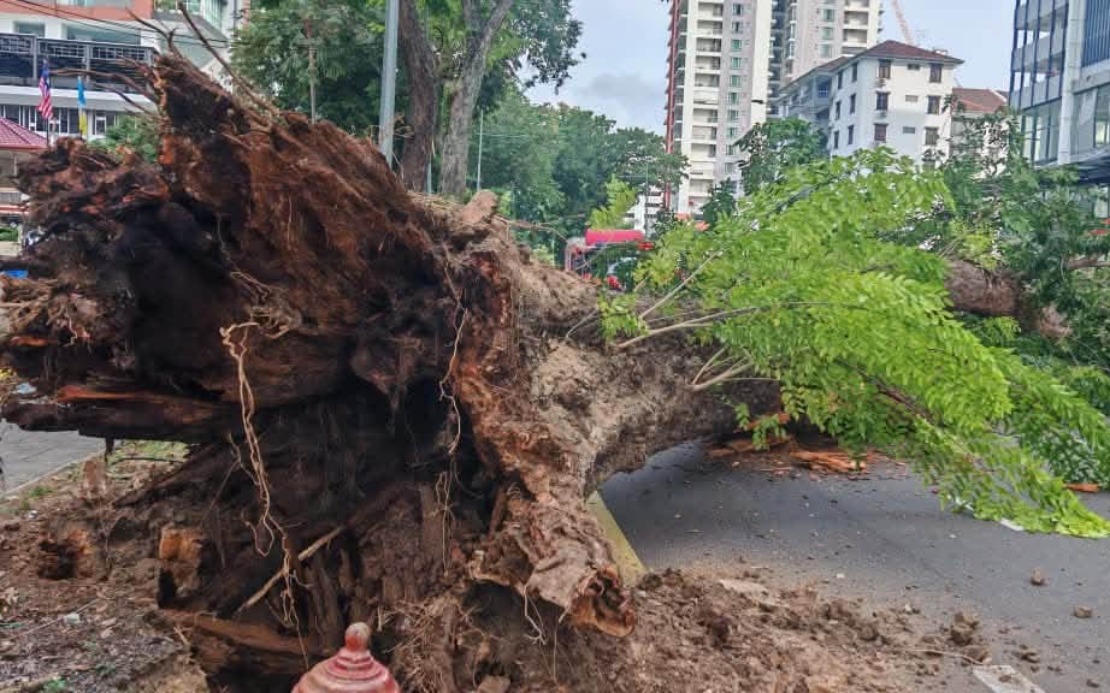
A towering 28-metre Angsana tree that had stood for nine decades along Jalan Macalister in George Town gave way without warning on August 9, crushing a Perodua Ativa carrying an elderly couple and their grandchild. The incident marked a significant infrastructure failure in Malaysia's heritage district, prompting municipal authorities to undertake a detailed investigation into the structural collapse and rethink their urban tree management protocols. According to MBPP Mayor Datuk A. Rajendran, the tree's failure resulted from a combination of internal deterioration and external environmental pressures that together created an untenable structural situation.
The internal decay proved far more extensive than might have been apparent from the tree's outward appearance. Pterocarpus indicus, the scientific designation for the Angsana species, had suffered approximately 30 per cent root rot throughout its base system, a condition that would have severely compromised its ability to absorb nutrients and water while maintaining structural stability. More critically, cavity decay had consumed roughly 40 per cent of the base trunk itself, creating a hollow core that eliminated the tree's load-bearing capacity. These two factors alone would have rendered the tree increasingly vulnerable, but the investigation revealed additional compounding issues that made collapse inevitable rather than merely possible.
Beyond the biological degradation, the tree existed within an urban environment that had become progressively hostile to its survival. Chronic soil compaction around its root zone—a common consequence of intensive pedestrian and vehicular activity on established streets—had strangled the tree's ability to access moisture and oxygen. The rooting space available to the tree had been severely limited, likely by underground infrastructure including water mains, drainage systems, and other utilities typical of a developed urban corridor. These spatial restrictions meant the tree could not develop the extensive, deep root systems necessary to counterbalance its considerable height, leaving it perpetually unstable despite appearing healthy to casual observation.
Major infrastructure upgrading works undertaken in the vicinity further destabilised the situation by introducing vibrations and additional ground stress into an already compromised system. Rajendran emphasised that despite the absence of heavy rain or strong winds at the time of collapse, these structural weaknesses had accumulated over years, creating what arborists would recognise as a latent failure condition. The tree's 90 years of age meant it had witnessed the gradual transformation of George Town from a less densely developed colonial settlement into a modern urban centre, each phase of development encroaching further upon its survival requirements.
The incident occurred with shocking suddenness at approximately 9 am. MBPP mobilised clearing operations immediately, with removal efforts commencing at 9.41 am and the roadway fully reopened by 2.20 pm after debris removal and safety assessments concluded. The rapid response prevented further incidents but underscored a gap in preventive tree management: despite a 2024 assessment of mature and aged trees along the same corridor that had identified 13 trees for felling—all subsequently removed—this particular Angsana had not been flagged as an immediate danger. The most recent maintenance work along Jalan Macalister had occurred only seven months earlier on January 29, and a remote sensing study conducted during 2023 had characterised the trees along the road as being in acceptable condition with no discernible warning signs.
This apparent contradiction between assessment outcomes and actual structural failure suggests that current detection methodologies may have limitations when dealing with internal decay that does not manifest as obvious external symptoms. A 30 per cent root rot and 40 per cent cavity decay represent advanced deterioration, yet the tree apparently presented sufficiently normal external characteristics to avoid triggering removal protocols. The gap between what remote sensing detected and what physical inspection ultimately revealed raises systemic questions about tree health evaluation procedures across Malaysia's municipal systems, where similar ageing tree populations exist in comparable urban settings throughout the country.
MBPP's broader tree management framework reveals the scale of ongoing challenges facing Malaysian municipalities. The authority had identified 179 high-risk trees for felling during 2023, of which 148 had been removed by the time of the Jalan Macalister incident, with 247 trees felled during the first three quarters of the year for various reasons. These removals addressed multiple hazards including drainage obstruction, dead or leaning specimens, collapse risks, development projects, road and river widening requirements, and encroachment on Penang Water Supply Corporation pipeline alignments. The diversity of reasons underscores how urban infrastructure development and tree preservation exist in increasingly zero-sum tension within densely built environments.
A comprehensive 2022 survey had identified 2,535 trees across George Town requiring assessment or intervention, categorised across multiple risk profiles: 45 cases involved drainage obstruction, 138 trees were classified as dead, 2,242 fell under risk or other categories, and 110 were linked to development or infrastructure works. These figures suggest that the Jalan Macalister collapse represents not an isolated anomaly but rather an instance of a recurrent problem facing the municipality. The sheer volume of trees requiring management—over 2,500 in one district alone—presents resource challenges that likely constrain the frequency and depth of individual tree assessments, potentially creating conditions where deteriorating specimens slip through monitoring systems.
Following the August incident, MBPP instructed its contracted arborists to accelerate risk mitigation work specifically along Jalan Macalister, prioritising height reduction and removal of trees exhibiting collapse potential based on certified arborist evaluations. This reactive approach, while necessary for immediate public safety, reflects a defensive rather than proactive posture toward urban forestry. The authority's stated priority of focusing on trees affected by infrastructure works and growing in restricted conditions acknowledges the underlying problem: Malaysian cities face a fundamental incompatibility between preserving heritage tree populations and accommodating modern urban development demands.
For Malaysian municipalities and planners, the George Town collapse carries lessons extending beyond Penang. Heritage trees increasingly survive in environments fundamentally altered from their original contexts, surrounded by underground infrastructure, constrained by limited soil volumes, and subjected to regular disturbance from maintenance and development activities. Current assessment methodologies, while incorporating remote sensing technology, may inadequately capture internal decay that poses sudden failure risks. The incident suggests that established urban trees in Malaysia's older commercial districts may warrant more frequent invasive diagnostic procedures, including core sampling and cavity assessment, despite the logistical challenges such protocols would impose on municipal budgets.
The failure also highlights the need for integration between infrastructure planning and arboricultural management at the strategic level. When underground utilities are installed, expanded, or maintained, arborists should be consulted regarding impacts on established tree health and stability. Similarly, when tree assessments identify specimens under stress from infrastructure pressures, engineers should explore protective or remedial options rather than defaulting to removal. For George Town specifically, the loss of another heritage tree represents incremental erosion of the district's historical character, while for other Malaysian urban centres, it serves as a cautionary reminder that visual health and structural integrity may diverge sharply in ageing urban trees.

