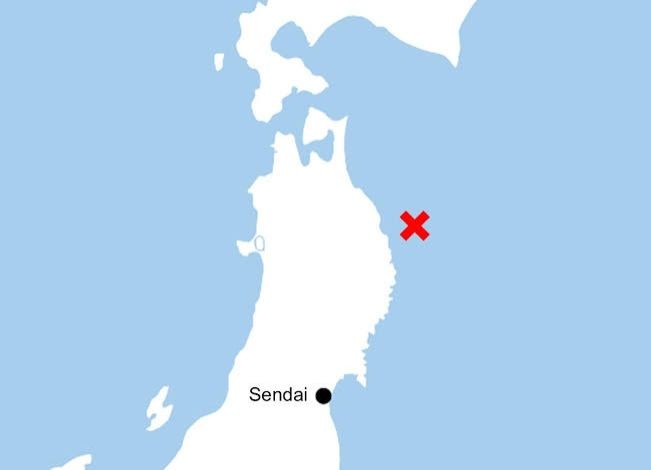
A powerful 7.2-magnitude earthquake jolted northern Japan on Thursday morning, sending tremors across hundreds of kilometres to the capital but sparing the region from serious harm. The undersea quake struck off Iwate prefecture at 7:30 am local time at a depth of 44 kilometres, prompting authorities to issue immediate alerts and conduct damage assessments. Despite the considerable force involved—initially registered as 6.9 before the Japan Meteorological Agency revised it upward to 7.2—the incident resulted in no reported deaths or significant structural damage to homes and critical infrastructure.
Residents in affected areas experienced characteristic indicators of a strong seismic event. Kitchen appliances tumbled from shelves, picture frames toppled from walls, and store merchandise scattered across floors as television footage documented the momentary chaos. In Aomori prefecture further north, the tremor registered at the upper sixth level on Japan's seven-point Shindo intensity scale, a classification where unsecured furniture typically overturns and standing without support becomes difficult for most people. Mutsumi Shimohata, a food processing company employee in Hashikami, described the experience as surprisingly lengthy, with her smartphone's early warning system activating almost instantaneously as the ground began moving beneath her feet.
The quake's impact on daily operations proved more disruptive than structural damage might suggest. Several shinkansen bullet train services halted temporarily as a precautionary measure, affecting commuters and travellers across the region. A primary school in Hashikami closed its doors for the day following the tremor, while the school principal reported ceiling damage within the facility. Emergency services recorded at least four distress calls across Hashikami and Hachinohe, with reports indicating that people became temporarily trapped in an elevator during the shaking. Additionally, a tanker truck overturned during the incident, and some automatic door systems malfunctioned, though emergency responders worked swiftly to restore normal operations.
Government officials moved quickly to coordinate response efforts and maintain public confidence. Prime Minister Sanae Takaichi instructed all relevant ministries and agencies to maintain close coordination with local authorities throughout the assessment period. Speaking publicly hours after the earthquake, the prime minister urged residents in areas that experienced stronger shaking to remain vigilant regarding potential aftershocks of comparable magnitude, a standard precaution given Japan's seismic environment. Government spokesman Minoru Kihara acknowledged that while no human casualties had been confirmed at that stage, comprehensive monitoring would continue to evaluate the full scope of any damage as information accumulated.
Critical infrastructure operators reported no significant problems following the quake. The Nuclear Regulation Authority confirmed that no abnormalities had been detected at regional nuclear power stations, providing reassurance to communities still conscious of the 2011 Fukushima disaster. Traffic conditions in Hachinohe city appeared normal in broadcast footage, with traffic signal systems functioning properly and vehicular movement proceeding as routine. These positive indicators suggested that the nation's disaster preparedness systems and building codes—strengthened substantially since previous major seismic events—were performing effectively once again.
Japan's position within one of Earth's most geologically active zones makes earthquake preparedness an essential aspect of national life. The country sits atop four converging tectonic plates along the Pacific Ring of Fire's western margin, a geological circumstance that generates exceptional seismic activity by global standards. The Japanese archipelago, which houses approximately 125 million people, typically absorbs hundreds of earthquake jolts annually and accounts for roughly 18 percent of all earthquakes recorded worldwide. While the overwhelming majority prove mild and cause minimal disruption, the potential for catastrophic events remains perpetually present given Japan's exposure to subduction zone dynamics.
Memory of devastating seismic impacts weighs heavily on Japan's national consciousness. The 9.0-magnitude undersea earthquake of 2011, which unleashed a colossal tsunami, claimed approximately 18,500 lives through deaths or disappearances and caused massive infrastructure destruction across northeastern coastal regions. That catastrophe additionally triggered a complete meltdown of the Fukushima nuclear facility, fundamentally reshaping Japan's energy policy and public attitudes toward nuclear power generation. The disaster demonstrated that even highly developed nations with advanced warning systems and building standards cannot entirely prevent loss of life when geological forces exceed anticipated parameters.
Thursday's earthquake arrived in the context of heightened seismic concern that had gripped the nation only weeks earlier. On April 20, 2023, a 7.7-magnitude tremor struck northern Japan, injuring at least 10 people and generating sufficient building movement in Tokyo to unsettle workers and commuters across the metropolitan area. That event prompted authorities to issue a special advisory warning citizens of elevated risks for earthquakes potentially measuring magnitude 8.0 or exceeding that threshold. The advisory maintained public awareness and institutional preparedness throughout the subsequent period before being lifted after seven days, once statistical probabilities returned to baseline levels.
Thursday's incident, occurring merely two months after those warnings had concluded, illustrates the reality of living atop active geological zones where prediction remains fundamentally limited. While seismic networks can detect and locate earthquakes with precision once they occur, determining when and where significant tremors will strike remains beyond scientific capability. Japanese society has therefore built comprehensive disaster response frameworks assuming regular major earthquakes will continue indefinitely. Building codes mandate earthquake-resistant construction, early warning systems provide seconds to minutes of advance notice, and public education campaigns ensure citizens understand appropriate protective responses when shaking begins.
The swift assessment concluding that this week's earthquake had generated only minor consequences reflects Japan's matured approach to seismic risk management. Modern Japanese buildings, designed specifically to withstand repeated strong earthquakes, demonstrated their resilience through the incident. The absence of casualty reports and the minimal structural damage reported across multiple municipalities indicate that decades of investment in earthquake engineering and preparedness have yielded measurable benefits. However, officials' continued emphasis on remaining alert for potential aftershocks underscores the unpredictable nature of seismic activity and the necessity of sustained vigilance in a nation where the Earth's restlessness remains an enduring reality.

