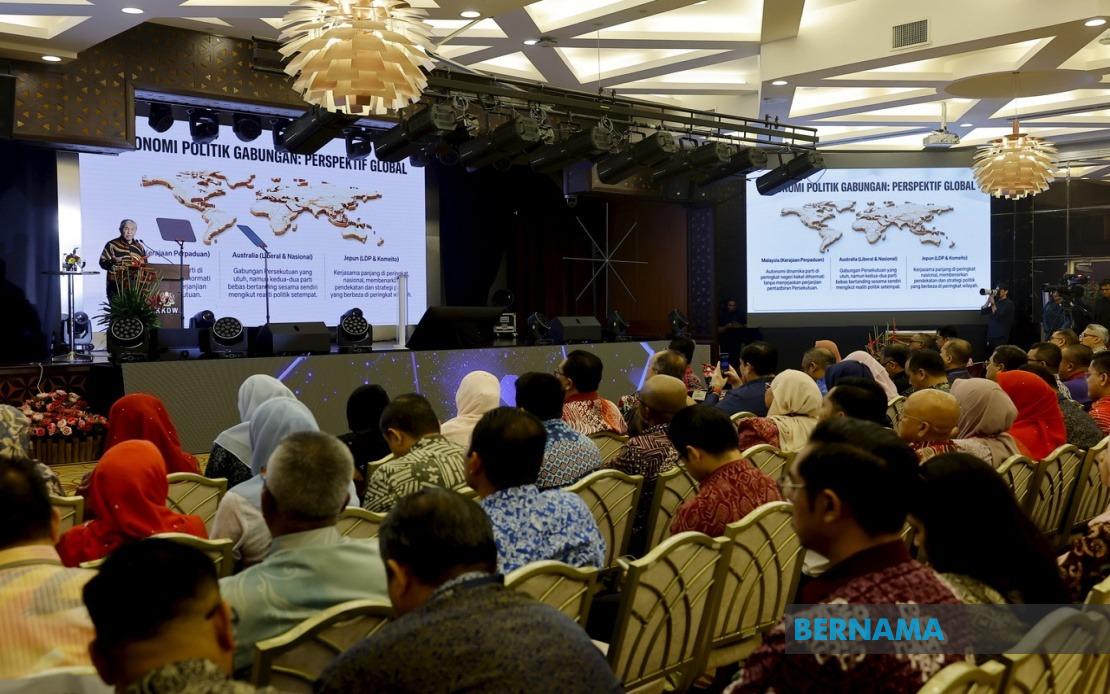
Deputy Prime Minister Datuk Seri Dr Ahmad Zahid Hamidi has sought to reassure the nation that contests and rivalries playing out in Malaysia's state politics will not cascade upward to destabilize the federal administration. Speaking at the Rural and Regional Development Ministry's monthly assembly in Putrajaya on August 6, the Barisan Nasional chairman emphasized that the bedrock of the MADANI Government—established through deliberate consensus and written understanding among coalition partners—remains sufficiently robust to withstand electoral fluctuations at the subnational level.
The timing of Ahmad Zahid's remarks underscores growing scrutiny of Malaysia's coalition government structure. Recent state elections, particularly in Johor and Negeri Sembilan, have rekindled questions about whether localized political jockeying might fracture the unity consensus that binds together the diverse parties comprising the federal executive. Such concerns are not unfounded in Malaysia's political landscape, where state administrations have historically served as testing grounds for coalition tensions and where electoral victories or defeats at state level have occasionally triggered shifts in federal alignments.
Yet Ahmad Zahid's framework for understanding the relationship between state and federal politics rests on a deliberately calibrated distinction. He stressed that as long as Parliament remains constituted—that is, until the dissolution that precedes general elections—the federal government retains full operational capacity to discharge its functions and deliver on policy commitments. This assertion amounts to a reassurance that short-term political developments in individual states do not possess automatic veto power over the MADANI administration's continuity or effectiveness.
Central to Ahmad Zahid's argument is his articulation of what he terms "political autonomy within a coalition government." This concept permits individual coalition partners to pursue their own political strategies, craft distinct messaging to their respective voter bases, and compete vigorously at state level without breaching the foundational agreement that sustains federal cooperation. In essence, the Deputy Prime Minister was carving out conceptual space for intracoalition competition while maintaining that such rivalry operates within bounded parameters that leave the federal compact intact.
The distinction Ahmad Zahid drew between party identity and coalition obligation carries particular significance for Malaysian governance. He acknowledged explicitly that coalition membership does not require parties to surrender their political identities or dilute their ideological principles. This framing is pragmatically important given that the Unity Government comprises entities with genuinely distinct constituencies, historical trajectories, and policy preferences. The BN itself encompasses parties representing Malay-Muslim, Chinese, Indian, and other communities, each with localized political strongholds and competitive pressures from rival parties at state level.
For Malaysian observers and regional analysts, Ahmad Zahid's comments reflect the delicate equilibrium upon which contemporary Malaysian federal governance rests. Unlike single-party dominant systems where state politics operate as mere administrative subdivisions, Malaysia's coalition-based structure requires constant negotiation and mutual forbearance among partners whose electoral interests may occasionally diverge. The test of such arrangements lies in whether they can tolerate genuine competition at one level while maintaining cooperation at another.
The invocation of Parliament's continued existence as the determinant of federal stability also carries legal and constitutional weight. Malaysian parliamentary dissolution is a prerogative power typically exercised by the Prime Minister, and absent such dissolution, the incumbent government retains its legislative majority and mandate to govern. This suggests Ahmad Zahid was essentially affirming that barring extraordinary political rupture leading to the loss of parliamentary majority, the MADANI Government will persist in its current form regardless of state-level electoral outcomes.
Regional implications warrant consideration as well. Southeast Asian governance observers have closely monitored Malaysia's experiment with coalition administration following the 2022 general elections, particularly given the region's broader trend toward coalition and consensus-based governments in countries like Thailand, Myanmar, and parts of Indonesia. How Malaysia's federal-state coordination mechanisms perform under electoral stress carries instructive value for other developing democracies managing similar arrangements.
The reference to ongoing policy implementation and fulfillment of government responsibilities suggests Ahmad Zahid was signaling continuity of development projects and administrative functioning. This matters considerably for states and constituencies whose governments may shift in electoral fortunes but whose infrastructure needs, development timelines, and federal fund disbursements remain constant. Political transitions at state level often create uncertainty about resource allocation and project prioritization; Ahmad Zahid's assurance aimed to minimize such disruption.
However, Ahmad Zahid's framework also implicitly acknowledged underlying tensions inherent in his position. A Deputy Prime Minister simultaneously holding party chairmanship inevitably navigates competing obligations—to the broad coalition government and to his party's electoral fortunes. His emphasis that political rivalry "would not affect" federal stability reads partly as reassurance and partly as normative prescription of how the system ought to function rather than certainty about how it necessarily will function under sustained pressure.
The sustainability of Ahmad Zahid's model depends ultimately on whether state-level political outcomes remain sufficiently balanced that no single coalition component feels existentially threatened by electoral losses. Should state elections produce dramatic reversals—overwhelming victories for opposition parties or decisive results that fundamentally alter party influence calculations—the tested limits of "political autonomy within coalition" governance might become clearer. For now, the Deputy Prime Minister's articulation represents the working theory of Malaysian federal politics in its current phase.

