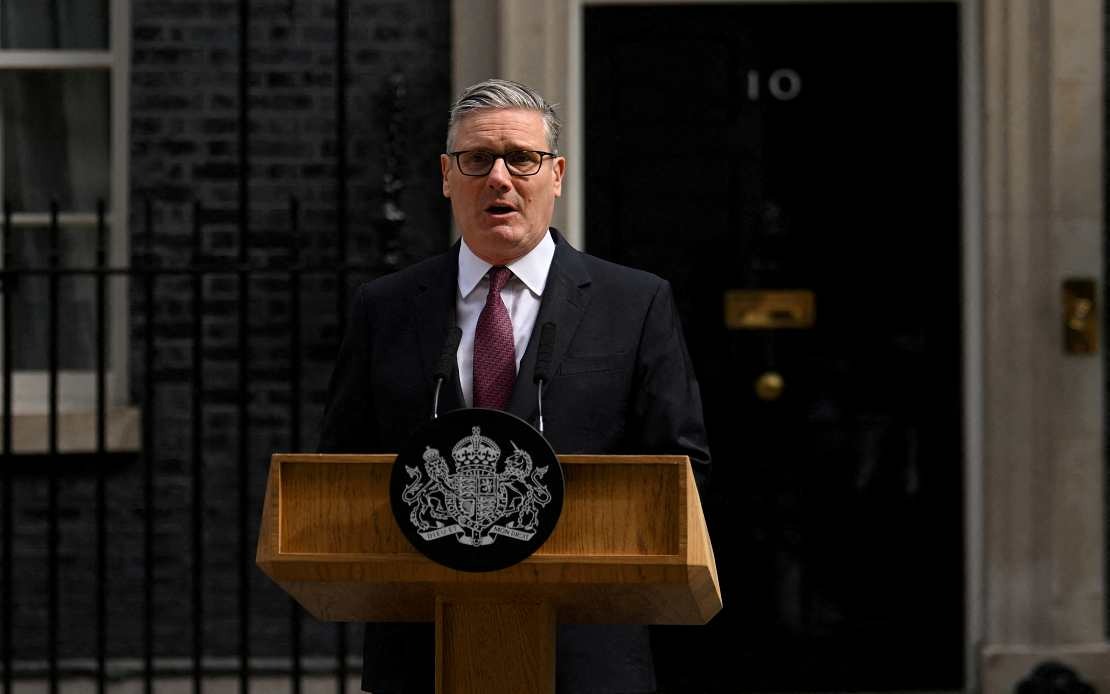
Keir Starmer announced his resignation as British prime minister on Monday in a final address delivered from Downing Street, stating confidently that his "work is done" and that he departs "with a smile." The Labour leader made the announcement before formally presenting his resignation to King Charles at Buckingham Palace, bringing to a close an era that lasted just over two years. In his remarks, Starmer emphasised the transformation he believes his government has delivered to the nation, framing his departure as the natural conclusion of a political mission accomplished.
Andy Burnham has emerged as the designated successor, poised to assume the office of prime minister and guide Britain through the next phase of its political evolution. This transition represents a significant moment in British politics, as the Labour Party shifts leadership while maintaining continuity within its ranks. The succession to Burnham indicates the party's confidence in his ability to carry forward the agenda established during Starmer's tenure and address the challenges facing the United Kingdom.
Starmer's reflection on his tenure centred on the Labour Party's remarkable political journey. He recounted how the party recovered from a devastating electoral defeat in 2019, when the Conservatives under Boris Johnson achieved a commanding majority. Over the intervening years, Starmer methodically rebuilt Labour's credibility and electability, repositioning the party to appeal to a broader swath of British voters. His efforts culminated in a landslide victory in the 2024 general election, representing a decisive rejection of Conservative governance that had dominated British politics for a decade and a half.
Throughout his remarks at Downing Street, surrounded by his wife Victoria Starmer, government colleagues, and close associates, the departing prime minister stressed that Britain had become "stronger and fairer" during his administration. This characterisation serves as his political legacy statement, suggesting that Labour policies implemented over two years have meaningfully improved the lives of ordinary British citizens and the underlying health of national institutions. The emphasis on fairness particularly reflects Labour's traditional electoral messaging, positioning the party as the guardian of social equity and protection for vulnerable populations.
The timing of Starmer's resignation comes at a juncture when the Labour government faced mounting pressures and challenges typical of administrations in their mid-term. Though his 2024 election victory was decisive, the subsequent two years appear to have tested his political capital and popularity, leading the party hierarchy to conclude that a leadership transition would better serve their electoral prospects. Burnham's rise to the premiership reflects the internal Labour decision-making process, though details of the succession mechanics remain subject to ongoing party procedures.
For Malaysian and Southeast Asian observers, the British political transition offers instructive parallels regarding governance transitions and party management. Like Malaysia, where coalition-building and leadership succession shape political outcomes, Britain's smooth transfer of power within a single party demonstrates institutional maturity and consensus-driven decision-making at the apex of government. The orderly nature of Starmer's departure, conducted through constitutional protocols and without acrimony, underscores the stability mechanisms embedded within Westminster-model democracies.
Starmer's six-and-a-half year tenure as Labour leader and two-year premiership encompassed substantial policy initiatives and attempted reforms across multiple government departments. His administration inherited an economy contending with inflation, strained public services, and social divisions accumulated during the Conservative era. Whether his successor Burnham can consolidate these efforts while generating renewed momentum for the Labour government represents an open question that will shape British politics in the coming years.
The transition also carries implications for Britain's international standing and diplomatic relationships. As a prime minister, Starmer oversaw British foreign policy during a period of global geopolitical turbulence, including Russia's ongoing military operations in Ukraine and rising tensions in the Indo-Pacific region affecting allies including Australia and fellow European nations. Burnham will inherit these diplomatic responsibilities and Britain's commitments to NATO, its relationships with European partners following Brexit, and its broader strategic positioning in an era of great power competition.
For the broader Labour movement, Starmer's exit crystallises a moment of generational transition. His stewardship moved Labour away from the left-wing positioning of his predecessor Jeremy Corbyn, attempting to reestablish the party as a centrist, pro-business force capable of managing capitalism rather than fundamentally challenging it. Whether this strategic repositioning survives the leadership change, or whether Burnham charts a different ideological course, will be closely watched both domestically and internationally by those tracking ideological movements within centre-left political parties globally.
The succession to Burnham occurs against a backdrop of complex domestic challenges including regional inequality, devolution debates—particularly regarding Scotland—housing shortages, and the ongoing balancing act between public expenditure and fiscal discipline. Burnham's record, including his tenure as mayor of Greater Manchester, will inform expectations about his approach to urban development, regional equity, and local-central government relations. His premiership will test whether his experience managing a major metropolitan region translates effectively to national leadership and whether he can maintain Labour's electoral coalition established during the recent landslide victory.

