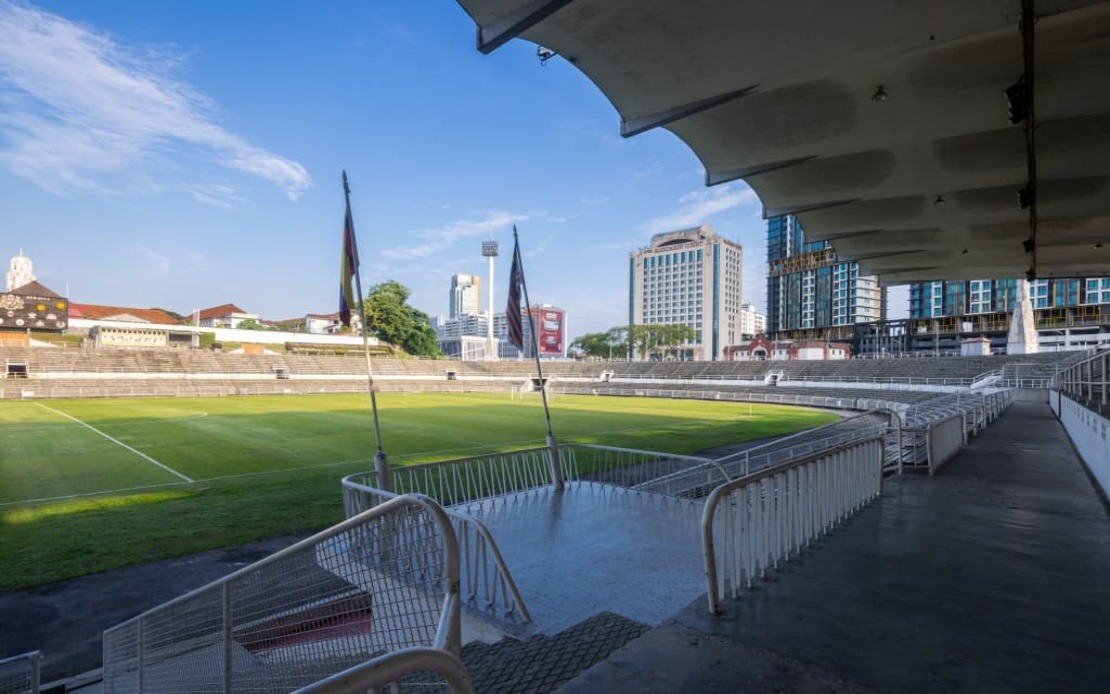
Nearly seven decades have passed since Stadium Merdeka hosted the proclamation of Malaya's independence on August 31, 1957, yet the venue remains far more than a relic of history. Standing prominently beside the modern Merdeka 118 tower in Kuala Lumpur, the stadium functions as an active bridge between Malaysia's colonial past and its contemporary identity, continuing to embody the aspirations and sacrifices that defined the nation's founding.
The stadium itself was built with remarkable speed and efficiency, completed within twelve months at a cost of approximately RM2.3 million. On that momentous independence day, Tunku Abdul Rahman Putra Al-Haj, the nation's first Prime Minister, delivered seven resonant cries of "Merdeka!" within its grounds, an echo that would reverberate through Malaysian history. This single venue thus witnessed the literal proclamation that transformed Malaya from a British colonial possession into a sovereign nation, making Stadium Merdeka one of Southeast Asia's most symbolically significant sporting venues.
Professor Sarjit Singh Gill of Universiti Putra Malaysia, a respected voice in social anthropology and Chairman of the National Council of Professors' National Unity Cluster, articulates why this distinction matters profoundly. He characterises the stadium not merely as infrastructure but as a historical monument that encapsulates the nation's identity, dignity and cultural inheritance. The independence proclamation represented far more than a ceremonial transfer of administrative authority; it symbolised the end of colonial subjugation and the commencement of self-determination for millions of Malaysians. The physical space where this transformation occurred thus carries immeasurable cultural weight.
Six years later, Stadium Merdeka witnessed another pivotal constitutional moment when it hosted the proclamation forming the Malaysian Federation in 1963, extending sovereignty to Sabah, Sarawak and Singapore (before Singapore's subsequent departure from the federation). This succession of momentous declarations consolidated the stadium's status as the crucible of Malaysian statehood, a venue where the boundaries and fundamental nature of the nation were literally redefined before public assemblies.
The stadium's survival itself represents a triumph of heritage preservation against modernisation pressures. During the late 1990s, the venue faced credible redevelopment threats as Kuala Lumpur's urban core underwent rapid commercial transformation. Public resistance, however, galvanised government intervention, resulting in Permodalan Nasional Berhad's acquisition of the site in 2000. This stewardship decision proved pivotal, placing the stadium under professional management specifically committed to historical conservation rather than commercial exploitation.
Permodalan Nasional Berhad's restoration approach, guided by original Public Works Department construction drawings, prioritised authenticity over modernisation. Restoration teams methodically removed later additions, including upper seating tiers, restoring the original 20,000-seat configuration. Simultaneously, they preserved original features including the scoreboard, washroom facilities, mosaic tile work and the distinctive cantilevered roof structure. This meticulous rehabilitation earned Stadium Merdeka a UNESCO Asia-Pacific Heritage Award in 2008, with subsequent national heritage site gazettal in 2009, formalising its protected status.
CEO Datuk Dr Izwan Ibrahim of PNB Merdeka Ventures emphasises that preservation transcends mere structural maintenance. The organisation's explicit mission encompasses ensuring the stadium's historical narratives remain accessible and meaningful to contemporary Malaysians. He articulates a vision where Stadium Merdeka functions not as a museum piece but as an active community space where cultural events, bazaars and public activities occur regularly. This philosophy reflects recognition that heritage preservation requires dynamic engagement rather than static preservation. The Bazram Merdeka bazaar, a Ramadan marketplace held annually at the venue, attracted over 250,000 visitors during the most recent iteration, demonstrating the stadium's capacity to serve contemporary community purposes whilst honouring historical significance.
A particular strategic focus centres on engaging younger generations who possess no direct memory of pre-independence Malaysia. For Malaysians under thirty, the events of 1957 exist as abstract historical content encountered through school curricula and family narratives. Ibrahim identifies potential disconnection and deliberates addressing this through experiential engagement rather than didactic instruction. The stadium now actively encourages school visits and youth participation in on-site activities, theorising that physical presence within the space generates emotional and historical comprehension unavailable through conventional historical education. Early evidence suggests this strategy yields measurable results, with neighbouring schools increasingly visiting to establish tangible connections with their nation's foundational moment.
Long-serving custodian Alias Daud, who dedicated thirty-five years to Permodalan Nasional Berhad with the final decade focused on Stadium Merdeka's maintenance, articulates the emotional dimension underlying conservation efforts. His perspective transcends professional responsibility, encompassing deep personal attachment to the venue and its historical resonance. Daud recounts witnessing visitors from diverse socioeconomic and ethnic backgrounds traverse the stadium's grounds, each carrying their own commemorations and family histories linked to independence. His observations suggest the stadium genuinely functions as emotional destination and pilgrimage site for Malaysians seeking tangible connection with their national genesis.
Visitors frequently express surprise upon learning that this particular venue hosted independence's proclamation, notwithstanding its prominence in Malaysian historical consciousness. This phenomenon indicates a subtle gap between abstract historical knowledge and spatial-temporal awareness. Younger visitors particularly demonstrate engagement when encountering the actual location where foundational national events unfolded, suggesting that educational impact amplifies when historical instruction becomes geographically and architecturally concrete. The stadium thus serves pedagogical functions extending beyond conventional museum operations.
As Kuala Lumpur's modern skyline continues expanding around Stadium Merdeka, the venue's comparative modesty paradoxically intensifies its symbolic potency. Contemporary towers like Merdeka 118 represent Malaysia's economic achievements and contemporary aspirations, whilst the historic stadium beneath embodies the freedom and sovereignty enabling such development. This architectural juxtaposition encapsulates Malaysia's progression from colonial dependence to independent agency, making Stadium Merdeka not merely retrospective memorial but active statement about national identity and continuity.
The stadium ultimately demonstrates that heritage preservation operates most effectively when envisioned not as static commemoration but as dynamic cultural institution. By remaining accessible, hosting community events and actively engaging younger Malaysians, Stadium Merdeka transcends antiquarian significance. It functions instead as living embodiment of Malaysian independence, perpetually renewing its relevance whilst honouring the historical transformation it witnessed. For a nation navigating contemporary challenges and opportunities, this physical reminder of collective achievement and unified aspiration possesses enduring value extending far beyond architectural or historical merit alone.

