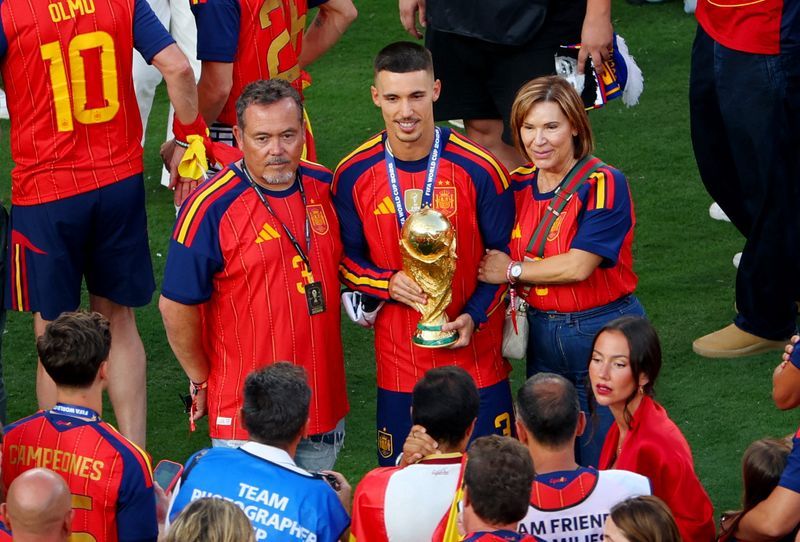
Spain achieved football's ultimate prize on Sunday by defeating Argentina 1-0 in the World Cup final, cementing their identity as champions who prioritise possession, patience and collective purpose over individual brilliance. The victory in East Rutherford, New Jersey, represented not a tactical reinvention but rather a validation of the Spanish footballing creed—that mastery of the ball trumps almost everything else in the game. Throughout 120 minutes of competition, the Spanish side controlled the match with characteristic discipline, maintaining over 65% possession and completing more than twice as many passes as their opponents, who seemed content to absorb pressure and look for counter-attacking opportunities.
The defining goal emerged fittingly from the bench, with substitute Nico Williams providing the assist for Ferran Torres to finish in extra time. This moment encapsulated the Luis de la Fuente philosophy perfectly: there are no irreplaceable individuals within this squad, merely players trained in identical principles who seamlessly execute the same vision regardless of when they enter the field. Indeed, substitutes had already delivered decisive moments in earlier knockout matches, underlining that Spain functions as an interchangeable unit rather than a collection of star personalities. The squad's depth and philosophical cohesion meant that fatigue or tactical adjustments never disrupted their fundamental approach to controlling matches through possession and controlled ball movement.
Statistically, Spain's dominance was overwhelming. The team registered 12 shots on target against Argentina's solitary effort, which arrived late in extra time and found the target wide. Yet this numerical superiority did not translate into overwhelming victory margins, revealing what remains Spain's persistent vulnerability: the absence of a world-class centre forward capable of converting created chances into goals. Throughout the tournament, Spain manufactured numerous opportunities but frequently lacked the clinical finishing that would have inflated their winning margins. This weakness, however, pales against the team's structural strengths and collective resilience.
The tournament awards reflected Spain's balanced contribution across the squad. Rodri claimed the Most Valuable Player honour, Unai Simon won Best Goalkeeper, and Pau Cubarsi received the Best Young Player accolade. Only the Golden Boot eluded Spanish hands, going instead to France's Kylian Mbappe. This distribution of individual recognition mirrored the team's philosophy perfectly: success flows from orchestrated teamwork rather than singular genius. Across eight tournament matches, Spain accumulated 14 goals scored by eight different players, a statistic that mirrors their 2024 European Championship triumph when 10 different players contributed to a tournament-record 16 goals. Such balanced scoring demonstrates a system where attacking responsibility rotates rather than concentrates.
The victory extended Spain's unbeaten international run to 38 matches, surpassing Italy's previous record and underscoring three years of sustained dominance in international football competition. This consistency reflects De la Fuente's patient methodology and his insistence on maintaining tactical principles regardless of opponent. Few international coaches have demonstrated such unwavering commitment to a specific philosophical approach while remaining flexible enough to adjust personnel and minor tactical details. De la Fuente's appointment once drew media scepticism—Spanish journalists dismissed him as Luis de la "Who"—based on his lengthy apprenticeship within the Spanish Football Federation's youth development structures. His trajectory from youth football administrator to World Cup-winning manager validates the virtues of patient development and deep understanding of systematic football.
Beyond the sporting dimensions, Spain's triumph carried profound symbolic significance for a nation often fractured by regional tensions and competing identities. The squad exemplified the country's geographical and cultural diversity in ways that transcended mere token representation. Mikel Oyarzabal, Unai Simon, and Mikel Merino represented the Basque Country's footballing tradition; Borja Iglesias came from Galicia; Ferran Torres from Valencia; Rodri from Madrid; Fabian Ruiz and Gavi from Andalucia; and Pedri from the Canary Islands. Catalonia contributed nine players including Marc Cucurella and Marc Gubarsi, whilst Lamine Yamal and Nico Williams embodied Spain's immigrant communities and demographic evolution.
This composition mattered profoundly because Spain's political landscape frequently emphasises regional distinctiveness over national unity. The independence movements in Catalonia and the Basque Country reflect genuine historical grievances and cultural aspirations that football cannot permanently resolve. Yet on Sunday evening, those regional identities did not disappear or merge into homogenised nationalism. Rather, they temporarily ceased functioning as obstacles to collective purpose. Players who might support different political visions for Spain's constitutional future nonetheless executed a unified tactical system with precision and commitment. The Catalan contingent and the Basque representatives shared equal status within the squad hierarchy, neither subordinate nor dominant.
Football achieved something that Spanish politicians frequently struggle to accomplish: it created conditions where diversity strengthened rather than weakened national identity. This achievement should not be overstated—a single sporting victory does not resolve constitutional disagreements or regional grievances—but it demonstrated football's unique capacity to unite populations across fault lines that prove intractable in political contexts. For one night at least, Spanish national identity encompassed rather than negated regional particularity.
For Malaysian and Southeast Asian observers, Spain's triumph offers instructive lessons about how systematic football philosophy, built on patient development and collective discipline, can compete at the highest international level. Many regional nations possess individual talent but struggle to create coherent team systems where substitutes seamlessly execute the same principles as starting eleven players. Spain's success demonstrates that tournament victory flows from sustained investment in youth development infrastructure and unwavering commitment to specific tactical principles, rather than from assembling a collection of famous players. De la Fuente's unconventional path to football's greatest prize—through youth administration rather than prestigious club positions—suggests that deep institutional knowledge and methodical player development sometimes matter more than high-profile appointments.
Moreover, Spain's retention of possession-based football despite pressure to adopt more direct, counter-attacking approaches indicates that teams need not abandon their identity to achieve success. Throughout the tournament, various opponents attempted to disrupt Spanish rhythm through aggressive pressing or tactical surprises, yet De la Fuente's side remained faithful to their principles. This consistency created confidence and allowed the squad to execute complex passing patterns even under pressure. The willingness to persist with controlled, possession-focused football even when facing defensive opponents reflects confidence in systematic superiority rather than reactive adjustment to tactical fashions.
The World Cup victory also validated Spain's investment in player development pathways that extend beyond traditional club football. Several squad members, including Cubarsi, Williams, and Yamal, represent the fruits of patient academy systems that develop talent through youth competition before integration into senior football. This contrasts with approaches in some regions that prioritise immediate senior success over long-term player development infrastructure. Spain's sustained success suggests that countries investing in comprehensive youth development systems eventually accumulate sufficient talented players to construct championship teams.
As Spanish football celebrates this achievement, the broader significance extends beyond tournament statistics. A nation often divided by regional identities found temporary but genuine unity through football. A coach once dismissed by sceptical media vindicated unconventional credentials through sustained excellence. A squad built on collective principle rather than individual star power proved that systematic football philosophy remains competitive at the highest level. These lessons resonate far beyond Spanish borders, offering guidance to any football federation seeking to construct sustainable international success through patient development, philosophical consistency, and inclusive team construction that transforms diversity from weakness into strength.

