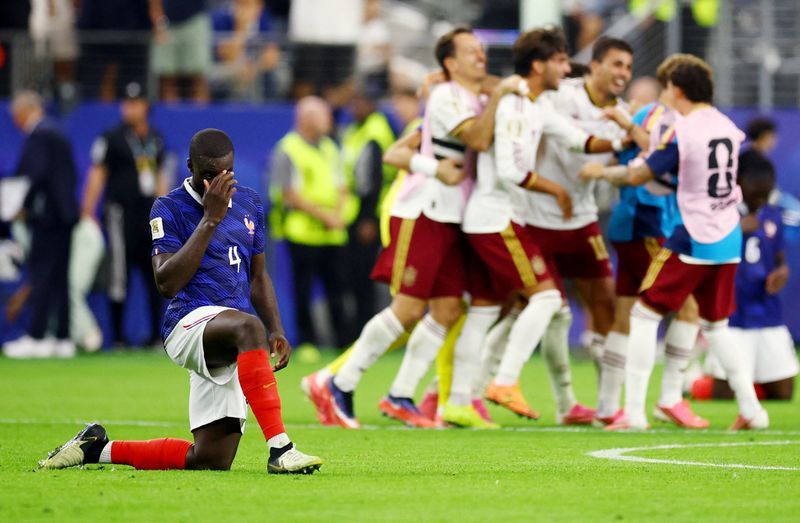
The weight of expectation that had surrounded France throughout the tournament came crashing down in Arlington, Texas, as Spain delivered a commanding 2-0 semi-final victory that laid bare the fragility beneath the pre-competition hype. France's elimination was no narrow defeat or cruel twist of fate, but rather a comprehensive dismantling that revealed their credentials had been significantly overrated by those who had tabbed them as tournament favourites.
Coach Didier Deschamps offered little in the way of excuses in the aftermath, acknowledging that his team had simply been outplayed across the ninety minutes. The candid admission underscored the scale of the failure—this was not a case of tactical misfortune or marginal differences, but rather a stark mismatch between two sides' understanding of how to control the match. France had encountered the first opponent willing and capable of meeting them head-on, and they had crumbled under the examination.
The gulf in midfield control proved decisive from the opening stages. Spain's midfielder Rodri orchestrated proceedings with the kind of commanding authority that left Deschamps' double pivot desperately scrambling in his wake. Adrien Rabiot, picking up an early yellow card that forced him to temper his natural aggression, became increasingly ineffective as the match wore on. More troublingly, Aurelien Tchouameni, returning from a hamstring injury that had sidelined him for the previous two matches, simply lacked the rhythm and fitness required to maintain pace with Spain's surging runs through the middle. The result was a consistently exposed French defence left vulnerable to waves of Spanish pressure.
Michael Olise symbolised France's broader attacking malaise on the pitch. The player whom many observers had championed as a generational talent, even drawing comparisons that placed him in Ballon d'Or conversation, appeared utterly overwhelmed by the occasion and the quality of opposition. Operating in spaces so congested they barely existed, Olise surrendered possession an alarming twenty times whilst failing to complete a single dribble—a truly damning statistical indictment of his contribution. He and his attacking colleagues seemed incapable of generating the creative spark necessary to trouble Spain's well-organised defence.
The supporting cast of attacking players fared little better. Ousmane Dembele, who had shown flashes of promise in earlier rounds, posed virtually no threat to Spanish defenders, whilst Bradley Barcola and his replacement Desire Doue proved equally ineffective in the final third. Even Kylian Mbappe, the tournament's standout performer throughout earlier rounds, found himself starved of meaningful opportunities and never produced the moment of individual brilliance that had defined his campaign to that point. The irony was bitter—in a stadium in Arlington, Texas, the loudest roar came not from a French breakthrough, but from the appearance of David and Victoria Beckham on the giant screen.
The tactical naivety displayed by France suggested they had fundamentally misread the dynamics of the encounter ahead of kick-off. Rayan Cherki, introduced as a second-half substitute, later reflected that the team had understood Spain's primary strength—their ability to manipulate tempo and drag matches into slower, more controlled rhythms—only after it was too late. Had France recognised this sooner and adjusted their approach accordingly, the outcome might conceivably have differed. Instead, they appeared to assume that their attacking prowess alone would suffice, a dangerous miscalculation against an opponent as disciplined and technically proficient as Spain.
Spain's teenage sensation Lamine Yamal had entered the match with the confidence of youth, publicly declaring that France should fear his side's capabilities. His swagger proved entirely justified. The Spanish team executed their game plan with mechanical precision, controlling possession whilst remaining ruthlessly efficient in converting rare defensive lapses into goals. Mikel Oyarzabal's penalty conversion in the twenty-second minute, stemming from a French error, was followed by Pedro Porro's clinical finish just before the hour mark—both goals arrived almost inevitably, such was Spain's dominance.
The contrast with France's previous World Cup semi-final appearance provided painful context. Against Argentina in 2022, the French team had similarly struggled through the opening hour, yet demonstrated the character and resilience to fight back and eventually force extra time and penalties. That night had concluded in heartbreak but with honour intact; the performance had showcased a capacity to recover from adversity. Tuesday's encounter offered no such redemption narrative. This was simply a superior team dismantling an inferior one across the full ninety minutes.
The scenes at the final whistle captured the extent of France's despondency. Mbappe stood isolated on the pitch, appearing hollow and disconnected from proceedings, whilst teammates around him dropped to their knees or buried their faces in their hands. The rhetoric of cohesion and unity that had dominated French discussion right up to match eve suddenly rang hollow. Questions would inevitably emerge about whether the squad had become complacent, whether tactical preparation had been inadequate, and whether the pre-tournament hype had obscured genuine vulnerabilities that more discerning observers might have identified.
For Malaysian and Southeast Asian football enthusiasts following the tournament, the elimination of France carried broader implications. The defeat suggested that even the sport's traditional powerhouses were not immune to comprehensive reversal when facing technically superior opposition executing a disciplined game plan. Spain's performance demonstrated that modern football increasingly rewards teams with genuine midfield control and tactical discipline over those relying primarily on individual attacking talent. As regional leagues and national teams continue evolving, the lessons from Spain's masterclass—that possession control, positional awareness, and collective discipline can overwhelm even star-laden opposition—offered valuable insights into contemporary football's strategic evolution.

