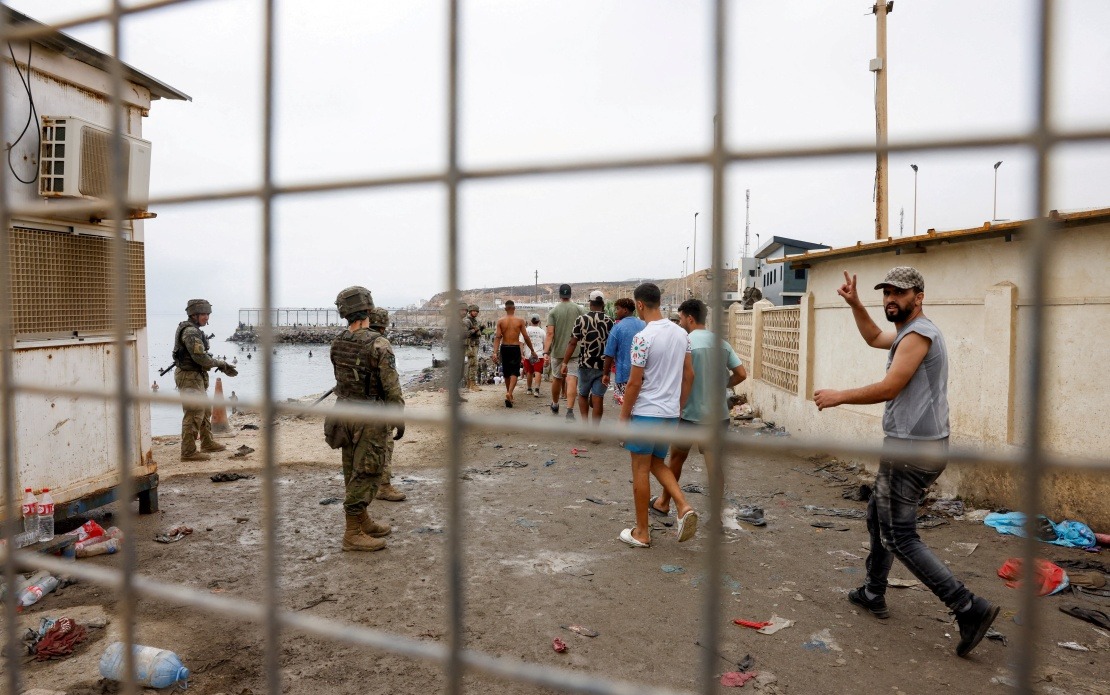
Spain declared on Friday that the majority of migrants who surged into the North African enclave of Ceuta have made their way back across the border to Morocco, as Madrid moved to contain what officials characterised as a significant challenge to border security and regional stability. The announcement came from Foreign Minister Jose Manuel Albares, who defended Spain's handling of the unprecedented crossing and pushed back against what he termed deliberate mischaracterization of events unfolding at one of Europe's most sensitive frontiers.
The migrant surge, which accelerated during Thursday and into Friday, represents a fresh pressure point in the complex relationship between Spain and Morocco, two nations separated by the Strait of Gibraltar yet bound by years of migration management protocols. Albares emphasised in a statement posted to social media that the Spanish authorities had maintained control of the situation and that the movement of people through the territory remained subject to rigorous identification procedures. He stressed that travellers seeking to move from Ceuta or the neighbouring enclave of Melilla toward mainland Spain must pass through police checkpoints where they undergo verification, a mechanism designed to safeguard both national security and the integrity of Europe's borderless Schengen movement area.
The repatriation agreement between the two neighbouring countries appears to have been the primary catalyst for the migrants' voluntary return. According to reports from Spanish news agencies, hundreds of people began heading toward the Moroccan border on Friday afternoon, motivated partly by the practical realisation that survival in Ceuta would prove difficult without functional infrastructure. The sudden closure or non-operation of shops, supermarkets, and restaurants in the enclave left arriving migrants without access to food and essential goods, effectively making continued presence untenable for those without established support networks or resources.
Spanish security forces mobilised substantially to manage the situation and prevent any further maritime arrivals. The Civil Guard, Spain's paramilitary law enforcement agency, deployed personnel alongside units from the Army's Regulares Group No. 54, a unit historically tasked with border security in Spain's North African territories. These forces concentrated their efforts along the Tarajal beach area, a known landing point for boats arriving from Morocco, establishing a visible security cordon designed to deter additional crossing attempts and maintain orderly management of the border zone.
The human cost of migration pressures in this region remains tragically evident. Spanish authorities documented that at least 57 individuals have perished during the broader migration crisis affecting the Ceuta and Melilla territories, a grim reminder of the dangers inherent in irregular maritime crossings and the desperation driving people to undertake such journeys. These deaths underscore why Spain and Morocco maintain regular coordination on border management and repatriation protocols, recognising that uncontrolled movement creates humanitarian as well as security risks.
Prime Minister Pedro Sanchez characterised the mass arrival of migrants as constituting both an "attack" on Spain and a violation of the nation's territorial integrity, language that reflects the political sensitivity surrounding immigration in the Iberian nation. His comments positioned the incident within a framework of national security rather than purely humanitarian concern, signalling that Madrid views control of its borders as fundamental to state sovereignty. Sanchez pledged to restore what he termed "normality" to Ceuta as quickly as feasible, implying that the situation had temporarily disrupted the ordinary functioning of the enclave and its relationship with mainland Spain.
For Southeast Asian observers, this crisis illuminates how even relatively wealthy European nations with sophisticated border infrastructure and bilateral cooperation frameworks face persistent migration pressures from regions experiencing poverty, conflict, and limited opportunity. The situation in Ceuta mirrors, in some respects, migration dynamics affecting Malaysia and other ASEAN states, where geographic proximity to less developed regions creates regular crossborder movement challenges. The Spanish authorities' reliance on repatriation agreements and bilateral coordination mechanisms reflects approaches increasingly adopted across Southeast Asia, though the legal and infrastructural contexts differ substantially.
The Ceuta episode also demonstrates how quickly informal networks can mobilise large numbers of people toward perceived opportunities, even when those opportunities prove illusory upon arrival. The migrants who crossed into Ceuta apparently acted on information or encouragement that suggested the enclave represented a viable gateway to European territory and opportunity. The rapid reversal, once they encountered the practical reality of operating within a closed commercial environment and facing coordinated security responses, highlights how vulnerable migration populations are to misinformation and how quickly circumstances can shift.
Spain's emphasis on Schengen integrity reflects broader European concerns about maintaining the passport-free movement area that underpins modern European integration. By stressing that security procedures at Ceuta's borders remain robust, Albares sought to reassure other Schengen member states that Spain was not allowing its territorial challenges to compromise the collective security architecture of the zone. This messaging matters for intra-European politics, where countries bordering external frontiers face periodic scrutiny regarding whether they adequately protect shared borders.
The return of migrants to Morocco also depends substantially on Moroccan cooperation and willingness to receive returning nationals and third-country migrants. While Spain maintains that almost all have departed, the sustainability of this outcome relies on continued Moroccan border management and absence of renewed pressure. Previous migration crises at Ceuta have sometimes rebounded when root causes remained unaddressed, suggesting that this moment represents a temporary resolution rather than a permanent fix to deeper structural issues driving migration from sub-Saharan Africa through Morocco toward European territory.
The broader context involves tens of thousands of migrants transiting Morocco annually, many originating from West and Central African nations experiencing economic distress and limited development opportunities. Morocco itself struggles with managing this population in transit, lacking resources to provide substantial support services. International organisations have noted that Moroccan border towns become overcrowded with waiting migrants, creating humanitarian challenges and occasional social tensions. Spain's management of its end of the equation through security deployment and repatriation agreements represents only one component of a much larger regional migration dynamic.

