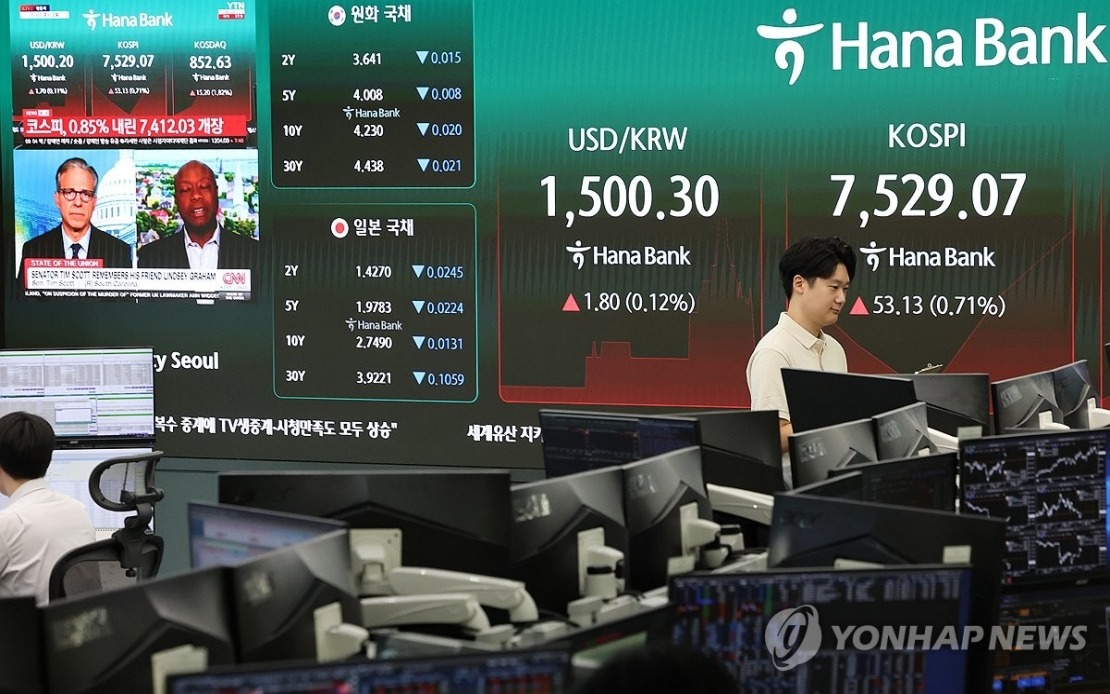
South Korea's bourse operator initiated an automatic trading suspension on Monday as the benchmark Korea Composite Stock Price Index tumbled sharply in response to escalating geopolitical tensions in the Middle East. The Korea Exchange activated its marketwide circuit breaker at approximately 1:28 p.m. local time after the KOSPI declined more than 8 percent from the previous trading session's closing level, triggering a 20-minute halt in share trading across the exchange.
The sharp market decline reflects mounting investor anxiety over renewed military posturing between the United States and Iran centred on control of the strategically vital Strait of Hormuz. This waterway serves as one of the world's most critical chokepoints for global energy shipments, and any disruption to shipping through the passage poses significant risks to international commerce and oil supply chains. Regional instability in West Asia has historically translated into broader market volatility across global financial centres, and South Korea's export-dependent economy remains particularly sensitive to disruptions in global trade and energy supplies.
Circuit breakers function as automatic market stabilisers, temporarily halting trading when indices experience sharp declines within specified timeframes. The suspension period allows market participants to reassess valuations and absorb information rather than engage in panic selling that could amplify losses. South Korea's stock exchange employs these safeguards to prevent disorderly market conditions and preserve investor confidence during periods of significant uncertainty. The 20-minute pause provides breathing room for traders to recalibrate positions without the pressure of mounting losses driving further selling momentum.
This represents the seventh occasion during 2024 that the KRX has deployed its circuit breaker mechanism, a frequency that underscores the persistent volatility affecting Korean equities throughout the year. The recurring activation reflects both external shocks—including geopolitical flashpoints and global economic uncertainty—and domestic factors affecting South Korean corporations and market sentiment. For regional investors and policymakers monitoring East Asian market stability, the increasing frequency of trading halts signals elevated risk perception across equity markets.
The Middle Eastern tensions affecting Korean markets carry particular significance for Southeast Asian economies like Malaysia, which maintain substantial energy imports and substantial trade exposure to the region. Malaysian investors with exposure to Korean equities through regional funds and direct holdings experienced downside pressure alongside Seoul-based traders. Furthermore, supply chain disruptions emanating from West Asian instability could ripple through Malaysian manufacturing and export sectors that depend on stable global commodity prices and shipping logistics.
South Korea's benchmark index exhibits considerable sensitivity to international developments given the nation's heavy dependence on exports and global supply chain stability. Corporations listed on the KOSPI range across semiconductors, petrochemicals, automotive manufacturing, and consumer electronics—industries susceptible to disruptions in raw material access and logistics networks. When geopolitical risks threaten major shipping corridors or energy supplies, Korean industrial firms face uncertainty regarding production costs and delivery schedules, prompting investors to reassess earnings forecasts and reduce equity positions defensively.
The timing of Monday's circuit breaker activation demonstrates how rapidly market-moving news propagates through modern trading systems. Digital communications networks transmit information instantaneously across global markets, allowing investors in Seoul to immediately react to developments in the Middle East through algorithmic trading and rapid portfolio rebalancing. This compressed reaction time means that once-regional concerns now generate nearly immediate consequences across interconnected financial markets worldwide.
Investor caution regarding the Strait of Hormuz reflects legitimate economic concerns rather than pure speculation. Roughly one-third of global maritime oil shipments transit through this narrow passage, making it essential infrastructure for global energy security. Any prolonged disruption would likely elevate crude prices substantially, increasing input costs for petrochemical producers, transportation companies, and energy-intensive manufacturers throughout Asia. South Korean firms face particular exposure given their reliance on imported energy resources to fuel industrial production and generate export revenues.
The frequency of circuit breaker activations this year—occurring seven times already—suggests that volatility may remain elevated throughout the remainder of 2024. Market participants appear increasingly reactive to headline risk, with geopolitical developments, monetary policy uncertainty, and earnings revisions driving rapid repositioning across equity portfolios. This environment challenges long-term investors seeking stable returns and rewards those capable of weathering significant interim fluctuations in portfolio values.
For Malaysian market observers, the Korean experience offers insights into how regional equity markets respond to external shocks and the mechanisms exchanges employ to manage systemic risk. As Southeast Asian economies become more integrated into global supply chains and financial networks, similar volatility dynamics could affect Malaysian bourses during periods of international tension. Understanding how circuit breakers function and their intended role in stabilising markets helps investors contextualise temporary trading halts as prudent risk management rather than harbingers of systemic dysfunction.
The broader implications extend beyond immediate stock price movements. Persistent uncertainty regarding Middle Eastern stability encourages investors to reassess asset allocation strategies, potentially shifting capital toward perceived safer havens and away from growth equities. This rotation affects not only Korean markets but regional markets throughout Asia where investors rebalance portfolios in response to changing risk assessments. Malaysian policymakers monitoring these developments must remain alert to potential spillover effects on local market stability and investor sentiment.

