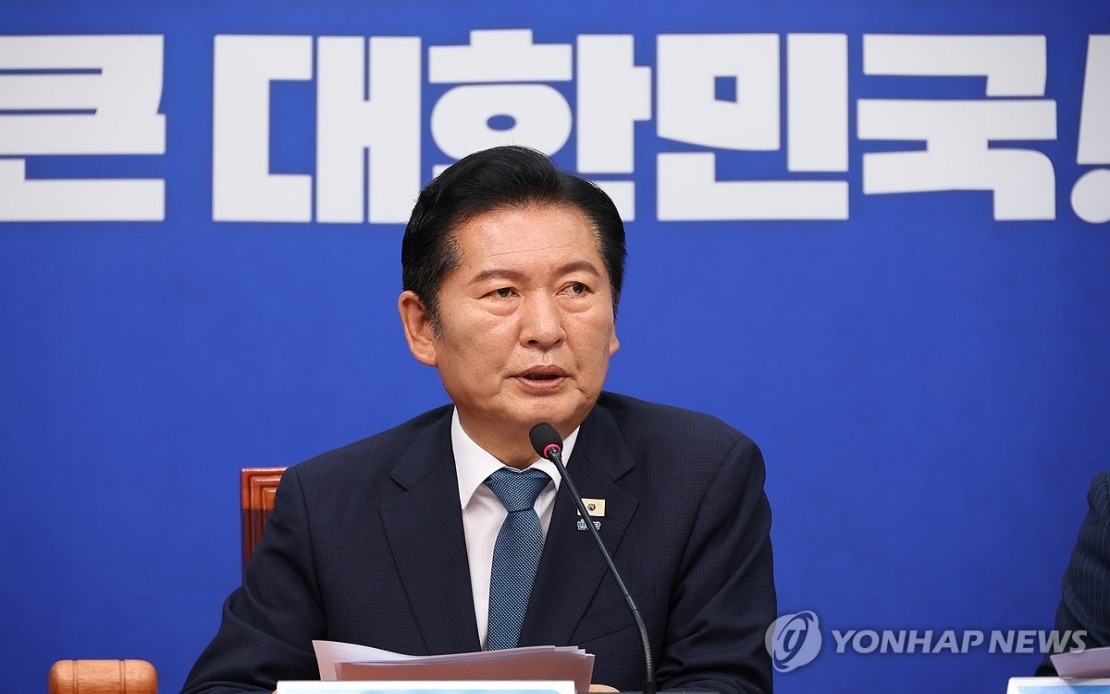
South Korean ruling party chairman Jung Chung-rae announced his resignation on Wednesday, a strategic move widely interpreted as clearing the path for his candidacy in an internal leadership race slated for mid-August. Speaking before the Democratic Party's supreme council at the National Assembly in Seoul, Jung framed his departure as a necessary step after extensive personal reflection, telling gathered members that recent days had been consumed with introspection regarding his political journey and tenure leading the party.
Jung's decision comes at a turbulent moment for South Korea's ruling Democratic Party, which has faced mounting internal strains between competing factions with differing visions for the party's direction and its relationship with the government. Throughout his remarks, Jung emphasised his unwavering commitment to supporting President Lee Jae Myung's administration, characterising his chairmanship as a period devoted entirely to ensuring cohesion between the party apparatus, governmental structures, and the presidential office. He underscored the personal toll of navigating factional tensions, describing sleepless nights and relentless criticism yet maintaining that he had discharged his responsibilities without complaint despite facing resistance both within party ranks and from external opponents.
The underlying friction that prompted Jung's departure reflects a substantive political disagreement within the ruling coalition. Critics from the pro-Lee faction, which forms a significant bloc within the Democratic Party, have contended that Jung has been steering the party toward the preferences of his own hardline supporters rather than maintaining alignment with the president on critical policy matters. This tension illustrates the broader challenge facing ruling parties in managing internal diversity while maintaining governmental effectiveness—a dynamic familiar to regional observers watching Malaysian and Southeast Asian political coalitions negotiate similar tensions between unity and representation.
Jung's resignation sets the stage for a high-stakes three-way contest for party leadership that promises to reshape the Democratic Party's internal balance of power. Prime Minister Kim Min-seok, widely recognised as a close political ally of President Lee, is expected to emerge as a frontrunner given his governmental position and established relationship with the administration. Song Young-gil, a veteran politician who previously served as Democratic Party chairman, represents an alternative pole of party influence, bringing institutional experience and his own support base within the membership.
Song's entry into the race carries particular significance given recent indications that he has held discussions with President Lee regarding his candidacy. According to Democratic Party lawmaker Park Jie-won, who disclosed the information during a radio interview with CBS, Song has explicitly informed the president of his intention to contest the leadership and has even raised the possibility of coordinating his campaign with Kim Min-seok's bid. Such coordination would represent a significant strategic calculation—potentially uniting the pro-administration wing of the party behind a single candidate, thereby marginalising other contenders.
The mechanics of party succession underscore the importance of August's convention in shaping not only the Democratic Party's internal structure but potentially the broader trajectory of South Korean politics over the coming months. With Jung stepping aside, party floor leader Han Byung-do will assume the role of acting chairman, maintaining institutional continuity until the August 17 convention formalises the party's new leadership. This interim arrangement provides necessary administrative continuity while the party conducts what amounts to an internal referendum on its future direction.
For regional observers, particularly those monitoring political developments in East Asia, South Korea's ruling party dynamics offer instructive parallels to coalition management in mature democracies across the region. The Democratic Party's struggle to balance presidential loyalty with internal representation mirrors challenges facing ruling coalitions throughout Southeast Asia, where maintaining party discipline while accommodating diverse factions remains an enduring governance problem. Jung's departure illustrates how personal and factional considerations can drive seemingly technical administrative decisions.
The three-way race also raises questions about policy continuity and governmental effectiveness during the leadership interregnum. With the convention scheduled for August, the Democratic Party faces a two-month window during which clear strategic direction from party leadership remains ambiguous. This period of uncertainty could affect legislative priorities, governmental message discipline, and the party's ability to mobilise support for administration initiatives. For Malaysian analysts observing regional governance patterns, such leadership vacuums remind observers of the importance of succession planning in parliamentary systems.
Jung's public framing of his resignation as a voluntary act of reflection stands in contrast to the obvious political calculation underlying his decision. By resigning now rather than contesting while in office, Jung positions himself as a principled operator willing to step back, potentially appealing to party members who value institutional humility. Simultaneously, resignation frees him from administrative constraints that might otherwise handicap his campaign, allowing him to organise supporters without the appearance of exploiting his official position.
The Democratic Party's leadership contest will inevitably interact with broader questions about President Lee Jae Myung's political standing and the government's policy agenda. The outcome will signal whether pro-administration forces can maintain party cohesion or whether internal divisions will persist. For Southeast Asian observers, this contest reinforces a fundamental insight about one-party dominance systems: succession struggles are rarely about personalities alone but rather reflect deeper disputes about party direction and governmental priorities that shape political outcomes far beyond leadership titles.
As the convention approaches, the Democratic Party faces pressure to demonstrate that it remains capable of functioning as both a presidential support mechanism and a venue for legitimate internal debate. The balance it strikes between these competing imperatives during the August contest will reveal much about the party's institutional health and its capacity to navigate the tensions between top-down leadership and democratic internal processes that define modern political parties across East and Southeast Asia.