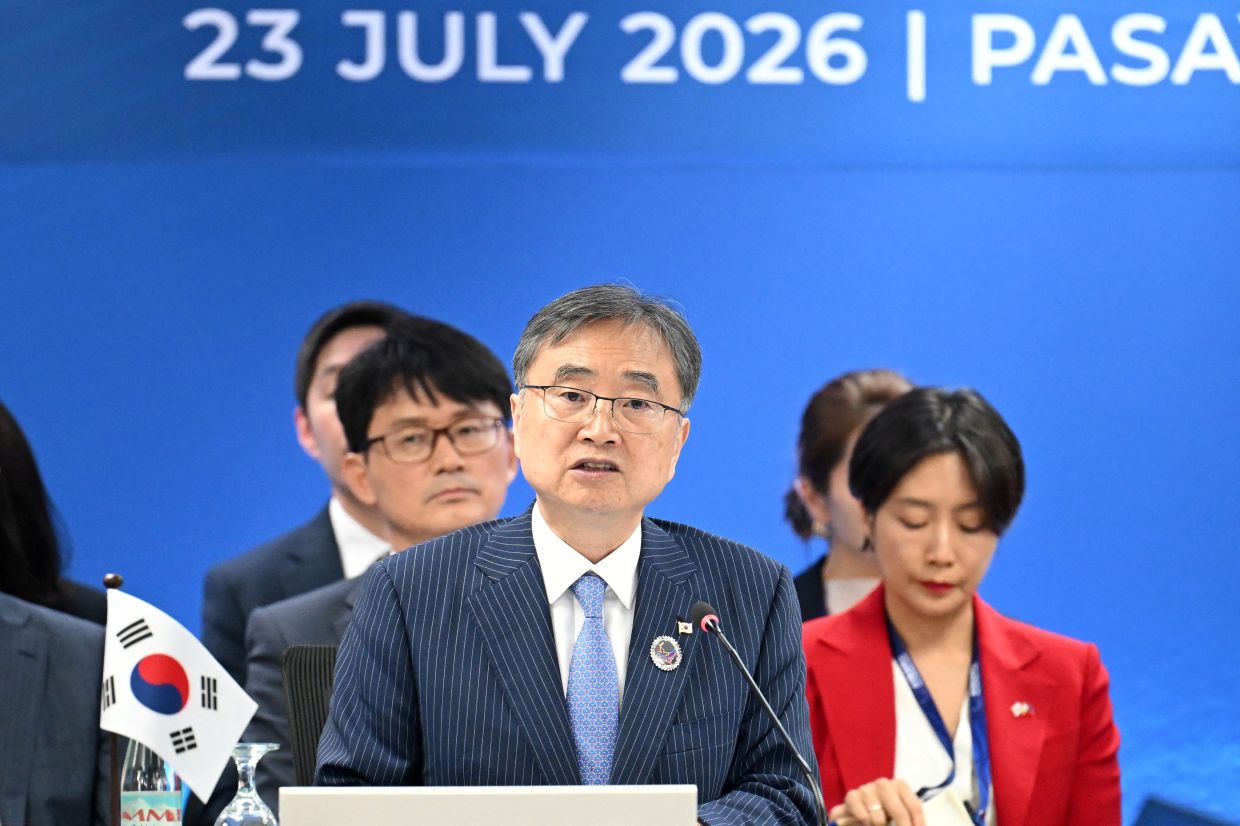
South Korea's policy apparatus is fracturing over how aggressively to pursue dialogue with North Korea, with senior cabinet ministers openly contradicting each other this week in a rare public display of governmental discord. Foreign Minister Cho Hyun dismissed proposals put forward by his counterpart, Unification Minister Chung Dong-young, as unrealistic idealism lacking broader institutional support, while Chung countered that aspirational thinking was essential for breaking diplomatic deadlock. The dispute underscores mounting tension between competing approaches to Pyongyang at a moment when Seoul is making renewed efforts to resurrect communication channels that have remained dormant for years.
Chung's blueprint for reviving engagement, presented at a policy session with President Lee earlier in the week, proposed convening four-party talks that would bring together Seoul, Pyongyang, Washington, and Beijing—a format last attempted years ago with mixed results. The Unification minister framed this as a cornerstone initiative for the remainder of the calendar year. However, Cho's immediate pushback, delivered to assembled journalists, highlighted that these proposals had not undergone sufficient vetting across government departments and lacked the consensus necessary to constitute official policy. The public nature of the disagreement proved particularly striking given the typically hierarchical and consensus-oriented nature of South Korean bureaucracy.
The brewing tension reflects deeper philosophical differences between Seoul's competing power centers over how to handle a neighbour that remains nominally at war with the South. Chung's office has advocated for what might be characterised as a confidence-building approach, proposing gradual steps toward normalisation that would lower barriers to communication. Cho's position, conversely, emphasizes caution and institutional discipline, suggesting that unvetted proposals risk undermining Seoul's negotiating credibility. The back-and-forth, with Chung insisting to local media that ideals were necessary to transform geopolitical reality, illustrated how divergent these worldviews have become within President Lee's administration.
The cabinet disagreement arrives as Seoul pursues what officials describe as a strategic reorientation away from the previous government's emphasis on denuclearisation as a precondition for engagement. The new framework prioritises what policymakers term "peace-first" diplomacy, signalling willingness to decouple arms negotiations from broader dialogue. Concurrently, the Lee administration has encouraged President Donald Trump to pursue direct talks with North Korean leader Kim Jong Un, calculating that American presidential engagement might unlock dormant channels that Seoul alone cannot access. These overtures—including the cessation of anti-North loudspeaker broadcasts previously viewed by Pyongyang as provocative—represent a fundamental recalibration of how South Korea presents itself to its neighbour.
Analysts warn that such visible internal disagreement may achieve precisely the opposite of Seoul's stated intentions. Lim Eul-chul, a specialist in Korean affairs at Kyungnam University, cautioned that exposed policy divisions signal weakness and undermine Pyongyang's confidence in Seoul's commitment to any agreement. The concern runs deeper than simple messaging: if North Korea perceives that South Korean governments routinely reverse commitments made by predecessors, incentives for meaningful negotiation evaporate. Historical experience suggests that Kim Jong Un's regime closely monitors South Korean domestic political currents, interpreting factional disputes within Seoul as evidence of inconstancy. When cabinet ministers publicly contradict each other on matters of fundamental strategy, the message to Pyongyang becomes one of institutional paralysis rather than resolve.
The broader context of Seoul's outreach efforts makes the cabinet discord particularly consequential. Inter-Korean relations have deteriorated markedly since the Covid-19 pandemic disrupted the limited contact that existed. In 2024, North Korea publicly renounced reunification as a policy objective and dismantled joint economic projects on its territory, actions that effectively announced a closing of diplomatic doors rather than an opening. Defections have plummeted to negligible levels, with just 63 North Koreans successfully reaching the South during the first half of 2026 compared to 1,047 a decade earlier. This dramatic decline reflects both stricter North Korean border controls and diminished incentives for escape, metrics that illustrate how thoroughly contact channels have constricted.
Seoul's diplomatic pivot has triggered criticism from human rights advocates and civil society groups that view engagement without conditionality as enabling authoritarian governance. While South Korea co-sponsored a United Nations resolution addressing North Korean human rights concerns in the previous year, observers note a subsequent softening in Seoul's public advocacy on this issue. The Lee administration has reportedly deprioritised certain human rights reporting and broadcasting initiatives, calculating that such expressions might antagonise Pyongyang and further complicate engagement efforts. Kim Tae-Hoon, formerly leading the advocacy organisation PSCORE, recounted that this recalibration has substantially reduced international funding for North Korean human rights work, creating operational strain for organisations dependent on such support.
The timing of the ministerial clash raises questions about the coherence of Seoul's broader strategic vision for the peninsula. When Foreign and Unification officials cannot present unified positions on fundamental engagement principles, negotiating partners face ambiguity about which voice represents authentic governmental intent. North Korea's historical pattern of exploiting South Korean political divisions suggests Pyongyang will use such moments to drive wedges between competing Seoul factions. The regime's negotiating strategy often involves identifying perceived divisions and magnifying them, thereby paralyzing decision-making through strategic ambiguity about which South Korean official commands actual authority.
Neither the Foreign nor Unification ministries offered substantive responses when queried about their divergent positions on Friday, instead issuing statements pledging continued policy coordination. The presidential office similarly demurred from comment, suggesting that senior leadership may be attempting to contain the fallout rather than definitively resolving the underlying disagreement. This silence itself communicates something troubling about the state of play: if the president's advisors cannot or will not publicly settle a fundamental strategic dispute, questions about policy direction become inevitable. For Seoul's diplomatic efforts to succeed, stakeholders both within and outside South Korea need reasonable confidence that negotiating positions reflect settled governmental consensus rather than preliminary positions subject to reversal.
The cabinet rift arrives amid broader regional uncertainty about how Washington's approach to North Korea will evolve under renewed Trump administration attention. Seoul hopes that direct presidential engagement between Washington and Pyongyang might create openings for South Korean participation, yet this gambit remains speculative. Meanwhile, Seoul must manage contradictions between its peace-first engagement strategy and the security commitments it maintains as a longstanding American ally. These tensions, playing out publicly across South Korea's ministerial level, only amplify concerns among Seoul's allies and adversaries alike about the coherence of the South Korean government's strategic direction as it confronts a persistently unpredictable neighbour.

