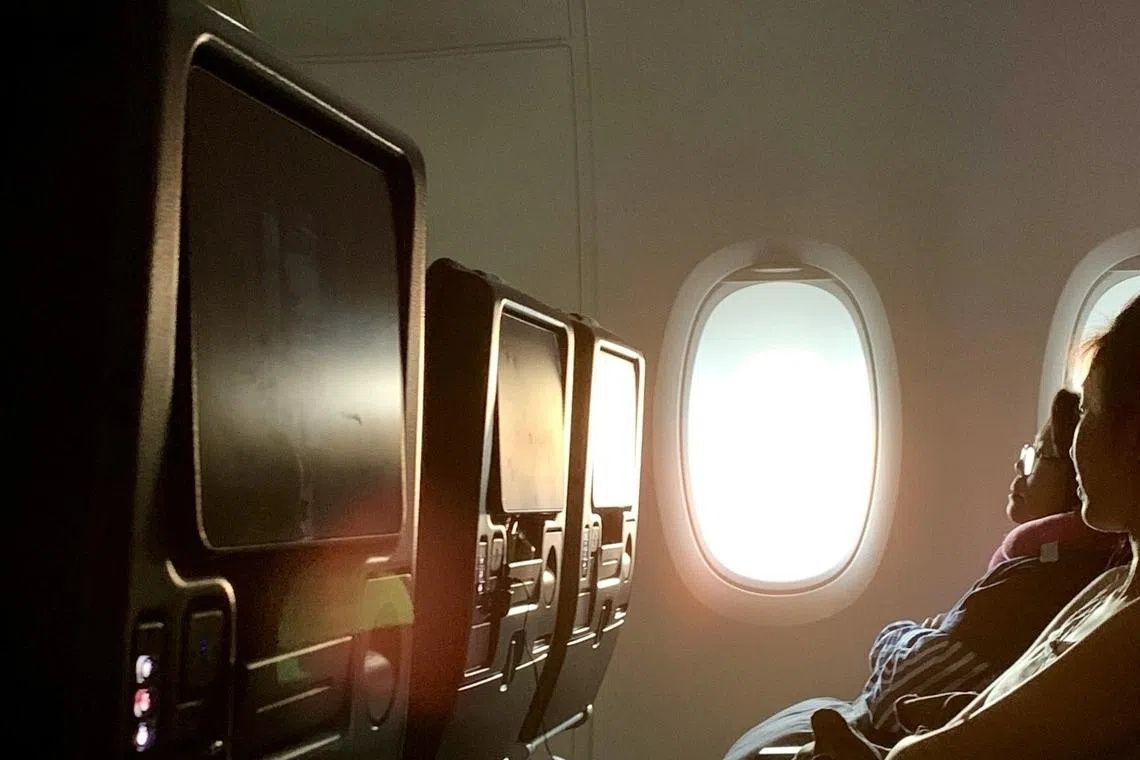
A middle school student in South Korea has escalated concerns about children's exposure to unsuitable content aboard commercial flights by filing a formal petition with the government, highlighting a gap in passenger protection measures that extends beyond the airline industry's existing self-regulation efforts. The complaint, lodged through the Petition 24 website administered by the Ministry of the Interior and Safety, argues that current practices on major Korean carriers fail to adequately shield young travellers from violent and sexually explicit material that can involuntarily capture their attention during long journeys.
The petitioner, who experienced the incident firsthand during a recent flight, described the dilemma faced by children seated near screens displaying mature-rated content. Their account emphasises a fundamental problem with in-flight entertainment systems: once inappropriate material appears on a shared or nearby monitor, young passengers have limited practical options to avoid witnessing scenes they should not be exposed to. The situation became more serious when the petitioner noted that a younger sibling, attending primary school, was similarly affected, suggesting the issue affects multiple age groups across the childhood spectrum.
In response to the unsettling experience, the petitioner has proposed a concrete solution: implementing mandatory privacy screening technology on seat-back monitors to prevent passengers seated nearby from viewing content rated above certain age classifications. This suggestion reflects a growing understanding that digital age-gating alone—where airlines restrict content availability—proves insufficient when physical adjacency to screens creates unavoidable exposure. The proposal aligns with technological solutions already deployed in other contexts, such as banking kiosks and sensitive workstations, where screen visibility is deliberately limited to the primary user.
The petition's legal foundation rests on existing South Korean legislation designed to protect minors. Both the Child Welfare Act and the Youth Protection Act contain explicit provisions requiring safeguards against exposure to harmful content, yet their application to the aviation sector appears incomplete. The petitioner's invocation of these statutes suggests that current airline practices may fall short of statutory obligations, creating a potential regulatory gap that government authorities could address through enforcement or clarification of existing laws.
South Korea's two largest carriers, Korean Air and Asiana Airlines, maintain ostensibly child-friendly policies by declining to offer films rated for viewers aged 19 and above. The airlines additionally utilise edited versions of movies in which the most graphic scenes have been removed or substantially altered from their theatrical releases. However, these measures, while well-intentioned, operate on the assumption that airline programming will remain within prescribed boundaries—an assumption that does not account for implementation failures, programming errors, or the reality that edited versions still contain scenes objectionable for young audiences.
A notable precedent underscores the complexity facing Korean carriers. In 2020, both Korean Air and Asiana removed the internationally acclaimed film Parasite from their in-flight libraries despite its 15-and-above rating classification. The decision reflected acknowledgment that even content technically permissible under their policies contained violent sequences and sexual references unsuitable for younger passengers, demonstrating that rating systems alone do not resolve the underlying tension between offering diverse programming to adult passengers and protecting children from age-inappropriate material.
The petition raises important questions about responsibility allocation in the digital age. Airlines operate as common carriers with obligations to provide safe environments for all passengers, yet the in-flight entertainment space exists in regulatory grey territory. While ground-based cinemas, television broadcasters, and streaming services face content regulations appropriate to their medium, the uniquely enclosed environment of an aircraft—where passengers cannot simply leave and have limited recourse against offensive content—presents distinct challenges.
For Malaysian and Southeast Asian readers, this South Korean case carries direct relevance. Regional carriers including Malaysia Airlines, AirAsia, and Singapore Airlines face identical pressures to offer engaging in-flight entertainment while managing diverse passenger demographics spanning infants to elderly travellers. The technological solution proposed in the petition—privacy screens—represents a relatively simple intervention that could be implemented region-wide without substantial cost or operational disruption.
Beyond the immediate question of screen visibility, the petition reflects broader societal conversations about children's media exposure in an increasingly connected world. Southeast Asian nations have generally adopted less stringent content regulations than developed countries, making the proactive approach demonstrated by South Korea potentially instructive for policymakers in Malaysia, Singapore, Thailand, and Indonesia who seek to establish protective frameworks without imposing excessively paternalistic controls.
The government petition mechanism itself merits attention from Malaysian observers. South Korea's Petition 24 system provides citizens direct channels to raise policy concerns, creating accountability pressure on both airlines and regulators. Such participatory mechanisms, when implemented thoughtfully, can identify practical problems that industry self-regulation overlooks. The South Korean case demonstrates that even seemingly minor inconveniences—unavoidable exposure to in-flight content—can catalyse policy change when citizens mobilise through formal channels.
Moving forward, the petition's success will likely depend on whether authorities treat it as a legitimate child protection issue meriting regulatory intervention or dismiss it as a minor operational matter best left to airline discretion. The existence of explicit statutory obligations in South Korea's youth protection legislation suggests that government agencies possess legal authority to mandate stronger safeguards, should public pressure and political will align. For regional carriers, the prudent course may involve investigating privacy screen technology now, before regulatory pressure becomes imminent.

