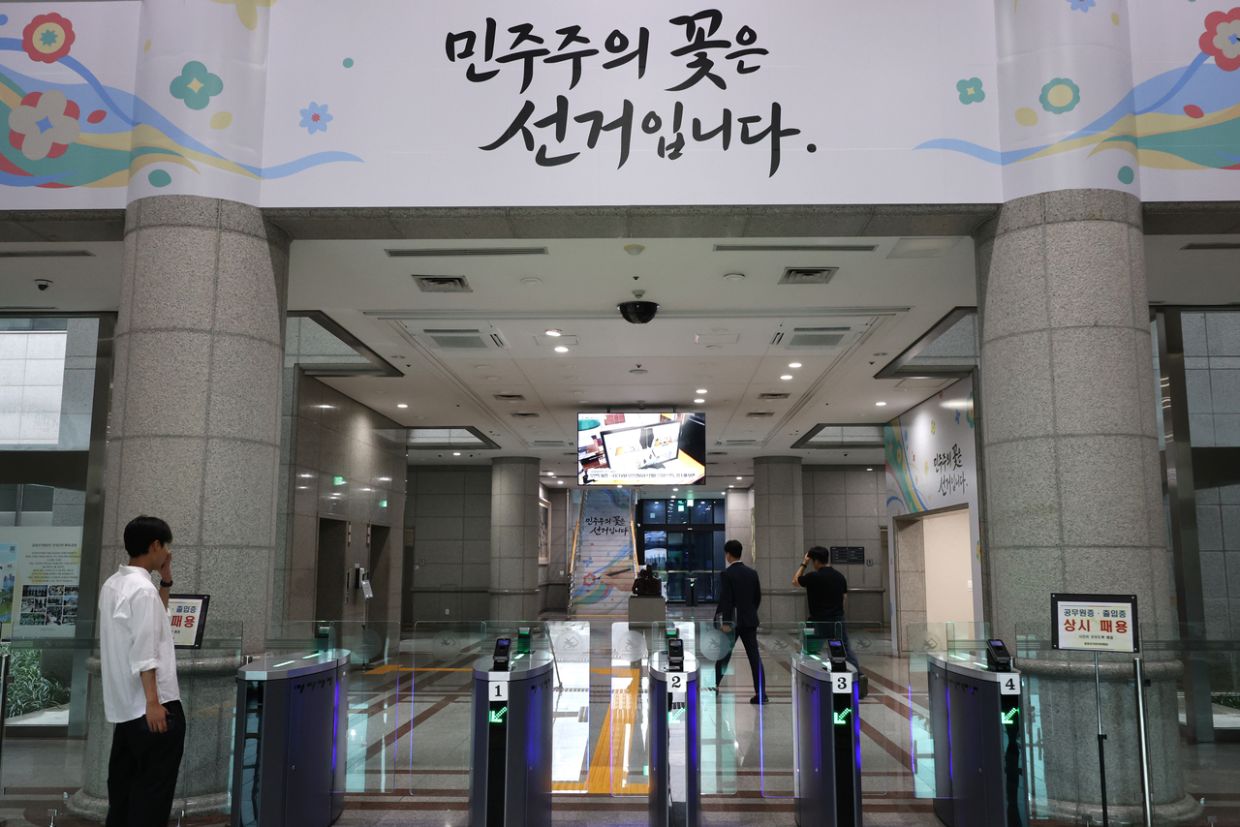
South Korean authorities conducted a major raid on the National Election Commission headquarters in Gwacheon on Thursday as part of an expanding investigation into irregularities that marred the June 3 local elections. The search operation, carried out by a joint task force comprising prosecutors and police investigators, targeted the election watchdog's main office to obtain evidence related to allegations that certain staff members had altered statistical records within the institution's computer systems. According to legal sources, officials suspected that data had been falsified to mask deficiencies in voter registration numbers and other administrative errors.
The incident underscores growing concerns about the integrity of South Korea's electoral processes and the operational competence of institutions tasked with safeguarding democratic principles. The raid represents an escalation in what prosecutors have characterized as a broadening inquiry into systemic failures that became apparent on election day itself. The decision to deploy a joint task force—combining the prosecutorial apparatus with police resources—signals the seriousness with which authorities are treating allegations of institutional misconduct at an organisation responsible for administering one of Asia's most closely watched democracies.
During the June 3 local elections, numerous polling stations reported insufficient ballots to accommodate all registered voters, creating a chaotic situation where citizens arrived to cast their votes only to discover that materials had run out. The shortages forced many voters to leave polling booths without participating in the electoral process, an outcome that fundamentally undermines the democratic principle of universal suffrage. These practical failures on election day prompted initial questions about whether the failures were merely logistical oversights or stemmed from more deliberate administrative negligence or manipulation at the commission itself.
Investigators allege that rather than addressing these documented problems transparently, certain National Election Commission employees allegedly manipulated computer records to obscure the extent of the voter registration discrepancies and ballot distribution errors. Such action, if substantiated, would represent not merely an operational failure but a deliberate attempt to conceal governmental misconduct from public and official scrutiny. The manipulation of institutional data to cover administrative failures represents a particularly serious breach of public trust, as it demonstrates an apparent intent to deceive both the electorate and oversight bodies about the reliability of electoral administration.
The broader implications of this investigation extend beyond the specific incidents of the June elections. In regional terms, South Korea's electoral system has long been regarded as relatively robust compared to some neighbouring democracies, with independent monitoring and transparent procedures generally considered international standards. However, the discovery of potential data falsification within the election commission itself raises uncomfortable questions about the actual vulnerability of these institutions to internal manipulation. For Malaysia and other Southeast Asian nations with their own election management bodies, the South Korean case serves as a cautionary reminder of the importance of implementing robust internal controls, audit mechanisms, and whistleblower protections within electoral institutions.
The joint prosecution-police task force's decision to execute a search and seizure warrant reflects investigative methodology that prioritises securing physical and digital evidence before subjects of inquiry have opportunity to destroy or alter materials further. This approach, while standard in serious criminal investigations globally, nonetheless represents a dramatic intervention in the functioning of a state institution. The execution of such warrants against government agencies carries significant political and institutional ramifications, potentially signalling that the investigation has moved beyond preliminary inquiry into territory where prosecutorial officials believe they have sufficient grounds to suspect concrete criminal conduct.
The timing and scope of the raid also suggests that investigators have developed specific allegations about which employees engaged in data manipulation and which records were altered. Rather than conducting a general exploratory search, the warrant was apparently targeted at particular computer systems and documentation, indicating that investigative work had already identified probable locations of evidence. This methodical approach would require preliminary investigation work, interviews, and document analysis before authorities secured judicial authorisation for the raid itself.
For electoral systems across Southeast Asia, including Malaysia's, the South Korean experience highlights the critical importance of maintaining independence and integrity within election management bodies. The National Election Commission operates as the formal guardian of electoral administration in South Korea, yet the investigation suggests that this institutional role provided insufficient safeguards against internal wrongdoing. This pattern—where institutions designed to ensure electoral probity themselves become subjects of corruption or manipulation investigations—represents one of the most troubling scenarios for democratic governance.
The substantive questions at the heart of this investigation ultimately concern accountability and institutional reform. If investigators substantiate allegations of data manipulation, it will raise fundamental questions about how such misconduct occurred, what institutional deficiencies enabled it, and what systemic reforms are necessary to prevent recurrence. These questions will likely dominate public discourse in South Korea as the investigation proceeds and may influence electoral reform discussions across the region, as neighbouring democracies assess whether similar vulnerabilities exist within their own electoral institutions and consider preventative measures.
The ballot shortage incidents themselves already represented a significant embarrassment for South Korean electoral administration, but the allegation that the National Election Commission subsequently manipulated data to cover up these failures escalates the matter into territory with potentially serious legal consequences for involved officials. Prosecutors will need to establish not only that data was altered, but also the specific intent behind such alterations—whether they represented deliberate concealment of misconduct or merely administrative mishandling of statistical records. This distinction will be crucial in determining the severity of potential charges and the ultimate culpability of individuals involved in the commission.

