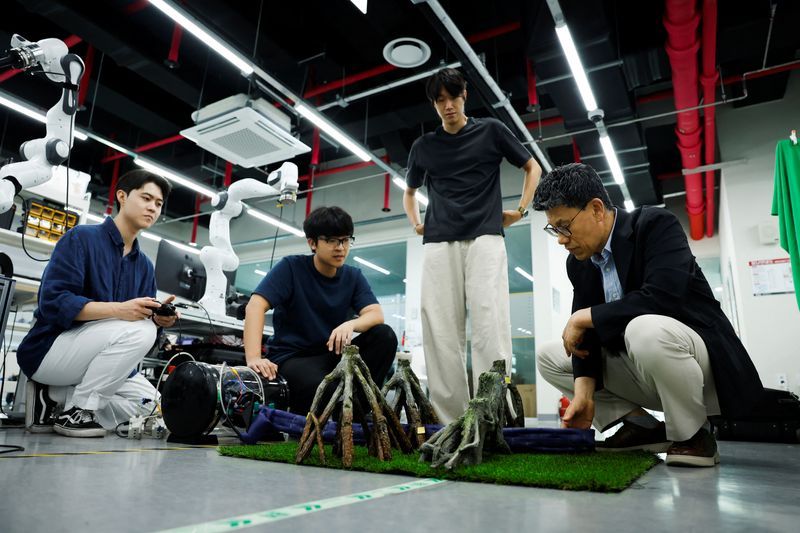
A collaborative team of engineers from South Korea's Korea Advanced Institute of Science and Technology (KAIST) and Stanford University has demonstrated a breakthrough in wearable robotics: clothing embedded with soft, flexible pneumatic tubes that automatically dress the wearer without requiring manual effort or external help. The innovation, unveiled in Daejeon, represents a significant advance in robotics that moves beyond software-driven systems to showcase how mechanical design can solve practical human problems.
The core technology relies on a network of air-pressurised "vines" woven into the fabric itself. When activated, these tubular structures inflate and guide the clothing up and around the wearer's body with a motion reminiscent of ivy climbing a wall or lattice. The system functions even when the person remains mobile—the wearer need not stand still during the dressing process, a critical distinction that sets this technology apart from earlier automated clothing concepts. The entire process of fully suiting up takes approximately 10 seconds, a speed that could prove invaluable in time-sensitive scenarios.
The inspiration for this innovation came from an everyday observation, according to Kim Nam Gyun, the postdoctoral researcher at KAIST who led the development effort. While cycling in unexpected rain, Kim envisioned a system that could deploy protective garments automatically without requiring the cyclist to stop or use their hands. This human-centred design thinking informed the entire project, ensuring that the final product addressed genuine usability challenges rather than simply pursuing technological novelty for its own sake.
The mechanical principle underlying the technology's effectiveness lies in how the robotic vines operate. Rather than shifting their entire structure along the body surface, the vines advance by growing incrementally at their tip, much like how actual ivy plants extend through their growing tips. This growth-based locomotion enables the system to maintain stable contact with curved surfaces and navigate the complex topography of the human form. As the vines advance, they simultaneously turn the garment inside out, neatly fitting it to the wearer's body without requiring any complex algorithmic control or active feedback systems.
Professor Ryu Jee-Hwan from KAIST's civil and environmental engineering department emphasized the robustness of this approach. The vine-climbing mechanism can traverse narrow gaps, adapt fluidly to environmental variations, and maintain function across diverse surface conditions—whether slippery, sticky, or inclined. This mechanical elegance reduces reliance on sophisticated software solutions, though not by abandoning engineering rigour. Instead, the design delegates problem-solving to the physics of the system itself, a principle that harks back to classical mechanical engineering before computational solutions became dominant.
The immediate applications for this technology extend well beyond theoretical interest. For elderly individuals and people with disabilities who struggle with conventional clothing fasteners and layering, the self-dressing system could substantially enhance independence and quality of life. The hands-free aspect makes it particularly valuable in professional contexts where workers cannot pause their activities to don protective equipment. Semiconductor manufacturing facilities maintain highly controlled cleanroom environments where contamination from human contact represents a constant concern; rapid, hands-free suiting could minimise such risks while maintaining production efficiency.
Emergency services represent another compelling use case. Firefighters, hazmat response teams, and other first responders frequently face situations where speed is critical and contamination prevention is paramount. Being able to rapidly don protective gear without removing gloves or interrupting other essential tasks could prove life-saving in time-critical scenarios. Medical personnel working in highly contagious disease environments could similarly benefit from accelerated donning procedures that eliminate the potential for self-contamination during the crucial transition into protective equipment.
Ryu also highlighted a broader philosophical point about contemporary technological development. In an era dominated by artificial intelligence and software innovation, which naturally attracts widespread media attention and investment focus, the vine-climbing robot demonstrates that mechanical engineering remains capable of generating transformative solutions. The technology does not represent anti-technology sentiment; rather, it exemplifies how mechanical design principles can complement and sometimes substitute for computational approaches. This perspective carries particular resonance for manufacturing-dependent economies in Southeast Asia, where precision mechanical engineering remains a core industrial competency.
The research team's work underwent rigorous peer review before publication in IEEE Robotics and Automation Letters, a leading journal in the field. This peer-reviewed publication distinguishes the findings from preliminary demonstrations or speculative proposals, providing confidence that the technology functions as described. The involvement of Stanford University alongside KAIST reflects the increasingly transnational character of advanced technology development, with research teams collaborating across continents to combine complementary expertise and resources.
Looking forward, the implications for robotics and human-machine interaction suggest promising directions for development. The principle of growth-based locomotion could potentially extend beyond clothing applications to encompassing fields like medical robotics, search-and-rescue equipment, and adaptive infrastructure. For Malaysian and broader Southeast Asian technology sectors, this work underscores how fundamental innovations often emerge from observing everyday problems—in this case, a researcher caught in unexpected rain—and applying rigorous engineering discipline to develop elegant solutions.

