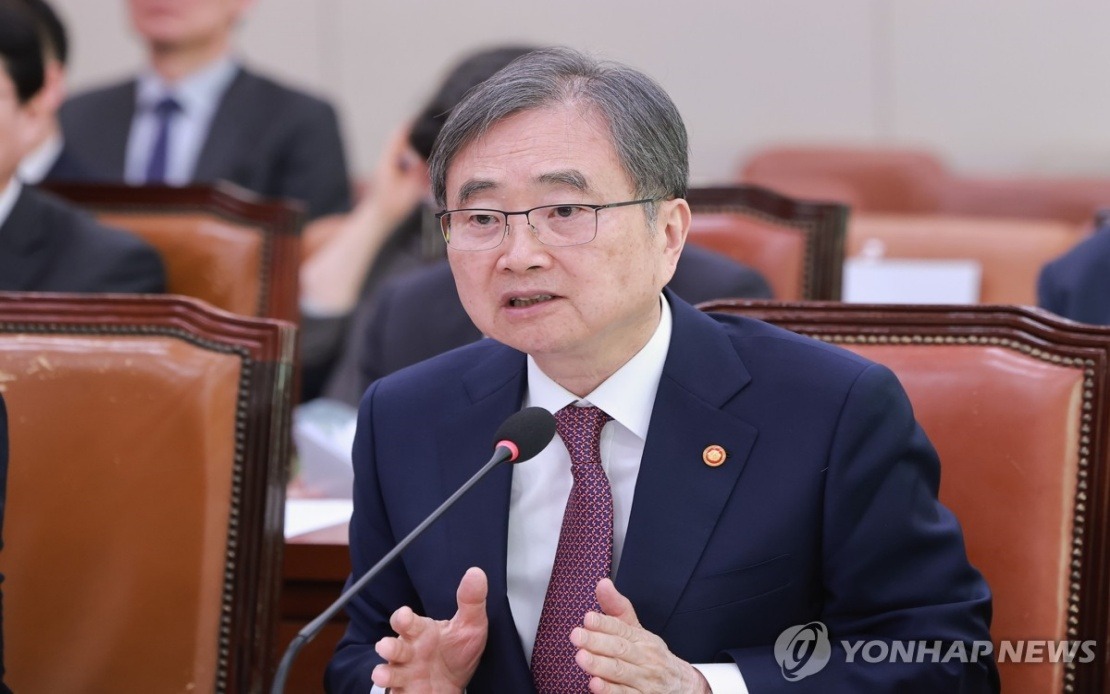
South Korea's Foreign Minister Cho Hyun has disclosed an unusual diplomatic moment: the country learned of significant cuts to its joint military exercises with the United States through President Donald Trump's social media post rather than through official government channels. Speaking before a parliamentary committee focused on foreign affairs and unification, Cho acknowledged that neither Seoul nor Washington's government officials had prior knowledge of Trump's announcement before it appeared online, creating an unexpected diplomatic vacuum that underscored the unpredictability of direct communication between world leaders in the social media age.
The revelation points to a concerning breakdown in the traditional diplomatic protocols that have long governed relations between South Korea and the United States, two nations whose security alliance has been foundational to regional stability in East Asia for decades. Cho's admission that Seoul received no advance notification from Washington officials stands in sharp contrast to the coordinated approach typically expected between allied defence establishments, where major strategic decisions involving military operations are usually negotiated and announced jointly to avoid public confusion or perceptions of discord.
The specific exercise affected is the Ulchi Freedom Shield, a major annual summertime drill that brings together South Korean and American forces for a comprehensive training programme. The exercise combines field manoeuvres with computer-simulated command post operations and civil defence drills, making it a cornerstone of the peninsula's security readiness. According to South Korea's Joint Chiefs of Staff, the duration of this year's iteration has been compressed from the originally scheduled ten-day period running August 17 to 27 down to just five days, concluding on August 21 instead.
Trump's announcement came on August 16, when the US President stated he had personally instructed the Pentagon to substantially reduce the scale of joint South Korea-US military exercises. This direct presidential intervention in military planning marked an unusual approach to alliance management, particularly given the traditional hierarchies and bureaucratic structures through which such decisions are ordinarily coordinated. The announcement preceded a visit by Xavier Brunson, Commander of the US Forces Korea, to South Korea's defence ministry, suggesting that damage control and realignment discussions followed rather than preceded the public declaration.
South Korea's Defence Minister Ahn Gyu-back moved swiftly to manage the diplomatic fallout, engaging in intensive consultation with American counterparts following Trump's social media disclosure. During parliamentary testimony, Cho sought to reframe the situation by characterizing it not as a unilateral American decision imposed on Seoul but rather as an ongoing collaborative process involving active dialogue between defence officials. This framing attempted to salvage the appearance of partnership, emphasizing that consultation had commenced immediately after Trump's announcement and continued through defence ministry channels rather than through formal diplomatic routes.
For regional observers and policy analysts, this episode raises several concerning questions about the stability of alliance decision-making structures at a time of heightened tensions on the Korean peninsula. North Korea has continued to develop its nuclear and missile capabilities, making coordinated South Korean-American military readiness increasingly important for deterrence purposes. The public nature of the drill reduction, announced through social media without coordination, risks being interpreted by Pyongyang as a weakening of allied resolve or a crack in the security partnership that underpins South Korea's defence strategy.
The incident also reflects broader uncertainties about how bilateral relationships will function during the current US administration, particularly regarding the approach to military alliances and defence commitments in East Asia. Trump's emphasis on reducing what he has characterized as expensive overseas military commitments has been a consistent theme throughout his political career, raising questions about the future scope and intensity of American military presence on the peninsula. For Malaysia and other Southeast Asian nations that depend on stable great-power relationships to maintain regional balance, developments affecting the Korea-US alliance carry implications for broader security architecture in Asia.
The Ulchi Freedom Shield exercise has grown in scope and complexity over successive years, with participation expanding to include civil government agencies and private sector partners in simulated crisis response scenarios. Reducing the exercise duration necessarily compresses the training value, potentially limiting the effectiveness of civilian-military coordination drills that have become increasingly important as security threats have evolved beyond purely military dimensions. The shortened timeframe may force South Korean and American planners to prioritize certain training objectives while deferring others, effectively downgrading the comprehensiveness of the annual preparedness assessment.
Diplomatic observers have noted that the manner of announcement, via Trump's social media platform rather than through established government-to-government communication channels, reflects evolving patterns in international relations where direct leader-to-public communication increasingly bypasses traditional institutional structures. This approach can generate both domestic political credit within the United States and signal unpredictability to allies and adversaries alike. South Korea's diplomatic corps faces the recurring challenge of managing alliance relationships with an American administration that operates according to communication patterns fundamentally different from those of preceding administrations.
The incident underscores deeper questions about the future of the South Korea-US alliance at a moment when regional security dynamics are shifting. China's rising military capabilities, Russia's strategic interests on the peninsula, and North Korea's ongoing weapons development all intersect with questions about the scale and commitment of American security guarantees. How Seoul and Washington navigate such communication challenges and coordinate responses to Trump's strategic preferences will significantly shape the alliance's trajectory and, by extension, the broader security environment across East Asia and the Indo-Pacific region.

