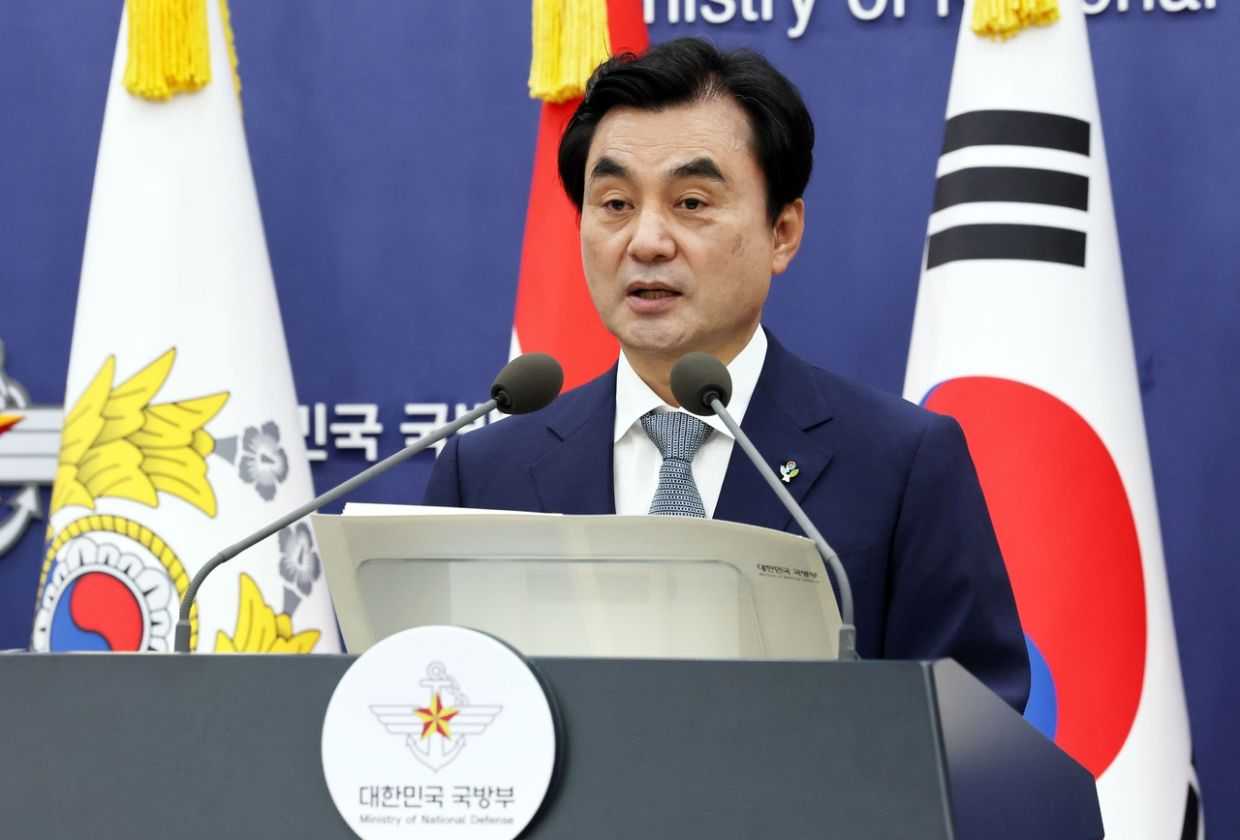
South Korea is undertaking a fundamental restructuring of its unmanned aerial capabilities, announcing plans to acquire more than 20,000 low-cost drones and expedite deployment of the K-Lucas long-range loitering munition system. Defence Minister Ahn Gyu-back outlined the sweeping initiative on Friday, emphasising that inexpensive drone proliferation has irreversibly altered how modern militaries must think about battlefield operations. The strategic pivot reflects Seoul's assessment that future conflicts will be characterised by swarms of affordable, expendable unmanned systems rather than high-cost platforms, forcing a fundamental recalibration of procurement priorities and operational doctrine across the entire defence establishment.
The timing of South Korea's drone initiative is no coincidence. Global military establishments have scrutinised Russia's extensive reliance on budget drones throughout its invasion of Ukraine, documenting how relatively cheap unmanned systems can saturate air defences designed for conventional threats. Similarly, recent tensions between the United States and Iran have underscored how accessible drone technology has become to state and non-state actors alike. For Seoul, these international case studies carry particular urgency given that North Korea has simultaneously expanded its own unmanned aerial arsenal, creating a layered security challenge that encompasses not only military installations but also critical civilian infrastructure and population centres. The North Korean dimension transforms what might otherwise be a routine military modernisation into an existential strategic imperative.
Defence Minister Ahn articulated the scope of transformation candidly, stating that the widespread deployment of low-cost drones has fundamentally reshaped contemporary warfare. The K-Lucas system, representing Seoul's domestically developed response to this challenge, will be capable of executing strategic strikes in future conflict scenarios, positioning it as a cornerstone of South Korea's deterrent posture. The accelerated fielding timeline reflects recognition that technological superiority in unmanned systems has become as critical as traditional air superiority once was. By bringing K-Lucas to operational readiness faster, South Korea aims to maintain a technological edge over North Korean capabilities, which officials assess are developing at an accelerating pace.
The procurement plan encompasses diverse unmanned platforms tailored to specific operational requirements. Short-range reconnaissance drones will enhance intelligence-gathering capabilities, while small loitering munitions provide distributed strike options that complicate adversary air defence calculations. The 20,000-unit acquisition target through 2030 reflects not merely a numerical increase but a wholesale philosophical shift toward expendable, attritable systems rather than high-cost platforms requiring expensive maintenance and personnel infrastructure. This approach carries significant implications for force structure planning, training doctrine, and industrial capacity within South Korea's defence manufacturing sector, which has positioned itself as a global leader in unmanned systems development.
Beyond current procurement, the Defence Ministry has outlined more ambitious long-term capabilities under development. Next-generation artificial intelligence-powered drone swarms represent the cutting edge of unmanned warfare, potentially enabling autonomous coordination of hundreds or thousands of systems operating across vast geographic areas. Directed-energy weapons, including laser and high-power microwave systems, are scheduled for mid-to-long-term deployment, offering innovative approaches to countering the drone threat itself. These layered defensive capabilities acknowledge that mere proliferation of offensive drones is insufficient without corresponding advances in counter-unmanned systems. South Korea is essentially designing an integrated ecosystem where offensive and defensive unmanned platforms reinforce one another.
Immediate defensive measures will begin next year with deployment of counter-drone systems and small unmanned aircraft defence systems in frontline areas adjacent to the inter-Korean border. These systems will serve as operational testbeds while simultaneously enhancing security in the most strategically sensitive zone on the peninsula. Deputy Defence Minister Kim Hong-cheol emphasised that technological change in unmanned systems occurs at such velocity that traditional military procurement processes have become obsolete. The ministry intends to streamline acquisition timelines by leveraging commercially available technologies, testing them under military conditions, and rapidly fielding successful systems through expedited certification procedures. This approach represents a significant departure from rigid military specifications and lengthy evaluation cycles that historically characterised South Korean defence procurement.
Legislative reforms underpin this accelerated acquisition strategy. By enabling rapid certification of commercially developed technologies, South Korea can compress development cycles from years to months, maintaining technological parity with adversaries who may operate under fewer bureaucratic constraints. The ministry recognises that the most innovative drone technologies often emerge from civilian commercial sectors rather than traditional defence contractors, necessitating regulatory frameworks that can absorb and militarise civilian innovations quickly. For Malaysia and other regional defence establishments observing these developments, South Korea's legislative approach offers a potential model for balancing procurement speed with rigorous capability validation.
Perhaps most striking is South Korea's ambitious personnel development programme targeting 500,000 trained drone operators by some unspecified future date. The military conceptualises drones as a "second personal weapon," suggesting that future service members will routinely operate unmanned systems as naturally as they currently handle rifles. This manpower strategy has profound implications for recruitment, training curricula, and unit-level tactics. It reflects confidence that unmanned systems will become so ubiquitous and user-friendly that mass training is feasible, though it simultaneously reveals expectations regarding the scale of future drone employment in operational environments.
The structural reorganisation of South Korea's drone command apparatus signals confidence in the strategic direction whilst simultaneously addressing recent controversies. Rather than disbanding the Drone Operations Command entirely, the Defence Ministry transformed it into the National Defence Drone Headquarters, removing operational authority and repositioning it as a policy and acquisition organisation. Operational planning and execution transfer to the Army, Navy, Air Force, and Marine Corps, enabling each service to develop doctrine suited to particular operational domains. This distributed approach acknowledges that maritime drone tactics differ fundamentally from air force employment patterns and land force operations. The centralised headquarters retains oversight of capability development and military-industrial coordination, preventing fragmentation whilst encouraging service-specific innovation.
The reorganisation deliberately addresses months of investigation regarding alleged drone incursions over Pyongyang in October 2024 and subsequent allegations of evidence destruction. By removing operational functions from a centralised command, the restructuring reduces the organisational opacity that enabled the previous controversy. Distributing operational authority across established service branches restores traditional command-and-control clarity whilst simultaneously modernising South Korea's drone warfare architecture. For international observers and regional defence establishments, the restructuring demonstrates how military organisations can respond to institutional failures whilst simultaneously advancing technological modernisation objectives.
For Southeast Asian nations monitoring these developments, South Korea's drone strategy holds particular relevance. The region faces its own maritime security challenges, territorial disputes requiring persistent surveillance, and asymmetric threats from non-state actors potentially equipped with unmanned systems. South Korea's emphasis on low-cost procurement models, accelerated civilian-military technology transfer, and distributed operational doctrine offers potential lessons for Malaysian and other regional defence planners considering their own unmanned system acquisitions. The emphasis on training large numbers of drone operators suggests that future conflicts in this region may be characterised by drone saturation rather than platform scarcity, fundamentally altering force planning assumptions.
President Lee Jae Myung's concurrent focus on fostering defence innovation companies further contextualises South Korea's drone strategy within broader industrial policy objectives. The drone initiative simultaneously strengthens military capabilities whilst stimulating the domestic defence and space industries, creating economic multiplier effects. South Korea's defence manufacturers—Samsung, Hanwha, and specialised unmanned systems companies—stand to benefit substantially from the expanded procurement pipeline. This integration of security strategy with industrial policy reflects recognition that sustained military-technological superiority requires robust commercial-defence sector partnerships and continuous innovation ecosystems.
South Korea's unmanned warfare revolution represents far more than incremental capability improvements. The strategy acknowledges that future conflicts will operate under fundamentally different assumptions regarding platform costs, attrition rates, and operational scales. By simultaneously pursuing aggressive drone acquisition, accelerating counter-system development, reforming procurement processes, and restructuring command architecture, Seoul is executing one of the most comprehensive military modernisation programmes in recent memory. For the region, the success or failure of this ambitious transformation will likely influence how other nations approach their own unmanned systems strategies in an era when drone technology has become as democratised and strategically consequential as aircraft once were.

