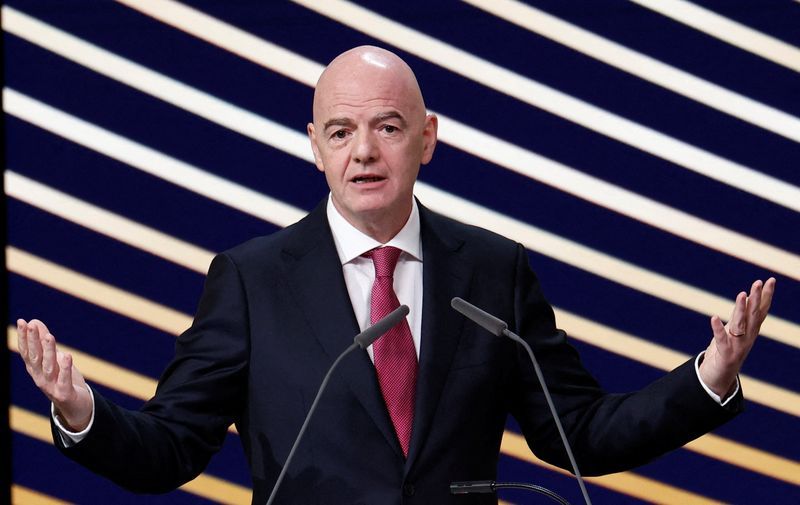
Gianni Infantino's path to retaining the FIFA presidency increasingly hinges not on appeasing Europe's traditional football powers but on leveraging financial relationships with smaller and emerging nations that have become deeply dependent on the world governing body's development support. The Swiss administrator confronts unprecedented pressure following his failed attempt to bring private equity investment into the World Cup competition, which prompted UEFA and CONCACAF to issue no-confidence declarations and triggered Wales's formal withdrawal of backing. Though Infantino confirmed his candidacy for a fourth term at April's Congress, the political crisis may force a reckoning well before the scheduled election.
The opposition has calculated that removing Infantino before the regular election is technically feasible. If 20 percent of FIFA's 211 member associations submit written requests, an Extraordinary Congress must be convened within three months, allowing alternative candidates to mobilise support. UEFA, representing 55 European nations that have already voted unanimously to boycott FIFA tournaments should the equity sale proceed, possesses sufficient votes to trigger such a congress unilaterally. Yet converting that procedural advantage into an outright majority capable of deposing Infantino presents a substantially different challenge, one that extends beyond Europe's football establishment.
The mathematical reality of FIFA's governance structure fundamentally shapes the political equation. All 211 member associations, regardless of their football infrastructure, wealth, or competitive status, command identical voting power. This democratic principle, unusual among international sports federations, transforms small island nations and emerging African and Asian federations into potentially decisive political players. Nations like Bhutan and Vanuatu, which have never qualified for a World Cup and operate with minimal professional football ecosystems, occupy the same voting position as France, Spain, or England. This structural quirk creates an unusual calculus where Infantino's political fortunes may depend less on winning back traditional powerhouses than on maintaining support among football's periphery.
Infantino has strategically cultivated relationships with smaller nations through an unprecedented financial commitment. During the 2023-26 World Cup cycle, FIFA member associations became eligible to claim up to three million dollars for football development initiatives, representing a one million dollar increase from the previous quadrennial period. While such sums appear negligible to wealthy federations operating professional domestic leagues, they represent transformative resources for smaller nations with fragile football infrastructure. The allocation methodology has effectively created a constituency of smaller nations whose football development programmes depend substantially on FIFA's patronage, making them potentially resistant to calls for Infantino's removal.
Vanuatu exemplifies how this financial architecture translates into political loyalty. The Pacific island nation, with a population of approximately 340,000, ranks 160th globally yet secured representation on FIFA's Executive Council as one of eight vice-presidents for its football association leader Lambert Maltock. More significantly, FIFA provided the nation with a 4.15 million dollar development grant specifically designated for constructing a 6,500-seat stadium in the capital Port Vila, completed in 2022. For a small developing nation, such investment proves transformative. Brian Kaltak, Vanuatu's first professional player now competing for Perth Glory in Australia, directly credits Infantino's leadership with expanding opportunities for emerging footballing nations. His assessment reflects a genuine sentiment among smaller federations that view the FIFA president's patronage as essential to their competitive development.
This pattern replicates across Africa, Asia, the Caribbean, and the Pacific. FIFA development grants have financed training facilities, gymnasium infrastructure, coaching programmes, and tournament participation that national associations would otherwise lack resources to provide. Countries across these regions have experienced genuine capacity-building through FIFA's allocation system, creating constituencies grateful for Infantino's administration. The financial dependency is real rather than illusory; many smaller nations genuinely cannot sustain competitive football programmes without international governing body support. When confronted with calls to vote against Infantino, representatives from these nations must weigh FIFA's material support against abstract governance concerns.
Yet this financial relationship simultaneously reflects a structural vulnerability in FIFA's governance model that critics argue has fostered institutional stagnation. The funding apparatus functions essentially as a system wherein financial patronage effectively purchases political support, creating difficulty in assembling coalitions capable of challenging incumbent leadership. Opponents contend that by distributing substantial resources to smaller nations, FIFA leadership simultaneously constructs insulation against internal accountability mechanisms. The private equity proposal itself reportedly targeted smaller nations as beneficiaries, suggesting Infantino anticipated their political utility in justifying controversial reform initiatives.
The mathematical arithmetic of an extraordinary congress creates particular challenges for anti-Infantino forces. Even if all UEFA member associations vote to remove him, that represents only 26 percent of FIFA's total membership. Building a majority requires compelling additional federations to vote against an administrator who has directly funded their football programmes. African federation members, which constitute nearly 25 percent of FIFA membership, represent a critical swing constituency. Many African nations have received substantial FIFA development support under Infantino's tenure. Similarly, Asian federations, while somewhat more independent in their voting patterns, include numerous smaller nations with similar financial dependencies.
The situation presents Malaysia and other Southeast Asian nations with a particular perspective relevant to the unfolding FIFA governance crisis. Southeast Asian federations occupy an intermediate position, neither part of Europe's traditional establishment nor among football's most marginalised nations. Malaysia's position as a moderately developed football market with evolving professional infrastructure places it in dialogue with both European perspectives on governance standards and the practical concerns of smaller neighbours regarding development support. How Malaysian football authorities view the Infantino question may influence neighbouring federations and contribute to the broader regional alignment that determines FIFA's political future.
Infantino's strategy appears focused on consolidating smaller-nation support while attempting damage control with major European federations. His confirmation of candidacy for a fourth term signals determination to proceed despite mounting criticism, while simultaneous diplomatic efforts may seek to convince European confederations that the private equity proposal was simply misunderstood rather than fundamentally flawed. The coming months will reveal whether European federations pursue the extraordinary congress option or whether behind-the-scenes negotiations produce compromises restoring confidence. Meanwhile, smaller nations like Vanuatu face genuine uncertainty regarding FIFA's future direction and whether continued patronage will flow regardless of Infantino's ultimate fate.
Ultimately, the FIFA succession question illustrates how democratic institutions with equal voting across highly unequal constituencies create paradoxical outcomes. Infantino's political survival may ultimately be determined not in European boardrooms but in capital cities across Africa, the Pacific, and Asia, where football administrators must balance the immediate financial realities of their programmes against broader concerns regarding FIFA governance. This distributes genuine power to nations that rarely exercise meaningful influence in international football affairs, creating both opportunity and instability. The resolution will establish precedent for how FIFA addresses governance challenges when constituencies have fundamentally different stakes in institutional reform.

