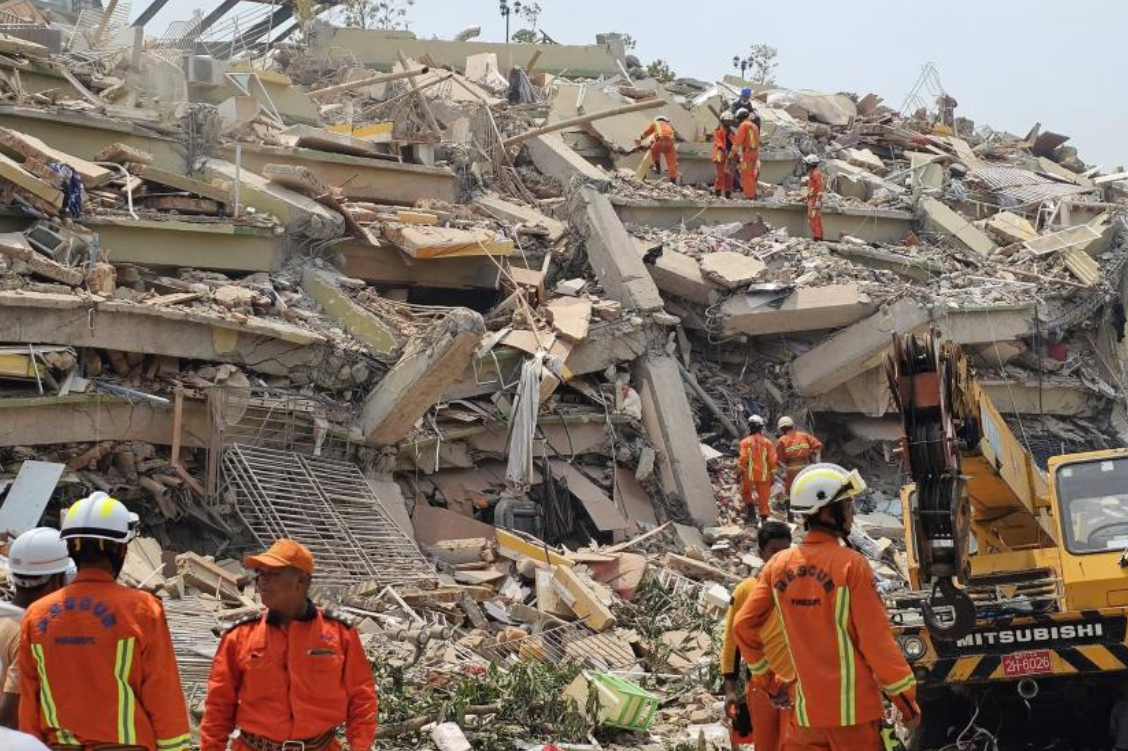
The owner of Sky Villa Condominium in Mandalay has been sentenced to five years imprisonment with hard labour by the Aungmyaythazan Township Court following a prolonged legal process stemming from the catastrophic collapse of the building during a major earthquake. U Naing Htun Lin received the conviction under Section 304-A of the Penal Code, which addresses criminal negligence, according to court records and sources familiar with the case proceedings.
The legal saga began when charges were formally filed against U Naing Htun Lin on February 10 at the Aungmyaythazan Township Court. Initially, he was permitted to post bail and continue his trial while remaining free, a standard practice in many jurisdictions to allow defendants to prepare their defence outside custody. However, the trajectory of the case shifted dramatically when the court revoked his bail on March 17, effectively remanding him into custody for the duration of the trial. This decision typically reflects judicial concerns about flight risk or the severity of the charges involved.
The original investigation commenced at the No. (1) Area Police Station in Aungmyaythazan Township before being escalated to court proceedings. The Special Investigation Department played a central role in the prosecution, with U Zaw Moe Aung serving as the staff officer and acting plaintiff in the matter. On June 23, the court delivered its verdict, imposing the five-year sentence with hard labour upon finding U Naing Htun Lin culpable under the criminal negligence provisions of Myanmar's Penal Code.
The Sky Villa condominium was an 11-storey residential building situated on 60th Street between 21st and 22nd Streets in Aungmyaythazan Township. When the earthquake struck Mandalay, the structure underwent catastrophic collapse, becoming one of the deadliest casualties of the disaster. Recovery efforts at the site yielded more than 200 bodies, positioning it among the most severe building failures attributable directly to the earthquake's seismic forces. The sheer scale of loss raised critical questions about construction standards and building safety compliance in the region.
The conviction does not represent the final chapter of this legal matter. Court officials confirmed that the Aungmyaythazan District Court has requested the case file for review under Criminal Revision Case No. 39Ka/2026, indicating that higher judicial review is underway. Additionally, both the prosecution and defence teams are actively pursuing appeals and revision proceedings, suggesting that contentious legal questions remain unresolved and that the verdict may yet be modified through the appellate process.
U Naing Htun Lin's company, NTL Construction Company, had been responsible for constructing the Sky Villa condominium, placing him in a position of direct responsibility for the building's design, materials, and construction quality. The failure of the structure during the earthquake invited scrutiny regarding whether proper engineering standards were followed, whether materials met specifications, and whether the building incorporated adequate seismic safety features. These questions form the foundation of the criminal negligence charge, which presumes that failure to exercise reasonable care in construction resulted in preventable deaths.
In the aftermath of the collapse, efforts were made to provide some measure of restitution to grieving families. Daw Thet Thet Khine, the wife of U Naing Htun Lin and managing director of NTL Construction Company, was part of a group that organised three separate memorial ceremonies at a monastery pavilion on 19th Street. During these events, the group publicly apologised to the families of victims, acknowledging the tragedy and its profound human cost. The group distributed compensation of 10 million kyats to each family that lost a member in the collapse, representing an attempt at financial reconciliation despite the irreplaceable nature of the loss.
The Sky Villa case carries broader implications for Myanmar's construction and safety oversight sectors. Building collapses during natural disasters often reveal systemic weaknesses in regulatory frameworks, inspection procedures, and enforcement mechanisms. This case represents a rare instance of criminal accountability being pursued in relation to such a tragedy, potentially setting a precedent for how Myanmar's judicial system addresses corporate responsibility in matters of public safety and structural failure.
For Malaysian and Southeast Asian observers, the Sky Villa case underscores the importance of rigorous building codes and enforcement mechanisms that remain consistent even in countries with developing regulatory infrastructure. The earthquake itself, while a natural phenomenon beyond human control, exposed vulnerabilities in how buildings were designed and constructed to withstand seismic activity. Southeast Asian nations, many of which operate in seismic zones or face typhoon and flooding risks, must continually assess whether their construction standards adequately protect residents from predictable hazards.
The conviction also highlights questions about where responsibility ultimately lies when disaster strikes. Whether accountability should fall primarily on the developer, the regulatory authorities who approved construction, the consulting engineers who designed the structure, or some combination of these parties remains debated in legal systems throughout the region. U Naing Htun Lin's case establishes that individual developers can face serious criminal consequences, though critics may question whether the five-year sentence adequately reflects the magnitude of loss or whether systemic regulatory failures share equal culpability.

