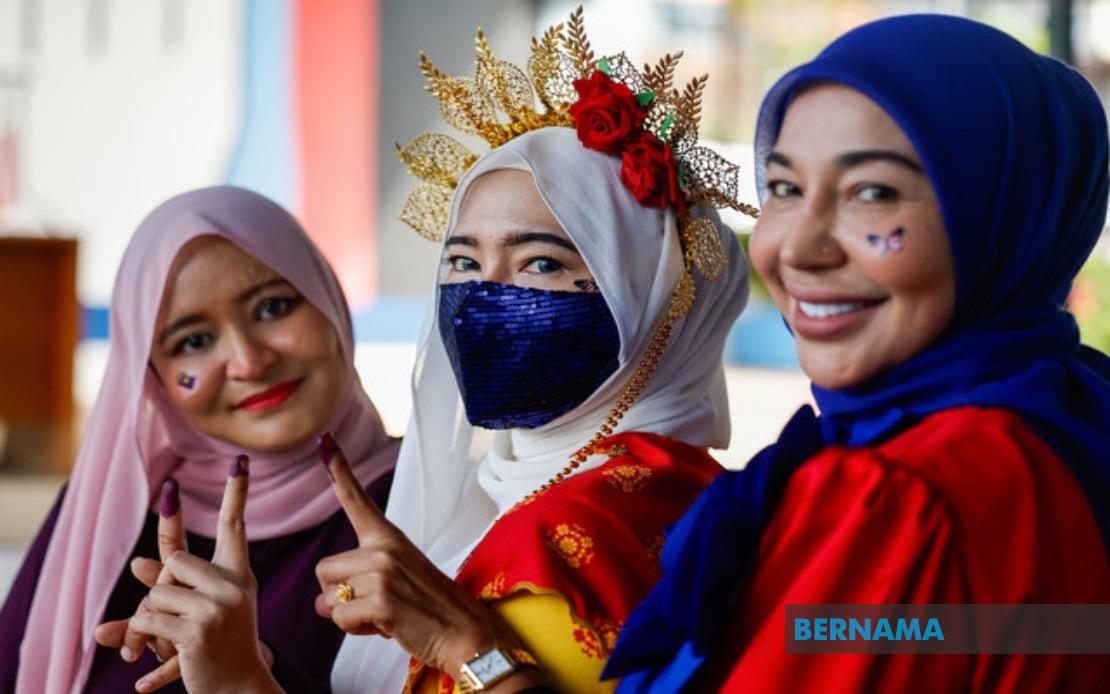
Elections took on a distinctly patriotic hue at Sekolah Jenis Kebangsaan Cina Chung Hua in Rantau today when three sisters arrived dressed entirely in Malaysian flag-themed attire, transforming their voting experience into a colourful display of national spirit. The coordinated appearance by the Basiron siblings captured the attention of fellow voters and election officials alike, demonstrating how personal fashion choices can amplify the ceremonial significance of participating in democratic processes. Their decision to blend civic engagement with the approaching National Day celebrations illustrated a growing trend among Malaysian voters seeking to infuse traditional occasions with heightened symbolic meaning.
Zamzarina Basiron, the eldest of the three at 45 years old, served as the catalyst for the group's fashion statement. A teacher by profession, Zamzarina explained that her annual tradition of assembling Jalur Gemilang-themed outfits for National Day festivities naturally extended to the electoral process. The timing proved fortuitous, with the Negeri Sembilan state election coinciding with the opening days of August, a month synonymous with national celebration and remembrance. Recognising this convergence, Zamzarina saw an opportunity to encourage her siblings to participate in what she described as brightening the atmosphere at the polling station, transforming a routine civic obligation into a visible expression of communal pride.
The preparation behind the sisters' coordinated look revealed considerable effort and planning. Bahirah Basiron, the middle sibling aged 39 and an established food entrepreneur, worked alongside her sisters over approximately two days to assemble their ensembles. The outfits themselves incorporated multiple layers of patriotic symbolism through carefully selected Jalur Gemilang-themed accessories that complemented their flag-coloured clothing. This meticulous attention to detail suggested that the sisters viewed their appearance not merely as a fashion statement but as a deliberate and thoughtful contribution to the day's events. Their commitment to achieving a cohesive visual effect demonstrated how collective family action could amplify individual statements of patriotism.
Nadzifah Basiron, the youngest of the trio at 36 years old, encountered logistical challenges that prevented her from assembling a complete patriotic outfit. Working commitments as a staff member at Hospital Rembau left insufficient time for her to source and prepare appropriate attire. Nevertheless, she demonstrated her solidarity with her sisters' initiative by appearing at the polling centre to lend moral support and participate in the collective family effort. Her presence, despite not wearing the themed outfit, underscored how even partial participation in community expressions of national identity can reinforce family bonds and shared civic values across varying circumstances.
The Negeri Sembilan state election proceeded with robust participation throughout the day, drawing from a substantial electoral base spread across the state. Election authorities had registered 859,760 voters eligible to cast ballots, a figure that encompassed both standard polling day voters and 7,391 postal voters who had arranged to vote in advance. This comprehensive registration reflected the extensive administrative machinery mobilised to facilitate democratic participation across diverse demographics and geographical locations. The inclusion of postal voting mechanisms acknowledged the practical constraints faced by certain voter segments, ensuring that professional obligations and geographical displacement did not preclude meaningful electoral participation.
State election management structures had established ambitious targets for voter participation, projecting a turnout of between 72 and 75 per cent. These projections reflected expectations that a strong majority of registered voters would exercise their franchise, suggesting sustained public engagement with state-level governance decisions. The preliminary election results were scheduled for release by 10 pm on election day, with comprehensive final tallies anticipated before midnight. This expedited reporting timeline prioritised rapid dissemination of democratic outcomes while maintaining rigorous counting procedures, allowing the Negeri Sembilan electorate to receive authoritative results within the same calendar day.
The appearance of the Basiron sisters at the Rantau polling centre represented a microcosm of how ordinary Malaysians contextualise electoral participation within broader national observances. By consciously linking voting day to the imminent National Day celebrations, the sisters positioned their individual act of voting as an element within a larger seasonal landscape of national remembrance and pride. This integration of personal civic actions with national calendars reflects how ritual and collective memory shape individual behaviour in democratic societies. Their voluntary decision to enhance the visual and symbolic tenor of the polling station suggested that voters increasingly perceive electoral participation as an opportunity for affective expression rather than merely a bureaucratic requirement.
The location of the polling centre at a Chinese vernacular school in Rantau also carried significance within Malaysia's diverse educational and community landscape. Such schools serve as important institutional anchors within their respective communities, hosting a range of civic activities alongside their primary educational missions. The deployment of Sekolah Jenis Kebangsaan Cina facilities for electoral purposes reinforced the inclusive character of Malaysian democratic processes, which routinely utilise existing community infrastructure to facilitate voter participation. The choice of such venues acknowledges the role that diverse community institutions play in sustaining democratic participation across ethnic and linguistic boundaries.
For the broader Malaysian electorate, the Negeri Sembilan state election represented an important moment for democratic renewal within a single state, yet also contributed to evolving patterns of political participation and voter engagement across the peninsula. State elections increasingly attract organised and enthusiastic voter participation, with growing numbers of citizens recognising the significance of sub-national governance for local development priorities and resource allocation. The visible enthusiasm demonstrated by the Basiron sisters and other voters reflected this expanding appreciation for electoral processes beyond federal-level politics, suggesting that Malaysian democracy continues to deepen as voters engage more actively with governance at multiple administrative levels.

