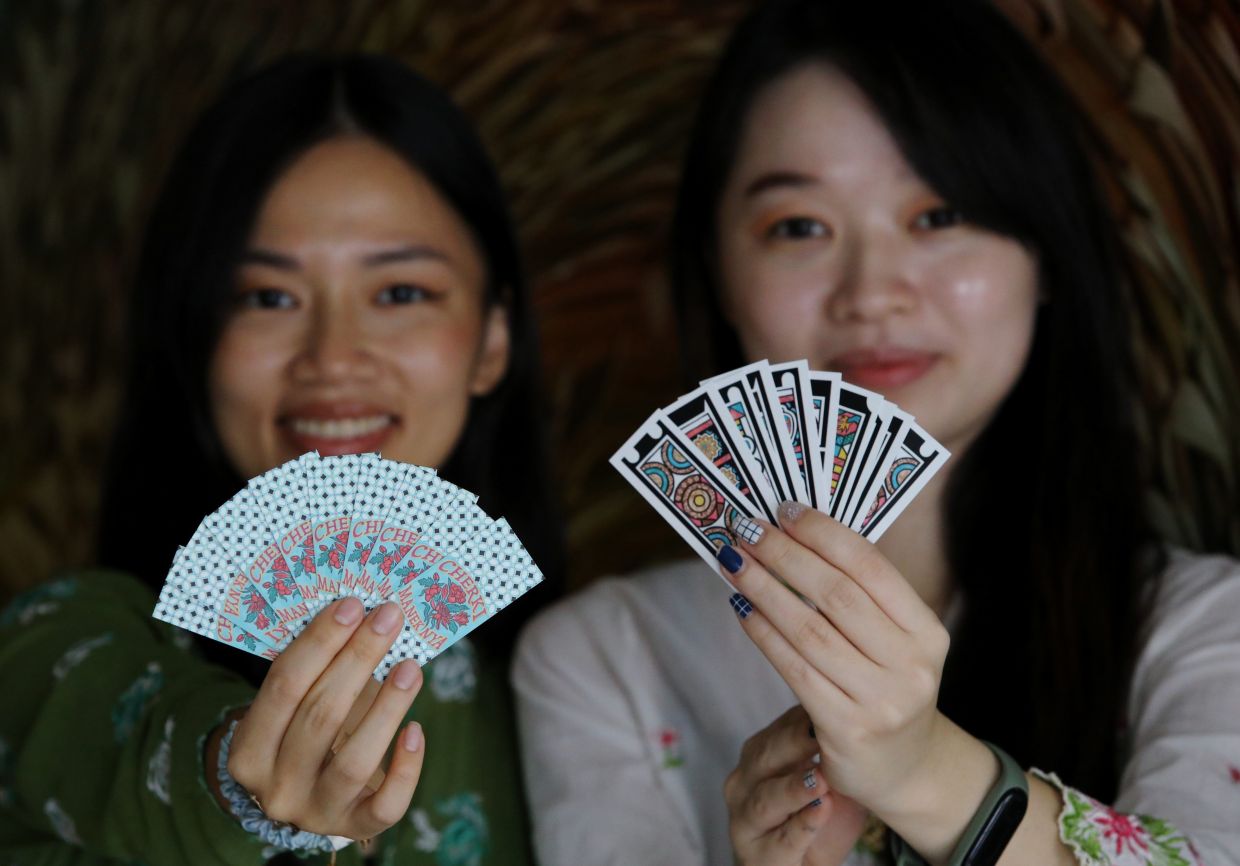
Two Melaka-born sisters are attempting to rescue a fading piece of Peranakan heritage by reimagining Cherki, a traditional card game that has largely vanished from the community's living memory. Lee Swee Lin, 32, and Lee Swee May, 31, have redesigned the game with vibrant colours and contemporary illustrations, moving away from the simple black-and-white designs that characterised original Cherki cards while maintaining the traditional motifs and symbols that define the game's cultural identity. Their initiative tackles a pressing reality facing the Peranakan community: as younger generations drift away from ancestral customs, foundational elements of their cultural heritage risk being forgotten entirely.
Cherki belongs to a broader constellation of Peranakan traditions that have captured public imagination through food, fashion and decorative arts. When people envision Peranakan culture, images typically surface of beaded slippers, baju kebaya, intricate Peranakan tiles, and signature dishes like ayam buah keluak and Nyonya laksa. Yet this card game represents an equally important but largely overlooked dimension of Peranakan identity – one that once occupied households across the community and served as a vehicle for social connection and cultural transmission. The Lee sisters, who operate a Kuala Lumpur-based enterprise focused on Peranakan beaded footwear and decorative pieces, recognised that revitalising Cherki represented a natural extension of their work to preserve and celebrate their heritage.
Their inspiration emerged from deeply personal roots. Swee Lin credits their paternal grandmother, Deo Yeok Kim, as the primary catalyst for the project. Having grown up in their grandmother's Melaka household, the sisters absorbed lessons about Peranakan culture through food preparation, storytelling, language and the quiet daily observance of tradition. Following their grandmother's recent passing, they recognised the profound debt they owed to her knowledge and realised how much of what they understand about their heritage originated directly from her guidance. That recognition crystallised into a mission: the beading techniques their mother and grandmother taught them, the symbols they employ, and the values they embed in their work all carry forward lessons from previous generations. Creating a new version of Cherki became an extension of this intergenerational relay.
The challenge Swee Lin and her sister identified extends well beyond a single game. The Peranakan community faces a structural problem: younger members increasingly lack regular contact with elders who once transmitted cultural knowledge organically. Swee Lin observes that many Peranakans her age and even her mother's generation have lost the ability to play Cherki, suggesting that the game's disappearance accelerated across recent decades as family structures shifted and traditional knowledge-sharing mechanisms weakened. She positions the Cherki revival as a bridge-building exercise, one capable of reconnecting youth to cultural practices that contain embedded stories, traditions and markers of identity. Without deliberate preservation efforts, she warns, the game could vanish entirely, taking with it a distinctive form of cultural expression.
This generational disconnection reflects broader patterns documented in academic research. A 2022 study examining cultural transmission among original and newer Peranakan descendants in Malacca highlighted how younger community members increasingly encounter global pop culture and outside influences that compete for their attention and commitment. The research underscored the necessity of proactive education and cultural awareness initiatives. Lee Yuen Thien, 36-year-old deputy president of Persatuan Peranakan Baba Nyonya Malaysia, the community's principal advocacy organisation, validates this concern. He attributes the cultural drift to pragmatic factors: career demands, time constraints, and the contemporary tendency to deprioritise traditional cultural engagement in favour of modern commitments. PPBNM maintains approximately 3,000 members, though Lee estimates the total Peranakan population nationwide likely ranges between 10,000 and 15,000 individuals.
Demographic and social transformations have accelerated this disconnection. Geographic dispersal represents a significant factor – as Peranakans relocate away from ancestral strongholds in Melaka and Penang, they lose the environmental reinforcement and family networks that historically sustained cultural practices. Additionally, intermarriage and shifting lifestyle patterns have fundamentally reshaped community composition and internal dynamics. The result is a generation of younger Peranakans increasingly distant from traditions their grandparents treated as automatic and daily. However, cultural leaders argue that heritage need not remain static. Tan, manager of the Baba & Nyonya Heritage Museum Melaka, contends that culture must evolve with time while simultaneously ensuring younger generations remain aware of their ancestry. By cultivating consciousness of their heritage, he suggests, the community can revive interest and create pathways for sustained cultural continuity.
Cherki itself carries historical significance extending beyond the immediate Peranakan sphere. The game emerged from Chinese origins – historical records from the Tang Dynasty in the ninth century reference a 'leaf game' – and subsequently travelled along trading routes to Europe by the fourteenth century. Regional variations developed across Singapore, Malaysia, Indonesia and Thailand, with the game acquiring multiple names: Ceki, Chi Kee or Koa. The Malay terminology daun ceki, wherein daun means 'leaf', was subsequently adopted by the Peranakan community, illustrating how the game became naturalised within their cultural vocabulary. This etymological journey reflects broader patterns of cultural exchange and adaptation that characterise Peranakan identity itself.
The original Cherki game follows a structure resembling mahjong, employing two decks of 60 cards featuring 30 distinct patterns repeated twice. These cards divide into three suits – coins, strings and myriads – with values ranging from one to nine, supplemented by three special cards: white flower, red flower and old thousand. Swee May and Swee Lin commenced their research and development work in 2024, collaborating with a modest design team utilising digital tools including Procreate and Adobe Illustrator. Their approach balanced innovation with fidelity: they introduced vibrant colours and contemporary illustrations while scrupulously preserving the game's fundamental essence and traditional structure.
Their redesigned version retains the essential 30-pattern framework but increases the repetition from twice to four times, maintaining the three traditional suits and nine values while replacing the original special cards – white flower, red flower and old thousand – with butterfly, dragon and phoenix. Each value card incorporates distinctly Peranakan symbols laden with cultural resonance: the kantan, a fragrant flower integral to Nyonya cooking; the chupu, traditional porcelain jars employed for serving food; the kerongsang, the jewelled brooch used to fasten the kebaya; and the gelang, bracelets worn by Nyonya women. These design choices embed cultural particularity throughout the game, transforming cards into miniature repositories of heritage.
Simultaneously, the sisters developed clearer instructional materials to lower barriers for new players. Swee May articulates the design philosophy underlying their work: they sought to create a game young people would actively want to play with friends, rather than something confined to history books. By introducing colour and modern illustrations, they aimed to make Cherki visually appealing and immediately engaging. Yet simultaneously, they preserved traditional Peranakan patterns and symbols, ensuring that players connect with the game their grandparents may have enjoyed. This dual mandate – making the game fun and accessible while maintaining its heritage authenticity – represents the core challenge in cultural revitalisation efforts across communities worldwide.
The Lee sisters' project resonates within a wider context of Malaysian and Southeast Asian efforts to preserve endangered cultural practices. As urbanisation, globalisation and economic pressures reshape traditional communities, institutions and individuals increasingly undertake deliberate preservation initiatives. These efforts extend beyond nostalgic restoration; they represent practical attempts to sustain cultural knowledge systems and transmission pathways that would otherwise atrophy. The Cherki revival demonstrates how contemporary design tools and marketing sensibilities can serve cultural preservation when applied thoughtfully and respectfully. If successful, their initiative could establish a model for revitalising other fading Peranakan practices, demonstrating that heritage need not choose between authenticity and contemporary relevance. For younger Peranakans seeking meaningful connection to their roots, the redesigned Cherki cards offer an entry point – a game their grandparents would recognise, adapted for friends they want to play with today.

