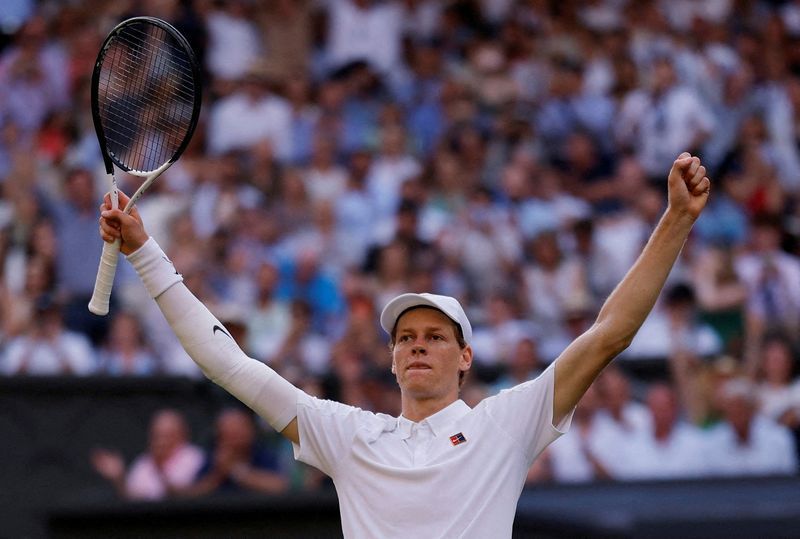
Jannik Sinner returns to the All England Club as defending champion, yet the Italian arrives in circumstances starkly different from twelve months prior. The world number one's aura of near-invincibility has fractured following a stunning collapse at Roland Garros last month, where his 30-match winning streak spanning from February simply evaporated in the second round. Now, as the sport's elite converge on grass for the year's third Grand Slam, Sinner faces the uncomfortable position of proving his remarkable consistency was not a mirage shaped by favourable conditions and a relatively light draw.
The physical demands of competitive tennis became unavoidable during his pre-French Open campaign. Sinner compressed an exhausting schedule into the two months preceding Roland Garros, accumulating matches across multiple surfaces with insufficient recovery periods or structured training time. This relentless pace left him depleted entering the Paris fortnight, a reality that would prove decisive when fatigue compounded technical inconsistencies. Mats Wilander, the seven-time Grand Slam champion, attributes Sinner's withdrawal to straightforward physical exhaustion rather than any fundamental technical fragility. According to Wilander's assessment, the 24-year-old simply lacked the energy reserves required to navigate the tournament's intensity, a condition that rest can remedy.
Wimbledon traditionally presents a contrasting examination compared to the grinding baseline exchanges that characterise clay-court tennis. The faster grass surface compresses rallies, demands more acute anticipation, and rewards aggressive shot-making over defensive consistency. For Sinner, this environment theoretically suits his attacking instincts and aggressive baseline game. His deliberate avoidance of warm-up tournaments before Wimbledon raises intriguing questions about his preparation philosophy. Rather than building confidence through additional competition, Sinner has opted for concentrated training and recovery, suggesting his camp prioritises mental and physical restoration over tournament rhythm. The gamble carries inherent risk; opponents will scrutinise his early performances for any lingering signs of vulnerability.
Singer's primary challenger emerges from an unlikely quarter. Novak Djokovic, at 39 years old and similarly subdued at Roland Garros, represents perhaps the most dangerous contender to Sinner's defence. The Serbian tennis icon's grass-court credentials remain formidable; his movement patterns and return capabilities transform on faster surfaces where rallies shorten and serve-and-volley sequences flourish. Djokovic's pursuit of an eighth Wimbledon title carries profound significance—matching Roger Federer's record represents both a statistical milestone and symbolic closure to a rivalry defining modern tennis. More pressingly, the Belgrade champion remains one Grand Slam title adrift of the standalone 25th major, a psychological target that has eluded him for several years. Andy Roddick, the former world number one, articulates the scenario clearly: with Sinner's recent struggles and Carlos Alcaraz sidelined by injury, Djokovic has perhaps his final genuine opportunity to achieve both objectives simultaneously.
Alexander Zverev arrives at Wimbledon buoyed by uncharacteristic success. The German crushed his long-standing Grand Slam curse by winning Roland Garros in commanding fashion, finally transcending the barrier that frustrated him through his twenties. Zverev's powerful serve translates seamlessly to grass courts, where his delivery becomes a genuine weapon rather than merely a productive advantage. Boris Becker, the six-times major champion and fellow German, has publicly endorsed Zverev as a genuine Wimbledon favourite given the altered landscape. With Alcaraz absent and Sinner's status uncertain, Becker contends that Zverev's serving prowess alone provides foundation sufficient to reach the semi-finals. The 29-year-old's ability to transfer clay-court momentum onto grass will prove critical; momentum carries psychological weight in tennis, particularly during the tournament's opening rounds when confidence-building victories accumulate.
Alcaraz's injury absence fundamentally reshapes the championship's competitive architecture. The Spanish prodigy had established himself as the pre-eminent grass-court player of this era, capturing both the 2023 and 2024 titles through displays of athletic dominance and tactical sophistication. His removal creates a vacuum in terms of raw playing dominance that no single player perfectly fills. This paradoxically expands opportunities for secondary contenders who previously faced insurmountable obstacles against Alcaraz's combination of power, mobility, and precision. The redistribution of viability creates genuine unpredictability, transforming what might otherwise have developed into another coronation narrative into a genuinely open competition.
America's rising contingent warrants serious consideration. Ben Shelton possesses the athletic foundation and powerful shot-making necessary to trouble established rivals, while Taylor Fritz and Frances Tiafoe provide complementary skillsets suited to grass surfaces. These players occupy the margin between genuine contention and credible threat—insufficient to navigate past the elite in regular circumstances, yet suddenly positioned to capitalise on any stumbles from established hierarchies. Flavio Cobolli, the Italian who reached Roland Garros's final before falling short, represents the advancing generation capable of imposing themselves within Grand Slam events. As defending champions age and the elite confront unexpected vulnerabilities, younger competitors inherit opportunities previously foreclosed.
The psychological dimension cannot be underestimated. Sinner must demonstrate that his French Open capitulation represents tactical malfunction under specific circumstances rather than evidence of systematic fragility. Djokovic requires validation that grass courts remain his domain despite approaching 40. Zverev must prove his Roland Garros breakthrough initiated a genuine upward trajectory rather than constituting an outlier. Each protagonist arrives at Wimbledon carrying narrative weight beyond immediate tournament success. The grass courts of south-west London will rapidly clarify whether recent upheavals represent temporary disturbances within an established order or genuine harbingers of competitive realignment.

