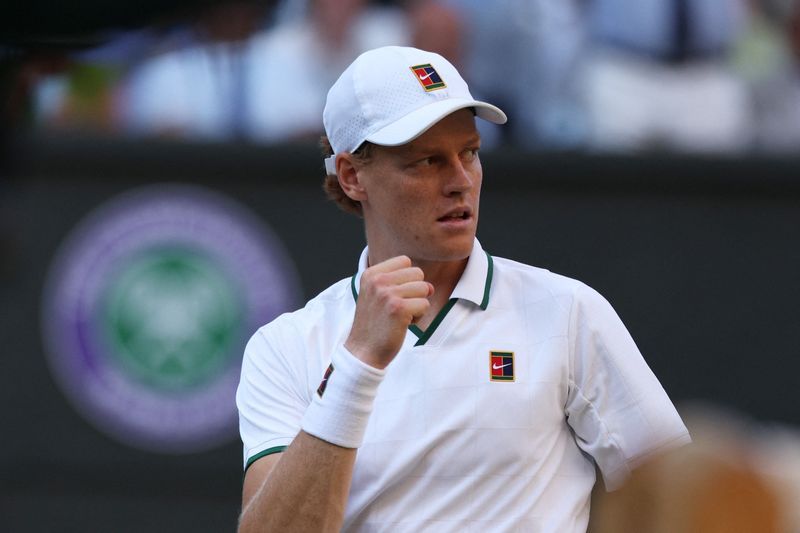
Jannik Sinner underlined his status as one of tennis's most dominant forces by claiming a second consecutive Wimbledon championship on Sunday, fending off a determined challenge from Alexander Zverev in a compelling final that showcased the highest calibre of grass-court tennis. The Italian's 6-7(7) 7-6(2) 6-3 6-4 victory adds a fifth Grand Slam title to his rapidly expanding trophy cabinet and places him among an exclusive group of just ten men in the professional era who have successfully defended the Wimbledon crown. At 24 years old, Sinner has cemented himself as a generational talent, combining explosive power with tactical intelligence to navigate one of the most challenging tournaments on the calendar.
Zverev arrived at the final riding an extraordinary wave of momentum, having claimed his first-ever Grand Slam title at the French Open mere weeks earlier. The German's presence in Sunday's match represented a watershed moment in his career, presenting him with perhaps his best opportunity to capture a Wimbledon trophy and become the first German man to achieve this feat since Michael Stich in 1991. Yet despite this exceptional form and an opening set won through sheer brilliance, Zverev ultimately discovered that maintaining consistency across a full match against Sinner remains a formidable task. The 29-year-old's forehand, traditionally one of tennis's most mercurial weapons, delivered sustained excellence in the opening set but gradually lost its cutting edge as the match progressed.
The opening set crystallised the tightness of the contest, with both players operating at the very limits of their capabilities. Across the first 65 minutes, barely a single break point materialised, with Sinner squandering a crucial opportunity at 4-3 when he uncharacteristically sent a forehand wide. Zverev's serving proved particularly sturdy, yielding just eight points throughout the opener and forcing the match to a tiebreak where precision and nerve would determine the outcome. In that decisive tiebreak, Zverev reached set point first after a net approach, only to be passed by Sinner's passing shot. The German saved a subsequent set point with an ace and ultimately prevailed when his forehand cracked through the court, snapping Sinner's remarkable run of fourteen consecutive set wins against him.
The psychological implications of losing that opening set became evident in the early games of the second set, as frustration visibly mounted on Sinner's face. Zverev's serve appeared utterly unbreakable during this period, with the German's efficiency preventing the Italian from generating any meaningful pressure. However, the turning point arrived in the second set's tiebreak, where Sinner executed a tactical shift and elevated his intensity to force a level match. This tiebreak victory represented more than a statistical reset; it demonstrated Sinner's capacity to recalibrate his approach and find answers when conventional tactics fail him. The psychological momentum swing would prove decisive in determining the match's trajectory.
For two hours and 42 minutes, the match remained suspended in perfect equilibrium, with both competitors unleashing thunderous serves and generating phenomenal pace from the baseline. The third set provided the critical juncture, as Zverev earned his maiden break point of the encounter at 3-3 while simultaneously creating the circumstances that would alter the contest's complexion. As Sinner executed an exquisite drop shot, Zverev's footwork betrayed him; attempting to reverse direction along the dusty baseline, he slipped and crashed awkwardly to the turf. Though Zverev assured Sinner he could continue, the tumble visibly unsettled the German both physically and mentally. Where before Zverev had moved with athletic fluidity, he now appeared tentative and constrained.
Sinner capitalised with surgical precision on Zverev's compromised condition, holding serve and then securing the critical break when the German's movement restrictions became increasingly apparent. Frustration boiled over as Zverev hurled his racket across the grass, a rare display of emotional deterioration that underscored the mounting pressure he faced. The fourth set saw Zverev recover some composure and competitive spirit, yet Sinner's form had reached its crescendo by this stage. The Italian broke serve once more to secure a 4-3 advantage, putting himself within touching distance of victory.
Sinner served for the championship in the fourth set, and those concluding moments produced two of the tournament's most captivating rallies, with both players engaged in breathtaking exchanges of power and precision. After three hours and 46 minutes of enthralling competition, Sinner's serve proved ultimately decisive, and he claimed victory to deafening applause. The win extended his already impressive record against Zverev to ten consecutive victories, though this triumph felt qualitatively different given the relentless quality and competitiveness that Zverev brought to every exchange.
Sinner's progression to this repeat championship has not been without obstacles. A second-round collapse at the French Open raised concerns about his mental resilience, and he came dangerously close to a first-round exit at Wimbledon against Miomir Kecmanovic a fortnight earlier. Yet these challenges proved merely temporary setbacks for a player of exceptional character and adaptability. By the tournament's conclusion, Sinner had rediscovered his optimal form, particularly in the semi-final and final where his service game proved virtually untouchable, avoiding service breaks altogether across those two matches. This resilience under pressure and capacity to elevate performance when tournament stakes reach their maximum demonstrates the hallmarks of a true champion.
In victory, Sinner reflected on the profound significance of defending his Wimbledon title, acknowledging the nervousness that accompanied Sunday morning and his awareness that opportunities to claim such coveted trophies cannot be presumed or taken lightly. His measured perspective and expressed gratitude for the quality displayed by both combatants suggested a maturity beyond his years. For Zverev, despite the sting of a fourth Grand Slam final defeat, the German can reflect with considerable satisfaction on a transformative period in his career. At 29 years old, reaching Wimbledon's final represented a breakthrough after four decades of searching for his first major championship, achieved just weeks earlier in Paris. His emergence as a genuine major championship threat, particularly on grass courts, marks a significant development in the sport.
The contest between Sinner and Zverev on Centre Court transcended mere competitive tennis, offering a masterclass in serving strategy, baseline construction, and match-play psychology that will resonate throughout the professional game. Both players demonstrated the technical excellence, physical conditioning, and mental fortitude required to compete at sport's highest level. For Malaysian and Southeast Asian tennis enthusiasts, the match underscored how the contemporary game demands not only raw talent but also the tactical flexibility and resilience to navigate multiple set formats against similarly gifted opponents. Sinner's victory and his now-established position as a multiple Grand Slam champion provides a benchmark for emerging players worldwide seeking to establish themselves among tennis's elite tier.

