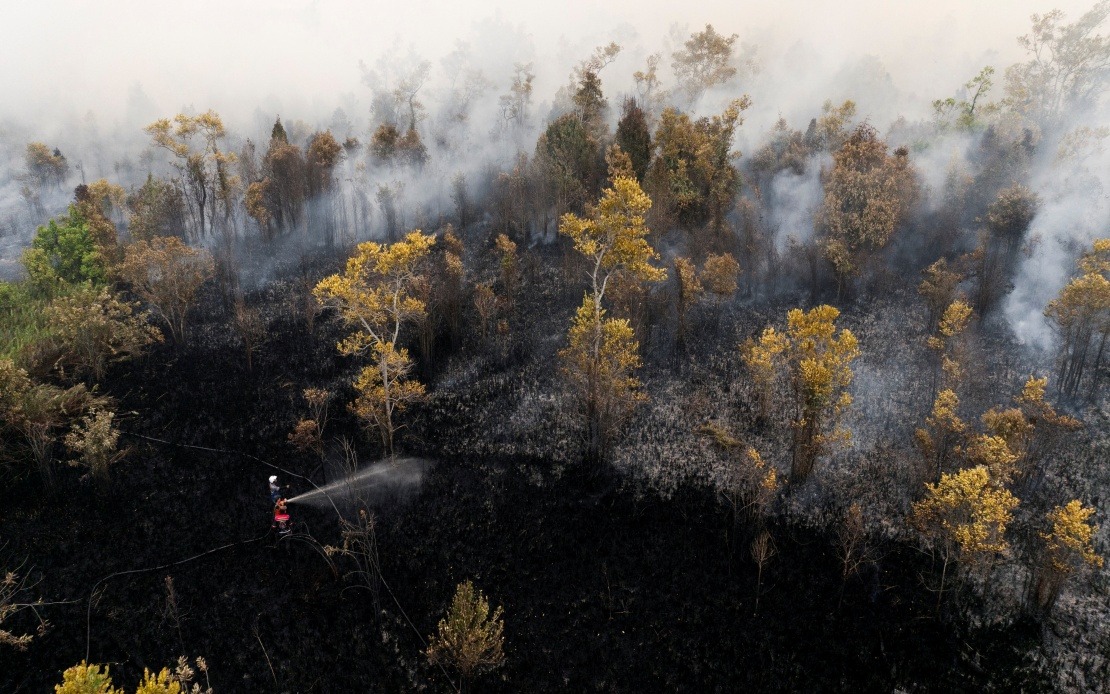
Singkawang Airport in West Kalimantan province was forced to suspend all domestic flight operations on Saturday as thick haze blanketed the region, rendering conditions unsafe for aircraft movements. The airport's management announced the sweeping cancellation through its official social media channels, citing flight safety as the paramount concern and directing affected passengers to liaise directly with their respective airlines for rebooking and alternative arrangements. The closure underscores the intensifying air quality crisis gripping Indonesia's vast Kalimantan region, where uncontrolled forest and land fires have spawned smoke plumes affecting multiple provinces and neighbouring territories.
Located approximately 145 kilometres north of Pontianak, the provincial capital, Singkawang occupies a strategic position in western Indonesian Borneo and typically serves as a crucial transport hub for domestic connectivity in the region. The airport's shutdown represents a tangible disruption to regional commerce and mobility, as travellers now face extended delays and increased costs from rerouting through alternative airports further removed from their intended destinations. For Malaysia, which frequently experiences transboundary haze from Indonesian fires, the closure signals the severity of current conditions and suggests that the smoke phenomenon may intensify its cross-border drift within coming days, potentially affecting air quality across northern Peninsular Malaysia and Sabah.
Indonesia's Transport Ministry has maintained active monitoring of the crisis, with Director-General of Civil Aviation Lukman F. Laisa emphasising that visibility thresholds represent a non-negotiable operational constraint in commercial aviation. His statement reinforced that airlines must strictly adhere to minimum visibility requirements, with safety protocols mandating flight delays, diversions, or outright cancellations when atmospheric conditions fall below prescribed limits. This regulatory stance reflects international aviation standards that prioritise passenger protection over schedule adherence, though it inevitably creates economic friction for airlines, airports, and stranded passengers.
Satellite data from NASA's Terra and Aqua monitoring systems painted an alarming picture of fire distribution across Kalimantan as of Friday evening, detecting 56 high-confidence hotspots in Central Kalimantan, 51 in West Kalimantan, and 19 in South Kalimantan. These figures suggest that the fire crisis spans multiple provinces simultaneously, indicating either widespread accidental ignitions or coordinated land-clearing activities that have spiralled beyond control. The Meteorology, Climatology and Geophysics Agency's air quality assessments confirmed that substantial portions of West and Central Kalimantan were experiencing categorically unhealthy atmospheric conditions, with implications extending throughout the maritime Southeast Asian region.
Government response efforts have mobilised both conventional and innovative firefighting methodologies. Ground-based and aerial operations, including water bombing campaigns, continued operating across affected zones, whilst weather modification protocols stood ready for deployment whenever meteorological conditions aligned favourably. These cloud-seeding initiatives represent Indonesia's attempt to induce precipitation in targeted areas, potentially suppressing fire activity and clearing atmospheric smoke accumulation. However, the reliance on weather modification reflects the limitations of conventional firefighting when confronted with fires operating across vast, difficult-to-access jungle terrain.
Law enforcement dimensions of the crisis have received attention through investigations by Central Kalimantan police, who had identified approximately 12 suspects connected to forest and land fire incidents as of mid-August. Inspector-General Iwan Kurniawan, provincial police chief, confirmed that all fire outbreaks were under investigation to establish causation and identify responsible parties. This prosecutorial approach aims to deter deliberate fire-setting, whether motivated by agricultural land conversion, property disputes, or profit-seeking through unauthorised timber harvesting. The criminal justice response signals government intent to hold perpetrators accountable, though investigation capacity and judicial processing often lag significantly behind the pace of ongoing fire activity.
The Singkawang airport closure carries implications extending well beyond immediate travel disruptions. For Malaysian and regional business communities, such stoppages disrupt supply chains, delay time-sensitive cargo movements, and increase operational costs across sectors reliant on rapid inter-island connectivity. Tourism sectors in both Indonesia and neighbouring countries face booking cancellations and reputation damage as air quality concerns deter leisure travellers. Regional airlines may face revenue pressures from successive cancellations, whilst airport operators experience lost landing fees and commercial revenue during extended closure periods.
From a Southeast Asian perspective, the Kalimantan fires demonstrate the persistent challenge of transnational environmental governance. When Indonesian fires generate haze affecting Malaysian, Singaporean, and Thai populations, diplomatic tensions inevitably arise around land management practices and enforcement capacity. Malaysia's own experience with recurrent haze episodes during the regional dry season has yielded limited progress in enforcing stricter Indonesian land-use regulations, suggesting that even bilateral and multilateral agreements struggle to prevent recurrent crises. The absence of robust cross-border environmental enforcement mechanisms means that communities throughout Southeast Asia remain vulnerable to periodic smoke events originating from uncontrolled land clearing across Indonesian territories.
The broader context involves competing economic pressures within Kalimantan's development landscape. Agricultural expansion, particularly palm oil cultivation, generates substantial revenues for Indonesian provinces and remains politically difficult to restrict despite environmental consequences. When farmers and plantation operators utilise fire as a land-clearing method, they often calculate that potential fines represent acceptable costs relative to the saved expenses of mechanical clearing. This economic calculus persists despite satellite monitoring and police investigations, suggesting that regulatory frameworks require fundamental strengthening through higher penalties, accelerated prosecution, or alternative land-clearing subsidies that reduce fire utility.
Looking forward, the Singkawang closure exemplifies a pattern likely to recur annually unless underlying fire prevention mechanisms strengthen substantially. Climate change patterns are intensifying dry seasons across tropical Southeast Asia, extending fire seasons and amplifying ignition susceptibility in degraded peatlands and secondary forests characteristic of much of Kalimantan. Indonesian authorities face mounting pressure to balance development objectives with environmental protection, whilst regional neighbours increasingly demand tangible improvements in transboundary smoke management. For Malaysian observers, the crisis underscores the necessity of maintaining preparedness for recurrent haze events, including healthcare system capacity for respiratory illness spikes and public communication strategies addressing air quality impacts.

