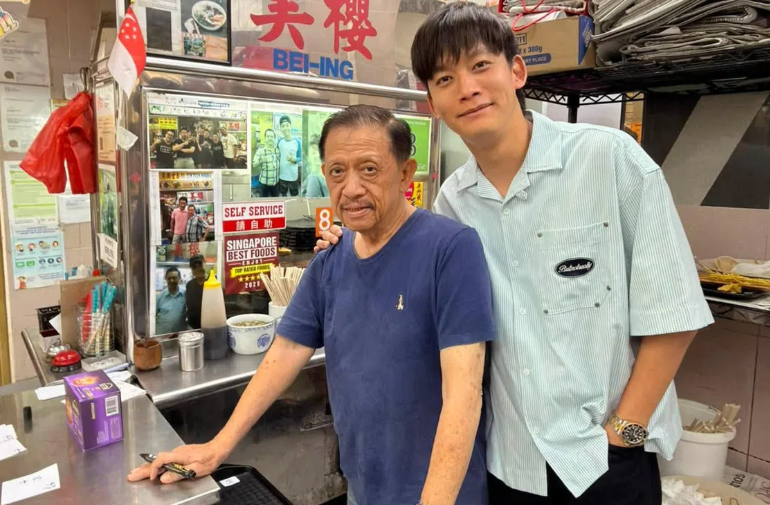
Singaporean actor Noah Yap has pushed back sharply against online detractors who accused him of leveraging a visit to an injured elderly hawker as a calculated bid for media attention and public prominence. The criticism emerged after Yap shared details of his encounter with the shopkeeper on social media, with some netizens contending that his gesture was transparently self-serving rather than genuinely motivated by concern.
One online commenter specifically alleged that Yap had orchestrated the visit to "show concern and gather publicity," characterizing the actor as a savvy operator who was keen to occupy the spotlight ahead of rivals in the entertainment industry. The insinuation stung enough for Yap to compose a detailed rebuttal, which he posted across his social media platforms to set the record straight about his intentions and motivations.
Central to Yap's defence is a longstanding personal relationship with the hawker that predates any potential benefit from publicizing his visit. Yap emphasized that he has patronized Bei-Ing Wanton Noodle, the stall in question, for more than two decades—a stretch of loyalty that commenced during his primary school years and has continued into adulthood. This sustained customer history undercuts the suggestion that his involvement was opportunistic; rather, it suggests a genuine bond had already been established between the two men.
Yap recounted how Yeo, the elderly stall owner, and his family had consistently shown interest in Yap's life whenever he stopped by for a meal, with the hawker affectionately referring to having witnessed Yap mature from childhood into adulthood. Such exchanges are typical of the informal but meaningful relationships that develop between regular patrons and small-business owners in Singapore's dense urban environment, where food establishments often function as social anchors within their neighborhoods.
The broader incident that triggered Yap's social media involvement occurred on August 15 when a confrontation between Yeo and a younger man escalated into physical violence at Roxy Square. According to Yeo's account, the sequence of events unfolded when the elderly hawker was walking past a table after shuttering his stall for the day. He noticed a young child at the table, whom he found appealing, and made what he believed to be a gesture of paternal kindness by gently patting the child on the head—a casual act commonplace in many Asian cultures but one that proved fatally misinterpreted by the girl's father.
The interaction rapidly deteriorated when the child's father confronted Yeo, apparently incensed by what he perceived as inappropriate contact with his daughter. Video footage that subsequently circulated online appeared to document the man forcibly restraining Yeo before pushing him forcefully to the ground, an action that caused physical injury to the elderly hawker. Singapore's police confirmed they had received a report regarding the altercation and confirmed that investigations into the matter are proceeding, suggesting the matter has entered the formal criminal justice system.
Yap determined to visit Yeo the day following the incident, on August 16, to check on his wellbeing and provide whatever support he could. Upon arrival at the hawker's location, Yap discovered Yeo to be in surprisingly robust spirits considering the trauma of the previous day, though the elderly man had initially resisted seeking professional medical evaluation for his injuries—a reluctance not uncommon among older hawkers in Singapore who often prioritize work continuity over personal health concerns.
Yap's subsequent decision to document his visit by posting about the encounter on social media stemmed not from a desire for acclaim but rather from a wish to elevate public awareness of the incident and its circumstances, according to his own account. This explanation highlights a subtle but important distinction between seeking attention and attempting to amplify an issue of genuine community concern. The visibility generated by Yap's post arguably benefited not himself but rather Yeo, whose story might otherwise have faded into obscurity beyond the immediate viral moment.
In his written response to critics, Yap employed casual colloquial language to underscore his irritation with the accusations, remarking pointedly that he lacked the leisure time that his detractors appeared to possess. This vernacular flourish conveyed both genuine exasperation and an implicit critique of those who had time to speculate about celebrity motivations rather than engage in substantive community participation themselves.
The substance of Yap's message extended beyond merely defending his own actions. He used the platform to underscore a broader ethical principle, emphasizing unequivocally that "violence is never the answer" in situations of conflict or misunderstanding. Furthermore, he advocated for a cultural shift toward greater collective kindness and consideration, reflecting values that resonate deeply within Singapore's multicultural society where diverse populations must navigate close quarters and frequent everyday interactions.
The incident and its aftermath illuminate how social media has transformed celebrity interactions with ordinary community members, blurring the traditional boundaries between private gestures and public performance. For Malaysian and broader Southeast Asian readers, the episode serves as a cautionary tale about the speed with which digital discourse can weaponize good intentions, transforming compassionate acts into fodder for cynical interpretation without adequate context or understanding of underlying relationships.

