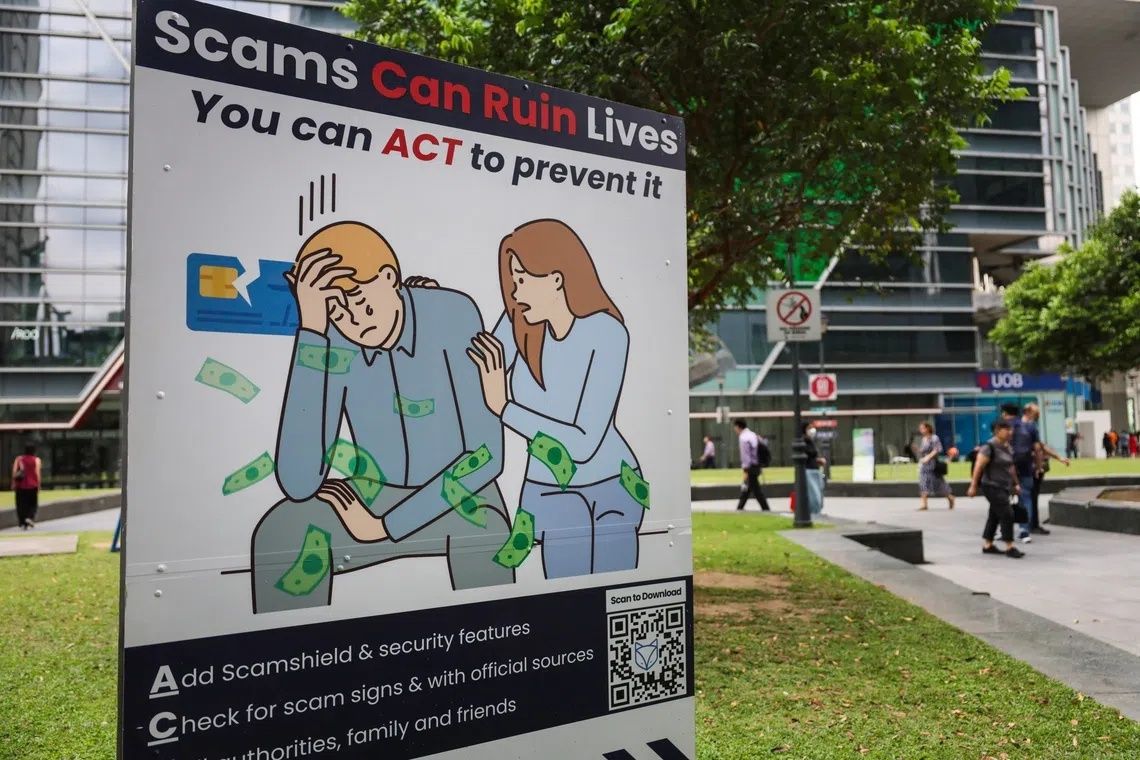
Singapore's government has moved to close a significant loophole in its anti-scam arsenal by introducing sweeping new legislation that criminalises the creation and trading of online accounts used for fraudulent purposes. The Scams (Countermeasures) and Other Matters Bill, tabled in Parliament on Tuesday, marks a major escalation in enforcement against criminal syndicates that have transformed digital platforms into conduits for large-scale fraud operations. While Singapore already possesses laws targeting money mules and those peddling SIM cards and Singpass accounts for criminal purposes, the new framework extends protection to online ecosystems where scammers have found fertile ground—Facebook, Instagram, WhatsApp, Telegram, TikTok and Carousell among them.
The legislation makes it an offence to supply, possess, receive or provide personal information used to establish fraudulent accounts on any digital service. Those convicted of operating as online account mules face fines reaching S$10,000, imprisonment of up to three years and 12 strokes of the cane. This represents the first time Singapore law explicitly criminalises the entire supply chain of account creation for scams, addressing what law enforcement officials have identified as a critical vulnerability in the current system. The move reflects a growing sophistication among scammers who have realised that compromised online accounts offer greater anonymity and are harder to trace than traditional financial infrastructure.
The bill's scope extends beyond individual mules to impose far stricter accountability on digital service providers themselves. Platforms that fail to comply with anti-scam codes of practice and government implementation directives now face maximum fines escalating from S$1 million to S$10 million. For continuing violations, daily penalties have been raised from S$100,000 to S$300,000. These dramatic increases signal Singapore's determination to pressure technology companies into adopting robust preventive measures rather than merely responding to complaints after harm has occurred. Meta, which operates Facebook and Instagram, has already received two implementation directives—in September 2025 and January 2026—requiring the company to strengthen its anti-scam mechanisms, with police reporting that such measures have successfully reduced impersonation scams on the platform.
The scale of Singapore's scam problem underscores the urgency of this legislative response. Fraudulent schemes accounted for three of every five police reports filed during 2025, with victims losing a staggering S$913.1 million to scammers in that year alone. Even more alarming, government official impersonation scams—a relatively niche scam category—more than doubled from 1,504 cases in 2024 to 3,363 in 2025. Cumulatively, scams have drained more than S$4 billion from Singapore's population since 2019, making this not merely a law-and-order issue but an economic one affecting consumer confidence and financial stability. The scale has prompted police to acknowledge that traditional manual review processes are fundamentally inadequate, as scammers now operate with industrial efficiency, establishing vast networks of fraudulent accounts and advertisements within hours.
Recognising that many modern scam networks employ artificial intelligence to automate their operations, the bill empowers police to issue anti-scam directives through computer programs and AI-driven systems. This technological arms race represents a philosophical shift in law enforcement—moving from reactive, human-dependent investigation to proactive, algorithmic detection and disruption. Police have pledged that safeguards will ensure such automated systems operate with accuracy and fairness, though the bill itself does not elaborate extensively on these mechanisms. The ability to match the pace and scale of AI-enabled scams offers Singapore a potential asymmetric advantage in future enforcement efforts.
Three new orders introduced in the legislation represent a structural innovation in how authorities will combat fraud networks. A disclosure order compels service providers to furnish information about specified accounts and scam-related activities, while an account disabling order allows police to force platforms to deactivate accounts for up to 30 days, with the possibility of a single extension of equal duration. These measures are designed to feed into Singapore's developing National Scams List, a real-time intelligence-sharing mechanism that will enable automatic transmission of culprit identities, bank accounts, phone numbers and compromised online accounts between government agencies and private sector partners such as banks. The philosophy underlying this approach is clear: speed is paramount. By halting the movement of stolen funds and disabling accounts before money can be transferred, authorities hope to break scam syndicates' operational cycles.
A third instrument introduced is the service limitation order, which permits police to instruct service providers to restrict access to financial, telecommunications and Singpass services for individuals suspected of involvement in scams. These restrictions can extend for up to three years. The order formalises and strengthens a framework already rolled out informally since October 2025, which has seen 1,423 money mules, 1,439 SIM card mules and 53 corporate mules placed under restrictions as of June 2026. Previously, compliance with this framework operated largely on a voluntary basis or through informal sector-specific pressure. The new legislation transforms it into a legally binding instrument, eliminating the ambiguity that may have previously encouraged non-compliance or created opportunities for jurisdictional inconsistency.
For Malaysia and other Southeast Asian economies facing similar scam epidemics, Singapore's legislative approach offers both a blueprint and a cautionary tale. The expansion of criminal liability to encompass online account provision directly addresses a loophole that scammers exploit across the region, often establishing accounts in one jurisdiction and targeting victims in another. The significantly heightened penalties—both for individuals and for platform operators—signal that authorities now view scam facilitation as a serious crime warranting substantial sanctions rather than merely a regulatory infraction. The integration of AI-driven enforcement mechanisms also presages a broader regional trend toward technology-enabled law enforcement, though questions remain about privacy implications and the potential for algorithmic bias in enforcement.
The bill's emphasis on service provider accountability is particularly significant given that many digital platforms operate at continental scale. By requiring Facebook, Instagram, TikTok and Carousell to implement specific anti-scam measures or face punitive fines, Singapore is asserting that technology companies bear substantial responsibility for criminal activity occurring on their platforms. This represents a middle ground between two extremes—outright platform bans, which some countries have attempted, and a purely hands-off approach that treats platforms as mere conduits. Whether this model will prove effective depends substantially on whether companies view the financial penalties as genuinely consequential versus simply a cost of doing business.
As scam syndicates have increasingly internationalised their operations and sophisticated their methods, Singapore's legislative response demonstrates that conventional criminal law designed for an earlier era of fraud has become inadequate. The bill acknowledges this by creating novel enforcement instruments specifically calibrated to the dynamics of digital crime—rapid account creation, immediate monetisation, cross-border money flows and AI-assisted scaling. Whether the legislation ultimately proves effective will depend on consistent implementation, adequate enforcement resources and the degree to which regional countries coordinate to prevent scammers from simply relocating operations to jurisdictions with lighter regulatory regimes.

