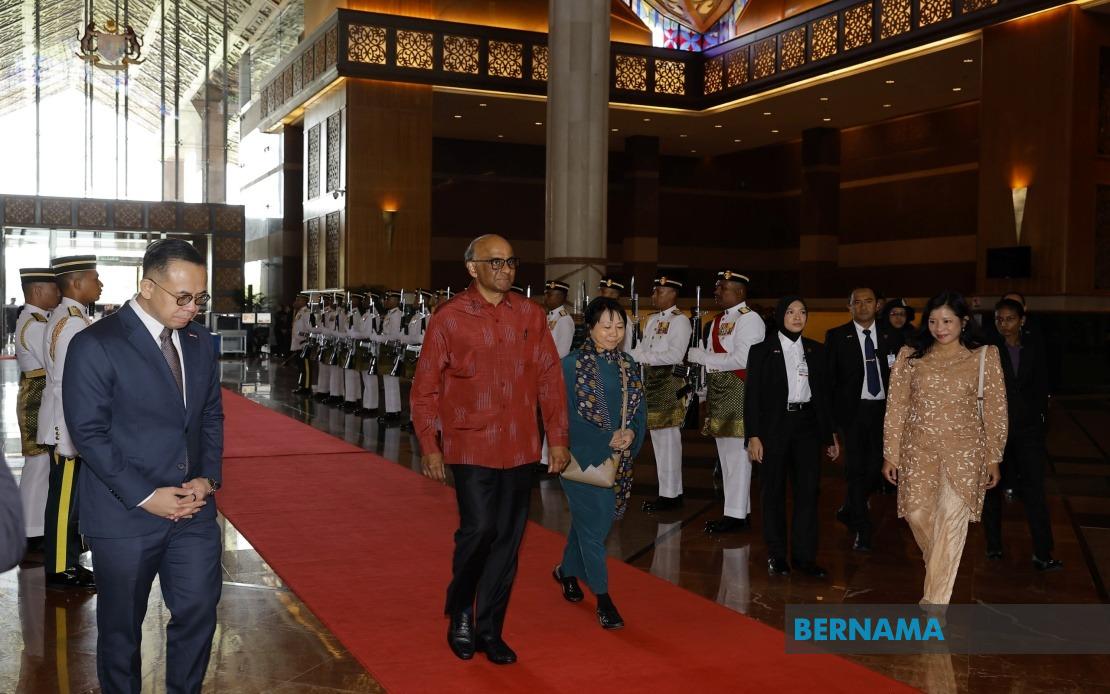
Singapore President Tharman Shanmugaratnam departed Malaysia on Monday afternoon, bringing to a close a three-day state visit that underscored the enduring diplomatic relationship between the two neighbours. The President, accompanied by his wife Jane Ittogi and an official delegation, boarded a commercial flight at Kuala Lumpur International Airport Terminal 1 at 2.20 pm, concluding a carefully choreographed series of engagements that had begun on Sunday at the invitation of His Majesty Sultan Ibrahim, King of Malaysia.
The departure ceremony itself reflected the formal nature of such state occasions. Upon arriving at the airport's Bunga Raya Complex shortly before his flight, Tharman was received with a static Guard of Honour comprising two officers and 26 personnel from the First Battalion of the Royal Ranger Regiment, led by Captain Muhammad Hanafi Ja'afar. Minister of Entrepreneur and Cooperatives Development Steven Sim attended the farewell, representing Malaysia's government in acknowledging the President's departure.
This inaugural state visit by Tharman to Malaysia since his assumption of office as Singapore's ninth President on September 14, 2023, carried particular significance for bilateral relations. The timing was deliberately structured as reciprocal diplomacy, responding to Sultan Ibrahim's own state visit to Singapore on May 6 and 7, 2024. Such exchanges between heads of state serve as the highest expression of goodwill between nations and provide frameworks for addressing matters of mutual concern at the most senior levels.
During his three-day stay, Tharman was extended the full ceremonial protocols befitting a visiting head of state. On Monday, he received a formal state welcoming ceremony before proceeding to Istana Negara for an audience with Sultan Ibrahim. The sequence of official calls reflected the structured hierarchy of Malaysian governance, demonstrating respect for both the constitutional monarchy and the executive branches.
Tharman's diplomatic schedule included a significant courtesy call from Prime Minister Datuk Seri Anwar Ibrahim, demonstrating the Malaysian government's commitment to engaging at the highest political level. This meeting was notably attended by several senior cabinet ministers, including Foreign Minister Datuk Seri Mohamad Hasan, Investment, Trade and Industry Minister Datuk Seri Johari Abdul Ghani, and the Minister of Entrepreneur and Cooperatives Development. The presence of the trade and investment minister underscores how state visits often serve as platforms for advancing economic cooperation between neighbouring nations.
Beyond the federal level, the visit extended to Malaysia's royal structure, reflecting the importance of engaging with all significant power centres. During the second day of his stay, the Sultan of Selangor, Sultan Sharafuddin Idris Shah, granted an audience to Tharman at Istana Alam Shah. This inclusion acknowledges the constitutional role of Malaysia's state sultans and ensures that diplomatic engagement benefits from broader institutional participation.
The bilateral relationship between Singapore and Malaysia remains among the most complex in Southeast Asia, shaped by geography, history, and economic interdependence. Despite occasional tensions over water rights, airspace, and maritime boundaries, both nations have demonstrated a pragmatic commitment to maintaining stability and fostering cooperation. State visits such as Tharman's serve as crucial mechanisms for reinforcing these bonds and providing high-level forums for discussing contentious issues.
For Malaysian readers, the significance of this visit extends beyond ceremonial protocol. Singapore remains a critical economic partner, with substantial trade flows and shared interests in regional security, maritime stability, and the preservation of the rules-based international order. The prominence given to the Minister of Investment, Trade and Industry in Tharman's official schedule signals that both governments recognise the centrality of economic relations to their broader partnership.
Tharman's presidency itself represents a symbolic moment in Singapore's political evolution. As the nation's ninth President and the first of Tamil descent to hold the position, his visit carries additional meaning for minority representation and inclusive governance in the region. Malaysia, with its own diverse population, may view Tharman's elevation and his conduct of office as relevant to discussions about pluralism and institutional development in Southeast Asia.
Looking forward, the rhythm of reciprocal state visits between Malaysia and Singapore helps establish predictable patterns of engagement that can stabilise relations during periods of diplomatic friction. The formal structures surrounding such visits—the Guard of Honour, the multi-level audience schedule, the careful orchestration of media and protocol—all serve to elevate the relationship above day-to-day disputes and remind both societies of their shared interests and common destiny within Southeast Asia's evolving geopolitical landscape.
The conclusion of Tharman's visit marks another chapter in the ongoing narrative of Malaysian-Singaporean relations, a relationship that remains essential to stability and prosperity across the entire region. As both nations navigate the complexities of regional great-power competition and economic uncertainty, the maintenance of robust bilateral ties through such formal engagements continues to serve national interests on both sides of the Johor Strait.

