Singapore police arrested a 49-year-old woman on August 6 in connection with the Fun Coffee investment scheme, a cryptocurrency-based operation that has drawn scrutiny from authorities across multiple Asian jurisdictions. The arrest marks an intensifying crackdown on what law enforcement describes as a sophisticated pyramid selling operation that has ensnared hundreds of victims and siphoned millions in deposits.
According to a police statement released two days after the arrest, the woman had been instrumental in actively promoting the Fun Coffee platform and enlisting new participants into the scheme. Her responsibilities extended beyond passive endorsement; she actively recruited others to participate in the investment opportunity, a role that carries particular legal significance under Singapore's Multi-Level Marketing and Pyramid Selling (Prohibition) Act. The maximum penalty for such violations is imprisonment of up to five years, a fine not exceeding S$200,000, or both—a considerable deterrent that underscores the seriousness with which the city-state treats such financial crimes.
The mechanics of Fun Coffee's operation reveal a structure designed to extract cryptocurrency from participants under the guise of legitimate investment returns. Individuals seeking to participate must first download a dedicated mobile application, then transfer Tether (USDT), a cryptocurrency whose value is designed to remain stable at approximately one US dollar, into wallet addresses accessible only through the platform. This arrangement creates an immediate barrier to fund recovery, as cryptocurrency transactions are largely irreversible and operate outside traditional banking safeguards.
What distinguishes Fun Coffee from legitimate investment platforms is its dual incentive structure. Beyond promising extraordinarily high returns on cryptocurrency holdings—returns that police characterise as "unrealistically high"—the scheme explicitly offers additional commissions to participants who successfully recruit new members into the system. This recruitment-dependent compensation model is the hallmark of pyramid schemes worldwide and creates a mathematical impossibility for most participants to profit, as the scheme inevitably exhausts the pool of potential new recruits.
The practical consequences became evident when Singapore-based participants discovered they could not withdraw accumulated funds through the Fun Coffee application. One victim reported investing approximately S$400,000 with no possibility of recovery, a figure that represents not merely a financial loss but a devastating personal catastrophe for many households. The inability to access funds distinguishes this case from mere investment failure; it suggests deliberate prevention of withdrawals, a characteristic of outright fraud rather than unsuccessful business ventures.
Fun Coffee's operational base in Phu Quoc, Vietnam, provides geographical distance from Singapore's regulatory authorities while offering proximity to Southeast Asia's financial hubs. The company claims on its public-facing website to control assets exceeding US$1 billion (approximately S$1.28 billion) and employs a team surpassing 5,000 personnel. These assertions appear designed to project legitimacy and scale, though such claims remain unverified and stand in stark contrast to the scheme's actual collapse and criminal investigation.
The problem extends far beyond Singapore's borders. In the past week alone, authorities in Hong Kong and Macau have made eight arrests collectively linked to Fun Coffee operations. Within these two jurisdictions, approximately 200 individuals have suffered documented losses totalling nearly HK$100 million (equivalent to S$16.3 million). This multi-jurisdictional pattern indicates a well-organised operation deliberately targeting multiple financial centres simultaneously, suggesting coordination among perpetrators rather than isolated opportunistic fraud.
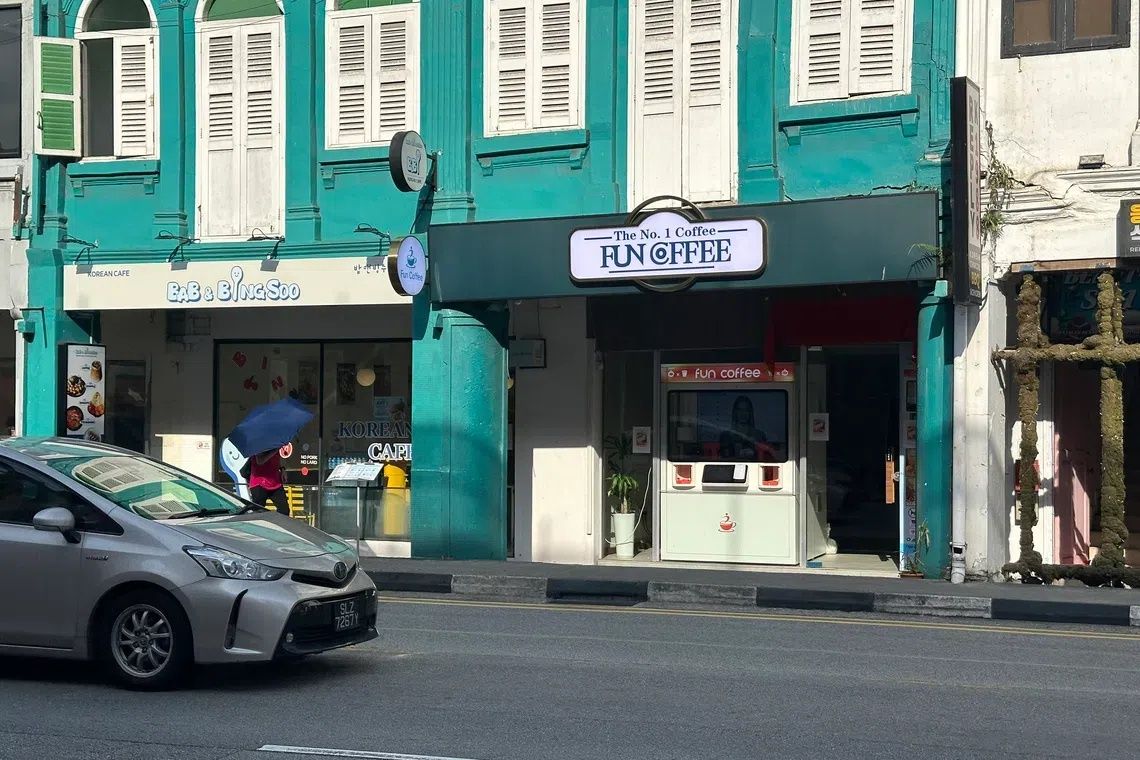
Fun Coffee's physical presence in Singapore adds another dimension to its operational strategy. The Straits Times visited the company's registered address at 202 Jalan Besar on August 7 and discovered a coffee vending machine positioned at the entrance, complete with handwritten instructions directing customers to scan a QR code for payment. This arrangement—blending a retail veneer with cryptocurrency payment mechanisms—exemplifies how modern financial fraud increasingly employs legitimate-appearing facades to obscure underlying criminal structures. The coffee vending machine serves not primarily as a revenue-generating asset but as a physical anchor point enhancing perceptions of legitimacy.
Singapore's police have issued explicit guidance to the public regarding warning signs of ongoing schemes. Residents should immediately cease all payments and transfers to Fun Coffee, regardless of assurances from individuals claiming official affiliation or directives received through the platform's application. The authorities have identified specific red flags deserving heightened suspicion: payment requests routed through private PayNow QR codes, requests for transfers to personal mobile numbers, or demands for funds directed to overseas accounts. These mechanisms deliberately circumvent traditional banking oversight and create paper trails resistant to law enforcement investigation.
For Malaysian observers, the Fun Coffee case carries particular relevance. Similar cryptocurrency-based pyramid schemes have emerged throughout Southeast Asia, exploiting regional populations' increasing familiarity with digital assets alongside widespread misunderstanding of legitimate blockchain technology. The scheme's operational strategy—combining unrealistic return promises with recruitment incentives—exploits a recurring vulnerability in populations with limited exposure to investment fraud. The geographical proximity of these schemes to Malaysia, combined with shared language and cultural networks, creates elevated risk for Malaysian citizens and residents.
The enforcement response demonstrates regional coordination among authorities. Singapore, Hong Kong, and Macau have moved in parallel to identify and apprehend operators and promoters, suggesting information-sharing and coordinated action. Yet the speed at which the scheme expanded and accumulated hundreds of millions in deposits suggests significant victims remain unidentified, particularly in less-developed regulatory environments. The substantial sums involved indicate that perpetrators operated with considerable sophistication in designing recruitment networks, managing cryptocurrency flows, and maintaining operational secrecy.
Moving forward, the case underscores regulatory challenges posed by cryptocurrency-based financial crimes. Unlike traditional pyramid schemes operating through physical sales networks, cryptocurrency schemes operate across borders instantaneously, complicate fund tracing, and exploit participants' limited technical understanding of blockchain technology's actual properties. The enforcement success achieved thus far, while welcome, likely represents merely the visible fraction of a much larger ecosystem of similar schemes targeting regional populations.

