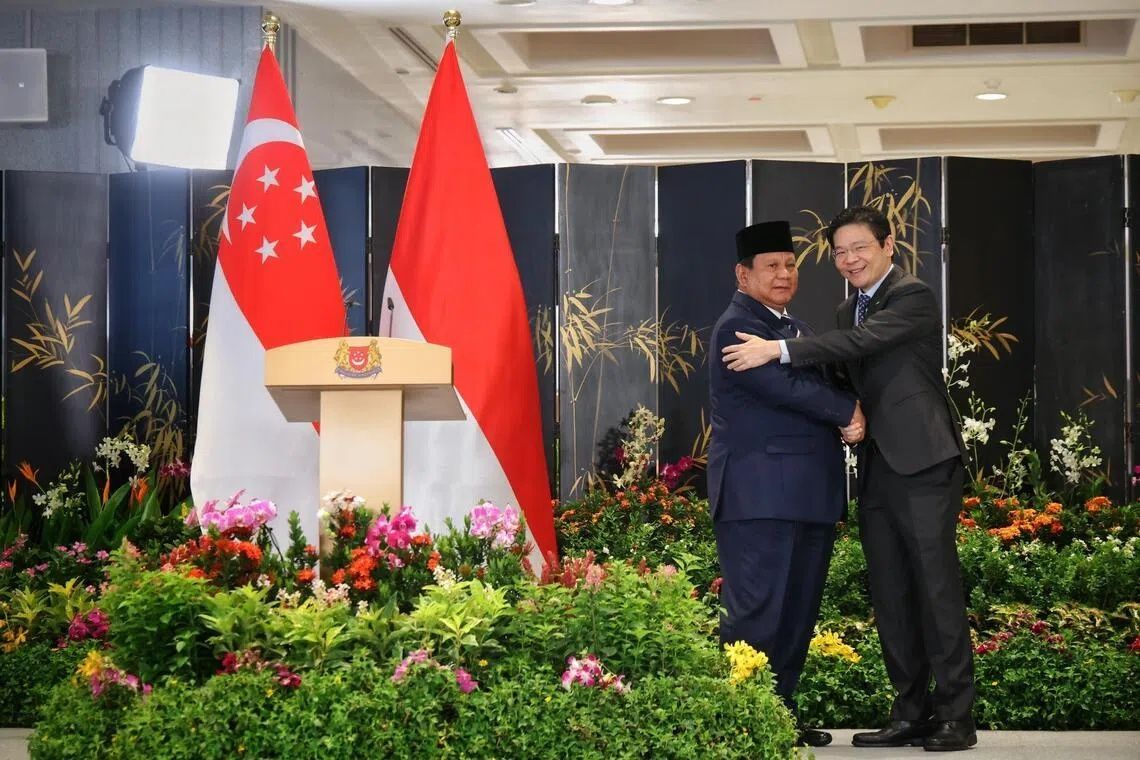
Prime Minister Lawrence Wong is set to travel to Jakarta on Monday, July 6, for the Singapore-Indonesia Leaders' Retreat, a high-level diplomatic engagement that underscores the importance both nations attach to their bilateral relationship. The retreat, hosted by President Prabowo Subianto, marks the second such meeting between the two leaders and reflects the institutional framework through which Singapore and Indonesia manage and advance their strategic partnership. According to a statement from the Prime Minister's Office on July 5, this annual gathering represents the most senior platform for bilateral engagement between the two neighbouring countries.
The Leaders' Retreat serves as a crucial mechanism for reaffirming the depth of the Singapore-Indonesia relationship, which extends across multiple dimensions of statecraft and economic cooperation. As the PMO noted, the meeting provides an opportunity for both governments to demonstrate their commitment to deepening collaboration and to chart the course of bilateral engagement across diverse sectors. The previous retreat was held in Singapore in June 2025, establishing a pattern of alternating venues that reinforces the principle of shared responsibility for nurturing the relationship. This continuity in the retreat format reflects the maturity of Singapore-Indonesia relations and the regular, structured dialogue that characterises their engagement.
The agenda for the retreat encompasses both substantive policy discussions and updates on ongoing collaborative initiatives. Prime Minister Wong and President Prabowo will receive briefings on the status of bilateral projects launched since their last meeting, providing an opportunity to assess progress and identify areas requiring additional attention or resources. Beyond reviewing existing arrangements, the two leaders will exchange perspectives on significant regional and global developments, a critical function given the strategic importance of Southeast Asia and the interconnected nature of geopolitical challenges affecting both nations. This exchange of views helps align the two countries' approaches to emerging international issues and strengthens coordination on matters of mutual concern.
A notable dimension of the contemporary Singapore-Indonesia partnership is the expansion of cooperation into new and strategically significant sectors. Traditionally, the bilateral relationship has been anchored in trade, investment, and defence collaboration, areas where both countries have built substantial institutional capacity and mutual understanding. However, in recent years, the scope of engagement has broadened considerably to encompass the green economy, cross-border electricity trade, carbon capture and storage technologies, artificial intelligence, and digital connectivity initiatives. These emerging areas reflect both global trends towards sustainability and technological advancement, and the recognition by both governments that their future competitiveness and prosperity depend on leadership in these domains.
The economic dimensions of the Singapore-Indonesia relationship remain substantial and consequential for both nations. In 2025, Singapore consolidated its position as Indonesia's leading source of foreign direct investment, with capital flows reaching US$17.4 billion, equivalent to approximately S$22.4 billion. This investment volume underscores the confidence of Singapore-based investors in Indonesia's economic potential and the integrated nature of the two countries' business ecosystems. The scale of Singapore investment in Indonesia has implications not only for bilateral relations but also for broader Southeast Asian economic integration, as Singaporean capital increasingly facilitates industrial development, technology transfer, and integration of Indonesian enterprises into regional and global value chains.
The composition of the Singapore delegation reflects the comprehensive nature of the bilateral agenda and the breadth of government involvement required to advance cooperation across multiple sectors. Accompanying Prime Minister Wong are Deputy Prime Minister and Minister for Trade and Industry Gan Kim Yong, whose presence underscores the economic dimensions of the discussions; Coordinating Minister for Public Services and Minister for Defence Chan Chun Sing, reflecting the defence and security aspects of the relationship; Foreign Minister Vivian Balakrishnan, who will engage on diplomatic and international issues; Minister for Social and Family Development Masagos Zulkifli; and Minister for Manpower and Minister-in-charge of Energy and Science and Technology Tan See Leng, whose portfolio connects to several emerging areas of cooperation including green technology and digital innovation.
The institutional history of the Leaders' Retreat demonstrates its evolution as Singapore-Indonesia relations have developed. The most recent retreat held in Indonesia occurred in April 2024, when then Prime Minister Lee Hsien Loong met then President Joko Widodo at the Bogor Presidential Palace. Notably, both Prime Minister Wong, who was then serving as Deputy Prime Minister and Finance Minister, and President Prabowo, who held the position of President-elect at that time, participated in those discussions. This continuity of personnel across leadership transitions has facilitated smoother policy implementation and maintained institutional memory regarding bilateral initiatives and long-term strategic objectives. The transition of both leaders to their current positions has not disrupted the momentum of bilateral engagement but rather provided an opportunity to revitalise and expand the partnership under new leadership.
For Malaysia and other Southeast Asian nations, the Singapore-Indonesia Leaders' Retreat carries implications beyond the bilateral context. The two largest and most developed economies in ASEAN have particular influence over regional policy directions, and their bilateral cooperation sets patterns that can either facilitate or complicate broader regional integration efforts. The expansion of cooperation into sectors such as renewable energy, cross-border trade mechanisms, and digital infrastructure reflects ambitions that affect the entire region's development trajectory. Malaysian stakeholders, including policymakers, investors, and business leaders, benefit from understanding how Singapore and Indonesia are positioning themselves in emerging technological and economic domains, as these decisions influence competitive dynamics and opportunities throughout Southeast Asia.
The retreat also provides a venue for discussing regulatory and operational matters that affect the broader regional ecosystem. Cross-border electricity trade, for instance, is not merely a bilateral concern but has implications for regional energy security and the transition towards renewable energy. Similarly, artificial intelligence governance, digital connectivity standards, and approaches to carbon capture and storage are areas where bilateral decisions by major regional economies can establish precedents or create frameworks that smaller neighbours must navigate. The discussions between Prime Minister Wong and President Prabowo thus carry weight extending beyond Singapore and Indonesia's immediate bilateral relationship.
During Prime Minister Wong's absence in Jakarta, Coordinating Minister for National Security and Minister for Home Affairs K. Shanmugam will assume the role of acting prime minister, ensuring continuity of Singapore's governance structures and decision-making processes. This arrangement reflects standard practice in managing the temporary absence of the head of government and demonstrates the depth of institutional development in Singapore's political system. The decision to dispatch such a senior and comprehensive delegation to Jakarta, rather than sending a smaller, lower-level team, reinforces the priority both governments attach to the retreat and the expectation that substantive progress will be achieved across multiple policy domains during these discussions.

