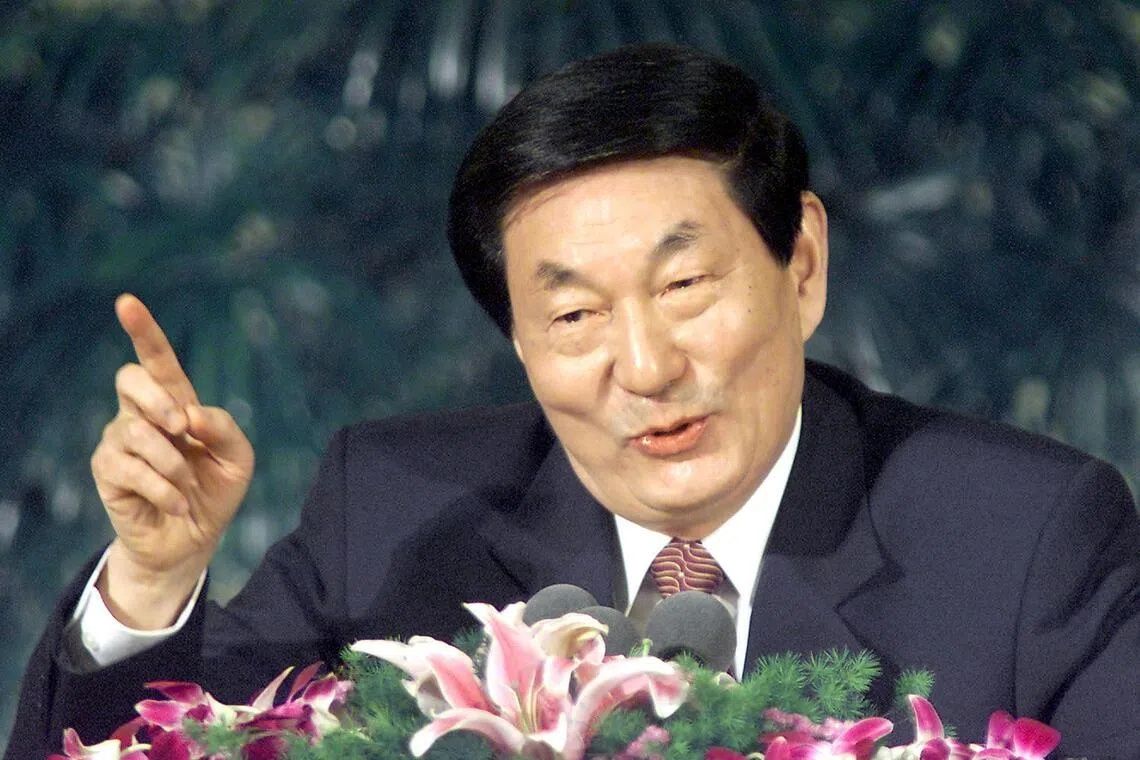
Prime Minister Lawrence Wong has formally extended Singapore's condolences to Chinese Premier Li Qiang following the passing of former premier Zhu Rongji, one of the architects of modern China's economic transformation. Zhu died on Wednesday, August 12, in Beijing, falling just two months short of his 98th birthday, according to state news agency Xinhua. The death marks the end of an era for a leader whose tenure fundamentally reshaped China's trajectory during a critical period of global economic integration.
In a letter dated August 13 to Premier Li, Wong acknowledged Zhu's towering legacy in advancing China's economic reform agenda while simultaneously steering the nation through its watershed moment of accession to the World Trade Organization in 2001. The timing of this accession proved transformative not only for China but for the regional and global economy, ushering in decades of unprecedented growth and manufacturing expansion that would reshape trade flows across Asia. Wong's recognition of these achievements underscores how profoundly Zhu's policies continue to shape contemporary economic relationships across East and Southeast Asia.
Wong characterised Zhu as an enduring friend to Singapore, emphasising the personal relationships the former Chinese leader cultivated with Singapore's founding generation of leaders. The Prime Minister noted that Zhu had met Lee Kuan Yew and Goh Chok Tong on numerous occasions, reflecting a pattern of diplomatic engagement that extended beyond ceremonial courtesy into substantive bilateral cooperation. These meetings represented more than symbolic gestures—they were part of a deliberate strategy to build institutional trust between two very different political systems navigating the complexities of the 1990s and 2000s regional environment.
Particularly significant was Zhu's role in 1999 when he became the first Chinese premier to deliver the Singapore Lecture, a prestigious platform organised by the ISEAS – Yusof Ishak Institute where leading global figures articulate their visions on world affairs. His address was more than a ceremonial obligation; it represented an explicit articulation of China's strategic outlook at a pivotal juncture. In that speech, Zhu outlined his conviction that China's economic development would serve as an engine for prosperity throughout Asia and beyond, a prediction that has largely proven prescient as China ascended to become the world's second-largest economy and a crucial trading partner for virtually every nation in the region.
During his Singapore Lecture, Zhu advanced a particularly prescient proposal: the establishment of a free trade area between the Association of Southeast Asian Nations and China. This concept, once considered ambitious, eventually materialised as the ASEAN-China Free Trade Area, which commenced in 2010 and became one of the most substantial trading blocs in the world. For Malaysian readers, this arrangement has had profound implications for regional trade patterns, investment flows, and the positioning of ASEAN nations within China's economic orbit. Wong explicitly noted that Zhu's strategic vision has been vindicated by subsequent events, with China now functioning as an indispensable economic partner not merely for Singapore but for the entire region.
Wong also highlighted Zhu's instrumental role in facilitating the China-Singapore Suzhou Industrial Park, which represented one of the first major government-to-government economic collaboration projects between modern China and a developed Asian economy. This initiative, established in the mid-1990s, served as a model for subsequent China-Singapore partnerships and demonstrated how compatible governance frameworks and shared economic interests could generate tangible development outcomes. The park's success bolstered confidence among regional investors and policymakers that China could be a reliable partner for sophisticated economic arrangements, a sentiment that would prove consequential for the broader trajectory of China's integration into the regional economy.
Further cementing bilateral ties, Zhu as Shanghai mayor fostered exchanges between municipal officials from Singapore and Shanghai, recognising that subnational relationships could deepen understanding and cooperation. These official visits and exchanges created networks of technocrats and administrators who developed shared interests in implementing economic programmes and addressing developmental challenges. Wong's reference to these efforts demonstrates how Zhu understood that durable international relationships are constructed not only through diplomatic summits but through the cultivation of relationships among officials managing economic development and urban administration.
The timing of Zhu's death carries particular symbolic weight for Southeast Asia. His generation of Chinese leaders—pragmatists schooled in administrative governance and economic management—presided over China's opening to global markets. Unlike some of their successors, Zhu's approach emphasised dialogue, engagement, and the demonstration of mutual benefit through concrete projects and measurable economic growth. For a region long concerned about the implications of China's rise, Zhu represented a style of leadership that prioritised economic interdependence and institutional engagement over coercive measures.
Wong's tribute reflects Singapore's positioning as a natural bridge between China and the West, and between China and ASEAN. As a Chinese-majority nation with deep institutional ties to the broader Commonwealth and Western economic systems, Singapore has consistently been among the most eloquent articulators of how China's rise can be managed through institutional frameworks, trade agreements, and dialogue-based diplomacy. Zhu's vision of mutually beneficial economic cooperation aligned remarkably well with Singapore's own strategic philosophy, making him a natural partner for then-prime ministers Lee and Goh, and subsequently for current leadership.
For Malaysia and other ASEAN members, Zhu's legacy remains pertinent. The free trade area he envisioned has become structural reality, embedding ASEAN economies more deeply into Chinese supply chains and investment patterns. The challenge for the region, as Zhu's successors navigate great power competition and technological rivalry, lies in sustaining the economic interdependence that characterised his era while maintaining strategic autonomy. Wong's eulogy implicitly poses this question: whether future Chinese leaders will maintain Zhu's commitment to transparent, mutually beneficial economic engagement that characterised his tenure.

