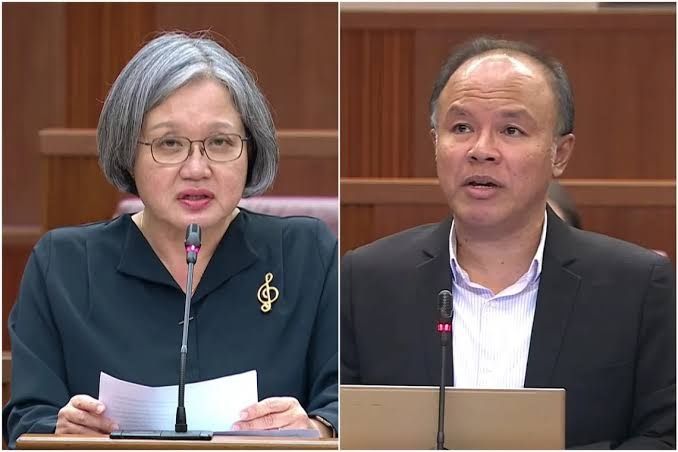
Singapore's Parliament has formally ended its pursuit of penalties against Workers' Party leaders Sylvia Lim and Faisal Manap for misleading a parliamentary committee, with Leader of the House Indranee Rajah citing the expiration of legal time limits under parliamentary law. The July 7 ministerial statement effectively concludes a protracted controversy that had occupied legislative attention since 2021, though it raises questions about the adequacy of procedural safeguards in parliamentary accountability mechanisms.
The roots of the controversy trace to former Sengkang GRC MP Raeesah Khan, who delivered a fabricated anecdote about police conduct during a 2021 parliamentary speech. A subsequent investigation by Parliament's Committee of Privileges determined that three Workers' Party figures—party leader Pritam Singh, Sylvia Lim, and Faisal Manap—had provided false statements to the committee investigating Khan's original deception. Singh's conduct was deemed substantially more culpable, as he allegedly instructed Khan to conceal her dishonesty. However, Lim and Manap, who were present during relevant meetings, denied that the matter had been discussed, contradicting evidence later presented to investigators.
The resolution of the matter hinged on technical provisions within the Parliament (Privileges, Immunities and Powers) Act, a statute designed to protect parliamentary integrity through clearly defined enforcement windows. According to Section 22 of this legislation, Parliament retains authority to penalize misconduct occurring either during the current session or the preceding parliamentary term's second session. When the 15th Parliament commenced following Singapore's 2025 general election, the statutory window for addressing conduct originating in the 14th Parliament's first session effectively closed, regardless of when investigation or judgment concluded.
Indranee's characterization of this outcome revealed an implicit tension in parliamentary procedure. She acknowledged that "had the timelines been different, I would have proposed a different course of action," suggesting that alternative sequencing of legal and investigative processes might have produced a more definitive outcome. The House's decision in 2021 to defer judgment against Lim and Manap pending the resolution of Singh's more serious culpability claims ultimately proved consequential, as administrative machinery could not complete its full cycle within the prescribed statutory framework.
Singh's own legal journey illustrated the substantive findings underlying the case. Convicted by the District Court in February 2025 of lying to Parliament, he subsequently appealed and lost in December 2025 when the High Court upheld the conviction. Indranee emphasized that the judicial findings effectively vindicated the Committee of Privileges' earlier conclusions regarding the dishonest conduct of all three Workers' Party figures. Nonetheless, the court's validation came too late to permit legislative enforcement through established parliamentary penalties, creating an asymmetry between judicial accountability and institutional oversight.
The characterization of Lim and Manap's culpability as occupying a "subsidiary" role, coupled with acknowledgment of their "somewhat helpful" cooperation with investigators, had influenced the House's prosecutorial calculus years earlier. This gradualism, while appearing judicious, inadvertently intersected with rigid statutory deadlines in ways that prevented ultimate resolution through standard parliamentary mechanisms. The decision to await Singh's criminal adjudication before addressing the lesser figures now appeared strategically consequential, as the interval consumed the finite window available under the PPIPA framework.
Parliament retained one residual recourse: passage of a motion expressing regret concerning the conduct of Lim and Manap. However, Indranee noted that the House had already signaled comprehensive disapproval of parliamentary dishonesty when it declared Singh unsuitable as Leader of the Opposition in January. This prior motion encompassed the broader ecosystem of untruthfulness and represented Parliament's institutional judgment on the matter, obviating the necessity for additional censure specific to the two Workers' Party MPs.
The Workers' Party itself had already addressed the controversy during its internal electoral processes on June 28, when party members voted to retain Singh as leader notwithstanding his conviction. This organizational ratification occurred just one week before Parliament's formal closure of the matter, suggesting that partisan accountability mechanisms had superseded institutional ones. The sequence of events—Workers' Party retention of Singh followed by parliamentary expiration of enforcement authority—created the appearance of allowing political actors to evade consequences through procedural timing.
For Malaysian observers, the case illuminates potential vulnerabilities in Commonwealth parliamentary systems regarding the enforcement of misconduct standards against sitting members. The PPIPA's time-bar provisions, while ostensibly promoting finality and clarity, inadvertently created a loophole wherein protracted investigations could render enforcement mechanisms temporally inaccessible. In Malaysia's own parliamentary context, where standing orders similarly govern legislative privilege and accountability, the Singapore experience suggests that rigid statutory deadlines warrant careful reconsideration, particularly when criminal proceedings involving the same underlying facts proceed through separate judicial channels.
Indranee's closing remarks emphasized that "the law, in this case the time bar provisions of PPIPA, must be observed" even where substantive findings confirmed dishonourable conduct. This articulation of formal legality over substantive justice reflected a positivist approach to parliamentary governance, prioritizing procedural compliance over institutional integrity. Whether such prioritization ultimately strengthens or weakens public confidence in legislative accountability remains contested, particularly in jurisdictions where citizen trust in institutional impartiality already faces broader challenges.
The episode also demonstrates how sequencing of enforcement decisions—the deferral of action against Lim and Manap pending Singh's resolution—can generate unintended consequences within statutory frameworks. Had Parliament pursued all three figures contemporaneously in 2021 or 2022, the case would have resolved within a single parliamentary term, rendering the time-bar provisions irrelevant. The gesture toward procedural fairness and differentiated culpability, while defensible in principle, ultimately proved counterproductive in achieving institutional accountability objectives.
Sylvia Lim's brief parliamentary response confirmed her non-objection to closure of the matter and reiterated earlier statements emphasizing her lack of opportunity to present evidence during court proceedings in which she was not called as a witness. Her restrained response suggested acceptance of the parliamentary closure, even if the legal technicality underlying that closure did not address the substantive findings of her dishonest conduct. This conclusion, while formally satisfying procedural requirements, leaves unresolved the broader question of whether institutional credibility is adequately preserved when parliamentary mechanisms exhaust themselves on technical grounds rather than through substantive resolution.

