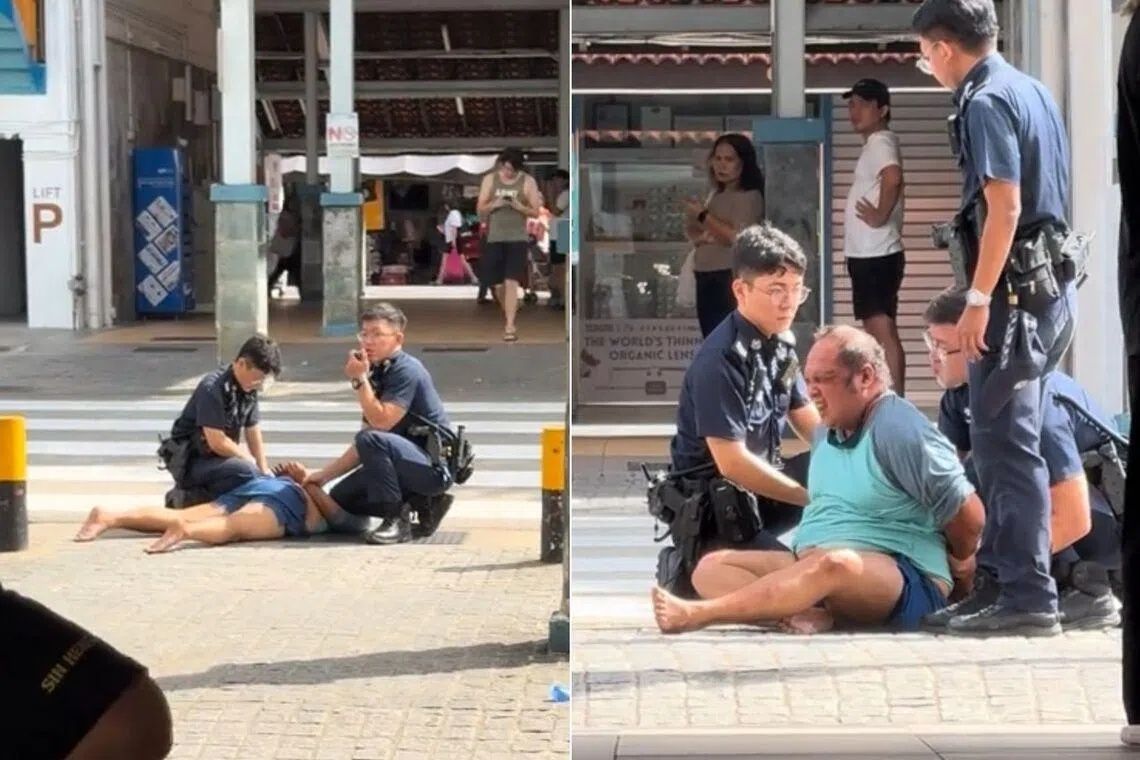
Singapore authorities have arrested a 36-year-old man following an incident in Toa Payoh on Sunday morning that involved a public disturbance and a direct assault on a police officer. The confrontation unfolded at Block 184 Toa Payoh Central around 9.45am, when officers responded to reports of disruptive behaviour inside a local coffee shop. The case has since drawn public attention through social media footage, highlighting the challenges law enforcement faces when responding to increasingly volatile public incidents across the city-state.
Police responded to an assistance call after receiving reports that the man was creating a significant disturbance within the coffee shop premises. The situation escalated during the arrest process when the individual struck a 19-year-old police officer directly in the face. The assault occurred as officers were moving to take the suspect into custody, underscoring the unpredictable nature of street-level law enforcement work that frontline officers encounter regularly. The young constable sustained minor injuries from the blow but remained conscious throughout the incident.
Social media documentation of the arrest has provided eyewitness perspective on how the incident unfolded. Multiple videos posted by TikTok user Kee Wee Shang captured different phases of the police response, showing officers restraining the barefooted suspect on the ground as they worked to secure him. Additional footage depicts a third officer present at the scene, with the handcuffed individual subsequently being escorted away by the attending officers. Such digital records have become increasingly common in Singapore's urban environment, where bystanders frequently capture law enforcement activities and share them across digital platforms.
The formal charges lodged against the suspect reflect the seriousness with which Singapore's legal system treats both public indecency and interference with law enforcement. The man faces accusations of committing an obscene act, a criminal offence under Singapore law that carries specific penalties. More significantly, he has been charged with voluntarily causing hurt to deter a public servant from his duty, a provision that carries enhanced sentencing because it directly targets individuals performing official functions. This dual-charge approach demonstrates Singapore's commitment to protecting those in uniform while maintaining public decency standards.
The 19-year-old officer's injury, though classified as minor, points to the occupational hazards inherent in policing work, particularly during interventions involving unstable individuals in public spaces. The officer's age and relative inexperience in the force suggest he was likely a junior constable, reflecting how Singapore deploys personnel across diverse incident types. His treatment at a hospital ensured proper medical assessment despite the apparent minor nature of his injuries, following standard protocols that protect officer welfare and create documented medical records.
Police investigations into the matter remain ongoing, with officers continuing to gather evidence and conduct interviews related to the incident. Investigators will examine the circumstances that led to the initial disturbance, the precise sequence of events during arrest, and any additional context that might inform understanding of why the individual acted as he did. This investigative phase is crucial for prosecutors preparing a case file should the matter proceed to court.
The incident reflects broader public order challenges that Singapore's police force manages across its densely populated urban landscape. While the city-state maintains relatively low violent crime rates compared to regional and global comparisons, isolated incidents involving assault on officers do occur periodically. Such confrontations often involve individuals experiencing mental health crises, substance intoxication, or acute behavioural disturbances that impair judgment during police interactions. Understanding these underlying factors becomes important for both law enforcement training and public health policy.
For Malaysian readers observing Singapore's law enforcement practices, this case illustrates the stringent legal framework that Singapore maintains regarding public order offences and assaults on officials. The offence of "voluntarily causing hurt to deter a public servant from his duty" has no direct equivalent in Malaysian law but reflects similar concerns about protecting law enforcement personnel. Both jurisdictions face comparable challenges in managing public disturbances in urban coffee shop settings, where daytime confrontations can escalate rapidly.
The reliance on social media documentation, evident in this Toa Payoh incident, has transformed how the public perceives and understands police actions across Southeast Asia. Digital transparency can serve accountability purposes while simultaneously creating challenges for officers, who now operate under constant potential recording. This evolving landscape requires ongoing dialogue between law enforcement agencies and communities about appropriate standards for intervention and documentation.
As investigations proceed, this incident serves as a reminder of the unpredictable nature of frontline policing work and the importance of public cooperation with law enforcement. The willingness of the young officer to engage despite the personal risk, and the professional response of attending officers to secure the scene, demonstrates the commitment Singapore's police force maintains to public safety. The case will likely proceed through Singapore's court system, where judges will determine appropriate sentencing based on the evidence presented and applicable legal precedents for similar offences.

