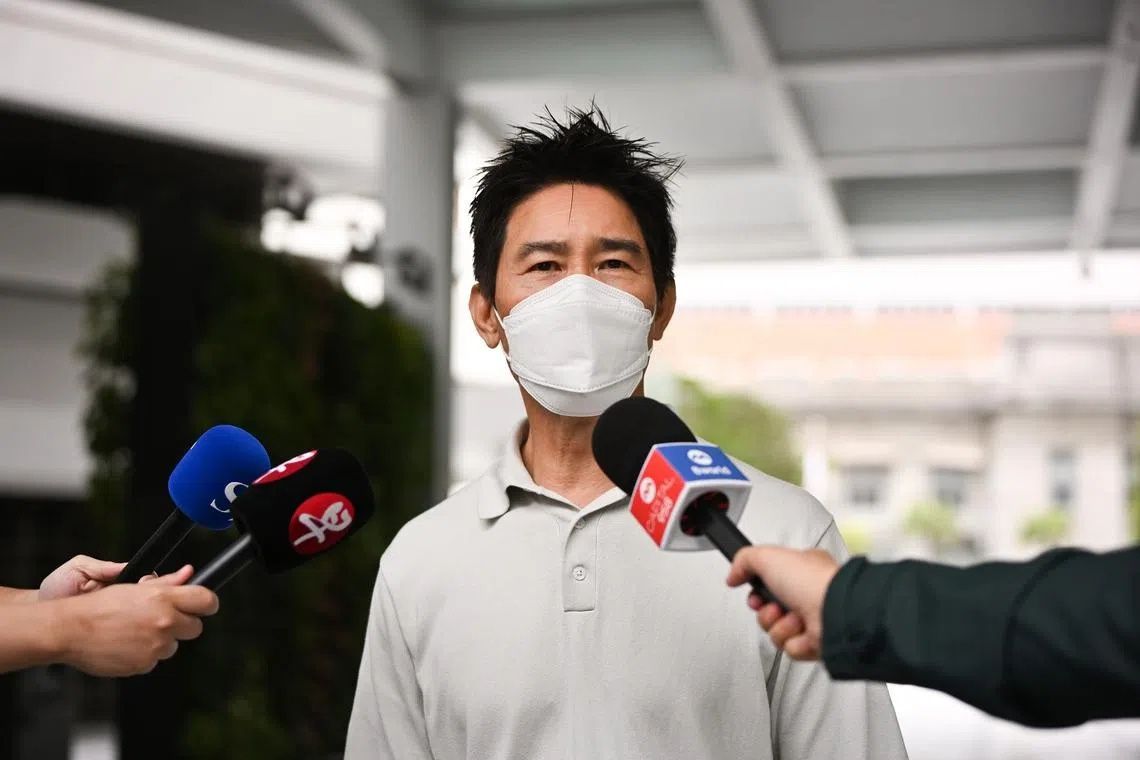
Singapore's High Court has significantly reduced the custodial sentence imposed on former television actor Edmund Chen, cutting his five-day jail term to just one day for his involvement in a road accident that left a young motorcyclist with serious wrist injuries. Justice Hri Kumar Nair delivered the decision on Monday, July 20, determining that the original sentence handed down by a district judge in January was manifestly excessive, though he acknowledged the judicial officer's initial finding that imprisonment was warranted.
The 64-year-old Chen, whose legal name is Tan Kai Yuan, had pleaded guilty to causing grievous hurt to a 21-year-old motorcyclist while operating his vehicle without due consideration for other road users. The incident occurred on the afternoon of March 4, 2025, along the Ayer Rajah Expressway as it connects to the Central Expressway. Chen's case has drawn significant public attention partly because of his prominence in Singapore's entertainment industry during the 1980s and 1990s, when he appeared in popular television dramas including Star Maiden and Patrol.
The circumstances surrounding the collision reveal a scenario common to congested expressways across Southeast Asia. Chen had been travelling in the fourth lane when he began decelerating his vehicle almost to a standstill in order to filter across the third lane. His intention was to access the CTE/SLE junction, but he had failed to position himself in the correct lane ahead of a critical road split. The motorcyclist, approaching from behind, attempted to swerve around Chen's car but collided with it despite this evasive manoeuvre. Chen immediately halted his vehicle to render assistance to the injured rider, who was subsequently rushed to Singapore General Hospital for surgical intervention to address multiple fractures affecting both wrists.
The appeal process centred on whether the custodial threshold—a fundamental sentencing principle used to determine when imprisonment is necessary—had been appropriately applied. Chen's defence team, led by Senior Counsel Abraham Vergis of Providence Law Asia, argued strenuously that the threshold for jail time had not been breached and that a financial penalty should suffice. The prosecution had originally sought a fine between S$3,000 and S$5,000, yet the district judge nonetheless imposed five days' imprisonment in January, a decision that sparked the subsequent appeal.
Dashcam footage presented during court proceedings became central to understanding the accident's mechanics. Vergis highlighted several mitigating factors derived from this visual evidence, noting that Chen had activated his indicator lights before attempting the lane change. The defence counsel also contended that the motorcyclist's view had been obstructed by another vehicle passing at that moment, given the curvature of the expressway. However, the prosecutor countered that dashcam evidence also showed Chen crossing white chevron lane markings following the impact, indicating a traffic violation. Additionally, witnesses indicated that two passing motorists had sounded their horns to warn Chen during the manoeuvre, but he continued regardless.
The severity of the victim's injuries formed another crucial battleground in the legal argument. Vergis characterised the injuries as falling within the less severe range of what constitutes grievous hurt under Singapore law. He emphasised that the fractures were confined to the extremities—the wrists—and were surgically repaired under local rather than general anaesthesia, suggesting the injuries were not life-threatening or structurally catastrophic. The injured motorcyclist spent two days hospitalised and received 99 days of medical leave but sustained no permanent physical disability, supporting the defence narrative that the harm, whilst serious, did not warrant incarceration.
Sentencing philosophy in traffic cases across Southeast Asia frequently grapples with the tension between deterrence and proportionality, particularly when deciding whether imprisonment serves justice or becomes excessive punishment. Justice Nair's intervention suggested that whilst the district judge had not erred fundamentally in determining that some jail time was appropriate, the quantum of five days had overstepped reasonable boundaries. This nuanced approach acknowledges that custodial sentences may sometimes be justified for grievous hurt offences, but courts retain discretion to modulate the length based on specific circumstances.
Beyond the immediate sentence reduction, Chen faces substantial collateral consequences. He has been disqualified from driving for five years, a penalty that remains intact following the High Court's decision. This lengthy prohibition addresses the broader traffic safety dimension of his case, particularly the finding that he violated lane-change regulations and failed to maintain adequate awareness of surrounding vehicles. The five-year ban reflects judicial concern about Chen's road conduct, even as the court softened the custodial component.
Chen's legal representation shifted notably between the district court and appellate stages, initially receiving counsel from Invictus Law before engaging Contigo Law for the High Court appeal. His engagement of Senior Counsel Vergis signalled a strategic recalibration, emphasising mitigation and proportionality arguments over disputing culpability. Before the Monday hearing, Chen revealed he had prepared for the worst outcome by bringing five days' worth of medication to court and reported that his family had not slept the previous night, underscoring the personal toll of facing potential incarceration at his age.
Chen's departure from acting occurred in 2000 following the birth of his daughter but did not constitute a complete retirement, as he accepted occasional television roles, most notably in the 2017 drama series Life Less Ordinary. He is married to Xiang Yun, a veteran actress recognised for performances in classic Singapore dramas such as The Awakening, Double Happiness, and The Little Nyonya. His case illustrates how even well-known figures remain subject to traffic laws and criminal accountability, a principle that courts consistently emphasise to maintain public confidence in equal legal treatment.
The High Court's decision carries implications beyond Chen's individual circumstances, signalling appellate willingness to scrutinise custodial sentences for traffic-related grievous hurt where injuries, though serious, do not constitute the most severe category. This reasoning may influence how Singapore's courts balance imprisonment with alternative penalties in comparable motor vehicle accident cases, potentially affecting how similar matters are sentenced in future proceedings.

