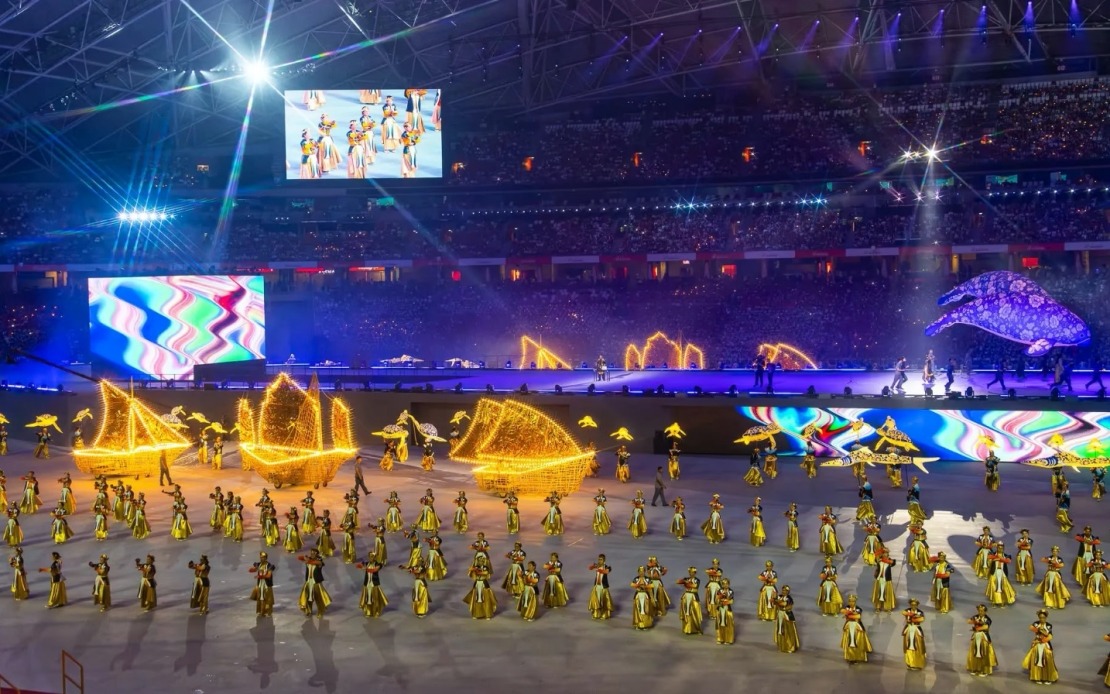
Singapore marked a significant milestone on Sunday with celebrations honouring the republic's 61st year of independence, highlighted by the return of the National Day Parade to the National Stadium after a ten-year absence. The event, orchestrated under the banner "Majulah Singapura, Go Beyond!", drew President Tharman Shanmugaratnam and Prime Minister Lawrence Wong alongside Cabinet ministers, Members of Parliament, and approximately 42,000 members of the public who transformed the stadium into a sea of red and white.
The decision to relocate the parade back to the National Stadium marks a symbolic reaffirmation of the venue's cultural importance to Singapore's national identity. The stadium had previously served as the traditional home for National Day Parade celebrations before the event shifted to other locations in recent years. This return represents not merely a logistical choice but a deliberate statement about continuity and the importance of shared physical spaces in fostering national unity—a consideration that resonates across Southeast Asia as nations balance heritage with modernisation.
What distinguished this year's proceedings was an unprecedented expansion of the ceremonial experience beyond the stadium's confines. For the first time in Singapore's six-decade history, the Presidential Gun Salute and the State Flag Flypast were conducted at Kallang Basin itself, transforming the surrounding precinct into an extended celebration ground. This innovation allowed thousands of additional spectators positioned across the wider Kallang area to participate in the most formal and solemn segments of the ceremony, democratising access to core national rituals in ways that traditional stadium-centred events could not achieve.
The gun salute itself demonstrated considerable logistical creativity. Four 25-pounder Howitzer guns, mounted on Mobility 3rd Generation (M3G) rafts, navigated the waters of Kallang Basin in a nautical choreography that brought the martial tradition closer to dispersed audiences. The 151 participants drawn from the 23rd Battalion of the Singapore Artillery and 35th Battalion of Singapore Combat Engineers executed a 21-gun salute, blending centuries-old military protocol with contemporary spatial innovation. This approach offers lessons for regional nations seeking to reimagine traditional ceremonies for modern, geographically distributed populations.
The parade itself commenced at approximately 6 pm, organised under the thematic framework "Go Beyond Self", which sought to transcend conventional narratives of national progress. The parade featured 32 contingents comprising more than 2,000 participants, structured to represent diverse institutional and social dimensions of Singapore's apparatus. Six Guard of Honour contingents escorted the Singapore Armed Forces Colours Party, drawing representatives from the Singapore Army, Republic of Singapore Navy, Republic of Singapore Air Force, the recently established Digital and Intelligence Service, Singapore Police Force, and Singapore Civil Defence Force. The inclusion of representatives from the Digital and Intelligence Service signals Singapore's recognition of cyber and information domains as integral to contemporary national security and identity.
Beyond the ceremonial parade, the evening's performance segment centred on the overarching "Go Beyond" theme, featuring 36 artistes and more than 2,600 performers in a showcase that deliberately emphasised Singapore's diversity and technological sophistication. The production moved beyond patriotic spectacle to present what organisers characterised as "authentic stories" of Singaporeans, interwoven with displays of innovative technology and a curated musical score. This approach reflects a broader regional trend wherein national celebrations increasingly emphasise inclusivity, technological advancement, and narratives of social progress rather than purely martial or governmental symbolism.
Particularly noteworthy was the deliberate inclusion of performers with disabilities in prominent roles within the show segment. Seven dancers from diverse backgrounds performed, including an autistic dancer and a dancer with Down syndrome, positioned not as peripheral gestures toward inclusivity but as central participants in articulating Singapore's vision of collective future-building. The programming statement—that "every Singaporean can contribute to shaping a shared future, regardless of background or ability"—carries significance beyond Singapore's borders, offering a counterpoint to nationalist rhetorics elsewhere in the region that often emphasise narrower definitions of participation and belonging.
The logistics underpinning such an event underscore Singapore's capacity for coordinated planning and execution. The mobilisation of 10 contingents from uniformed youth organisations, 16 supporting contingents, ceremonial units from multiple military and civil defence branches, and thousands of civilian performers required months of preparation, resource allocation, and institutional coordination. For Malaysian observers and policymakers, Singapore's ability to execute large-scale public events with minimal disruption while maintaining security and ceremonial dignity offers a comparative study in state capacity and public administration.
The decision to emphasise "going beyond" reflects deeper currents in Singapore's national discourse. The phrase suggests movement beyond established parameters—beyond self-interest toward collective concern, beyond national boundaries toward regional engagement, and potentially beyond traditional institutional frameworks toward innovation. This messaging, communicated through the carefully orchestrated medium of a national day parade, shapes public consciousness and positions Singapore within regional narratives around progress, technology, and social modernisation.
For Southeast Asian readers, Singapore's National Day celebrations merit attention as both ceremonial observation and substantive statement about governance priorities and national identity construction. The event demonstrates how traditional commemorative practices can be refreshed through spatial innovation, inclusive casting, and technological integration without abandoning their foundational significance. As other regional nations navigate questions about how to commemorate national identity in increasingly pluralistic, digitally connected societies, Singapore's approach—blending ceremonial formality with deliberate inclusivity and technological showcase—provides a notable reference point for considering what national celebrations might accomplish beyond mere remembrance.

