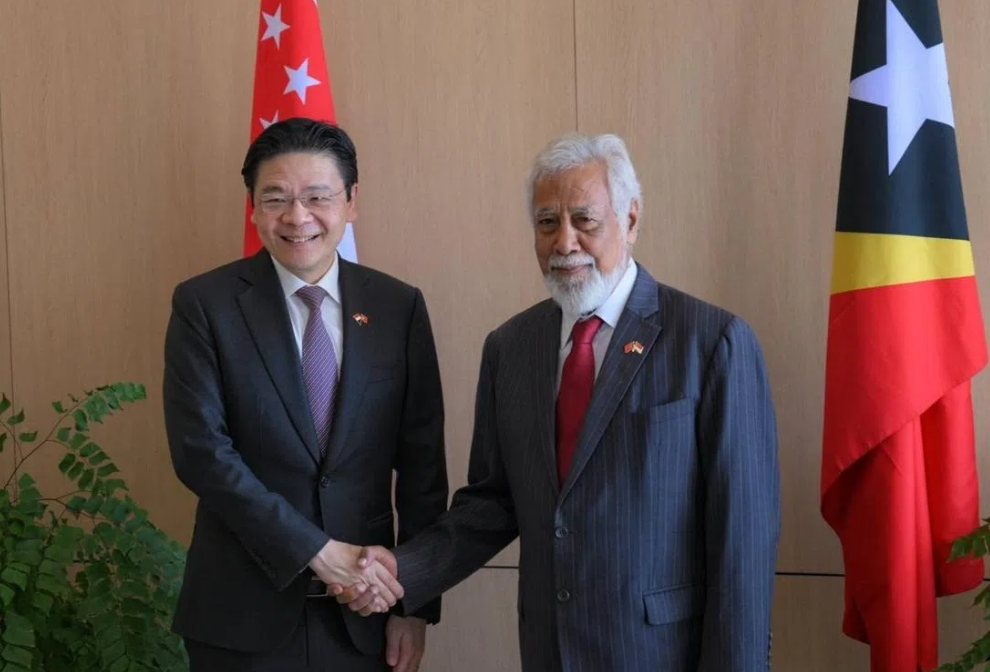
Prime Minister Lawrence Wong's historic visit to Timor-Leste marks a turning point in regional diplomacy, as the two island nations formalise an ambitious bilateral agenda spanning investment, human capital development and strategic coordination. The visit, the first by a Singapore prime minister to the newly independent state, culminates in a July 3 agreement establishing a structured framework for cooperation that extends far beyond traditional trade relationships into areas central to Timor-Leste's development trajectory.
The bilateral framework represents a significant elevation of ties between countries separated by geography but increasingly aligned by regional interests. By institutionalising a consultation mechanism through their foreign ministries, Singapore and Timor-Leste create a dedicated channel for continuous dialogue on bilateral matters alongside broader regional and strategic issues affecting Southeast Asia. This regularised engagement model offers Timor-Leste, as the region's newest nation-state, consistent access to a stable governance partner with deep experience navigating regional multilateralism. For Singapore, the arrangement reflects strategic interest in shaping outcomes across an adjacent territory whose stability and development directly influence maritime security and economic flows in busy waters.
The economic dimension of this partnership carries particular weight for Timor-Leste's resource-dependent economy. Singapore already ranks among the largest investors in the country, with companies exploring ventures across wholesale trade, renewable energy and extractive sectors. This existing presence demonstrates commercial confidence in Timor-Leste's investment climate and growth potential. By framing this engagement as a platform for identifying new mutually beneficial opportunities, both governments signal commitment to economic diversification away from traditional energy dependence, addressing a core vulnerability in Timor-Leste's long-term fiscal sustainability.
Most concretely, from the second half of 2027, Singapore will open selected construction and marine shipyard sectors to Timorese work permit holders, effectively incorporating Timor-Leste into Singapore's non-traditional labour sourcing framework. This initiative operates on multiple levels: it provides Timorese workers access to higher-wage employment opportunities in a developed economy; it supplies Singapore's labour-intensive sectors with workers during a period of domestic demographic constraint; and it strengthens people-to-people connectivity through employment linkages. Manpower Ministry officials noted early industry interest in Timorese workers, particularly in construction, indicating genuine demand rather than symbolic gestures. For Malaysian readers, this represents a model worth observing, as Southeast Asian nations grapple with balancing skilled migration inflows with regional labour market integration.
Healthcare cooperation introduces institutional depth to the partnership beyond transactional investment. The National University Hospital's planned framework with Timor-Leste's health ministry targets five-year collaboration encompassing workforce development, training systems and public health capability. The specificity of targeted areas—emergency care, paediatrics, obstetrics and ophthalmology—reflects pragmatic assessment of Timor-Leste's immediate healthcare gaps rather than aspirational generalism. This model of hands-on technical assistance, where a developed neighbour transfers operational capacity rather than simply providing aid, offers lessons for regional health security partnerships increasingly vital in a pandemic-conscious world.
Educational partnerships address arguably Timor-Leste's deepest structural challenge: building institutional capacity for sustainable development beyond a single generation of leadership. Singapore's commitment to support teacher training and school leadership development strikes at the foundation of human capital formation. By concentrating on educator development rather than direct student aid, the arrangement prioritises systemic capacity that outlasts individual interventions. For Timor-Leste, this addresses a critical bottleneck as it simultaneously builds state institutions and prepares populations for participation in increasingly complex governance structures.
The expanded Stars package—Singapore-Timor-Leste Asean Readiness Support—underscores the regional integration angle driving this partnership. Timor-Leste's October 2025 accession to Asean fundamentally altered its strategic positioning, transitioning from observer to member in the region's premier multilateral forum. However, membership itself requires sustained capacity building to participate effectively in Asean's technical working groups, coordinate on regional security issues and eventually assume the chairmanship burden. Singapore's expanded package, including tailored workshops on chairmanship protocols and direct attachments to Singapore's own 2027 chairmanship teams, directly enables Timor-Leste's transition from acceding member to substantive participant.
Prime Minister Wong's emphasis that national size does not determine destiny encapsulates a philosophy likely resonating across Southeast Asia's smaller states. This rhetorical positioning dignifies Timor-Leste's ambitions while simultaneously reflecting Singapore's own strategic identity as a city-state that leveraged partnerships and institutional excellence to punch above demographic weight. The sentiment carries particular resonance for Malaysian audiences familiar with negotiating regional dynamics as a mid-sized power navigating relationships with larger neighbours.
The conferral of the Order of Timor-Leste (Grand Collar) on PM Wong, while ceremonial, carries substantive meaning. Timor-Leste's recognition of Singapore's institutional contributions—naming specific training, professional knowledge transfer and on-the-ground presence—validates a development partnership model emphasising capacity building over aid dependency. Wong's acceptance speech redirecting credit to Singaporean technical personnel living and working in Timor-Leste reinforces this institutional approach, positioning partnership as collective professional endeavour rather than top-down assistance.
The timing of this partnership formalisation appears deliberately calibrated to Timor-Leste's strategic calendar. With Asean membership now established, the nation faces two critical milestones: consolidating its role within the organisation through substantive contributions to regional initiatives, and preparing for its chairmanship rotation in 2029. Singapore's expanded support framework addresses both objectives simultaneously. For Timor-Leste, this represents optimal leverage of regional partnership, securing institutional support and technical expertise precisely when most needed.
Regional implications warrant consideration beyond bilateral optics. The partnership demonstrates confidence in Timor-Leste's stability and development trajectory despite well-documented governance challenges and resource vulnerabilities. Singapore's investment and institutional engagement suggests assessment that the nation merits long-term commitment as regional partner rather than peripheral concern. This positioning potentially influences how other Southeast Asian states calibrate engagement with Timor-Leste, particularly regarding Asean working group participation and development assistance programming.
The labour mobility component, while modest in immediate scale, establishes important precedent. By formalising Timorese worker access to defined sectors, Singapore creates framework that other developed Asian economies might examine. For Malaysia, which faces distinct labour market pressures and regional integration imperatives, such bilateral arrangements offer alternative models to traditional guest worker programmes. The concentration on sectors facing acute skill and availability constraints—construction, marine services—targets genuine labour market needs rather than simply opening doors.
Ultimately, this partnership articulates a vision of regional architecture where newer members receive sustained institutional support enabling effective participation. For Timor-Leste, partnership with Singapore offers access to administrative expertise, healthcare systems knowledge and Asean navigation skills accumulated through Singapore's own institutional development. For Singapore, the arrangement secures a capable partner across maritime boundaries while contributing to regional stability through institutional investment. For Malaysia and other Southeast Asian observers, the model illustrates how bilateral partnerships can advance multilateral objectives when calibrated to both parties' development stages and strategic timing.

