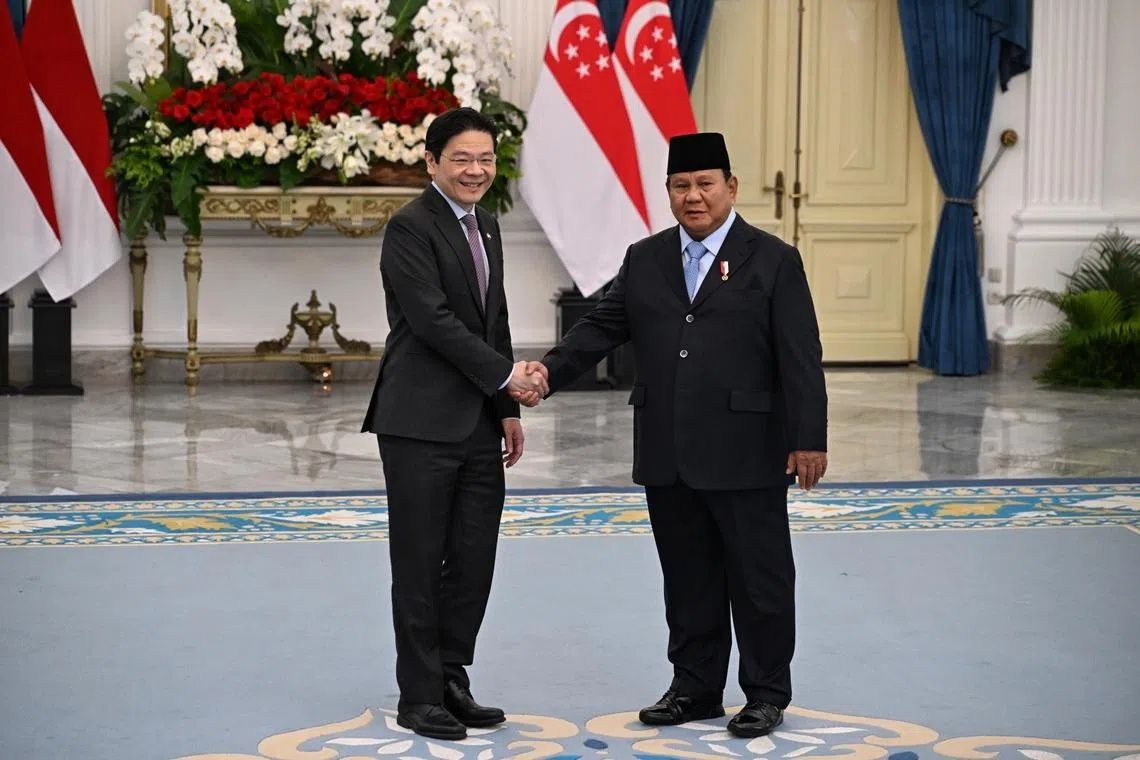
Singapore and Indonesia have jointly committed to preserving the Strait of Malacca as an open, safe and accessible maritime corridor for all nations, marking a significant elevation of maritime security within their bilateral partnership. The pledge emerged from talks between Prime Minister Lawrence Wong and President Prabowo Subianto on July 6 during the annual Leaders' Retreat, underscoring how both governments now view the protection of one of the world's most strategically vital shipping routes as fundamental to regional peace and economic prosperity.
The Strait of Malacca represents far more than a simple waterway between two nations. Connecting the Indian Ocean to the South China Sea, it serves as a conduit for substantial portions of global trade and energy supplies, making any disruption to its operations a matter of concern extending well beyond Southeast Asia. Recent international developments have amplified the urgency of this commitment, with Prime Minister Wong drawing direct parallels to the Middle East situation, where recent tensions have severely constrained traffic through the Strait of Hormuz and disrupted worldwide supply chains and oil movements. Against this backdrop, the emphasis on maintaining free passage through the Malacca Strait speaks to a recognition that maritime chokepoints now demand proactive diplomatic attention.
President Prabowo articulated Indonesia's position with clarity, emphasizing that both countries share direct stakes in the waterway's security and accessibility. Indonesia's geographic position as a littoral state bordering the strait positions it as a custodian of this critical passage, a responsibility the president took seriously in his remarks. He outlined a comprehensive vision for the strait's future that encompasses not merely ensuring open passage for commerce, but also safeguarding vessels from environmental threats, accidents, and maritime crime. This multifaceted approach signals that both governments view their stewardship obligations as extending across security, environmental, and safety dimensions.
Crucially, President Prabowo indicated that Indonesia plans to coordinate with Malaysia and Thailand to ensure compliance with international maritime law frameworks, specifically referencing the United Nations Convention on the Law of the Sea. This multilateral coordination reflects a sophisticated understanding that the Malacca Strait's security cannot be addressed by bilateral agreements alone, but rather requires sustained dialogue among all littoral states. The commitment to work through established international legal frameworks rather than pursuing unilateral measures demonstrates a measured approach to maritime governance that should reassure the broader international community, including major trading nations far beyond the region.
Prime Minister Wong's framing of Singapore and Indonesia as "strategically aligned" on this issue carries particular weight given the depth of bilateral ties between the city-state and the archipelago. His emphasis on shared interests in upholding navigational rights and freedoms reflects a convergence of perspectives that extends beyond immediate regional concerns to encompass principles of open maritime access that undergird global commerce. Singapore's own position as a major shipping hub and financial centre means its commitment to Malacca Strait security carries substantial economic implications, making the bilateral agreement a reflection of genuine mutual interest rather than mere diplomatic protocol.
Beyond maritime security, the Leaders' Retreat revealed an ambitious expansion of Singapore-Indonesia cooperation into sectors that will shape economic trajectories for decades. Cross-border electricity trade has emerged as perhaps the most significant new arena, with both nations recognizing that energy security and integration represent crucial foundations for future prosperity. Indonesia's sovereign wealth fund Danantara taking the lead in implementing such cooperation signals serious intent from Jakarta to structure these initiatives through credible institutional channels. The involvement of established Singapore firms including Keppel Electric, Sembcorp Industries and Singapore Energy Interconnections indicates that private sector capacity will be mobilized alongside government-level commitments.
Prime Minister Wong characterized the electricity trade initiative as contributing toward a broader ASEAN Power Grid, a concept that carries transformative potential for regional energy security and climate objectives. By positioning bilateral cooperation as building blocks for a wider multilateral structure, both leaders are framing their partnership as exemplifying the kind of connectivity that the entire region requires. For Malaysian readers, this development has direct implications: the success of Singapore-Indonesia electricity trade could establish precedents and infrastructure models that neighbouring nations, including Malaysia, might eventually integrate into regional energy architecture. The initiative thus represents not merely bilateral cooperation but potentially a template for expanded ASEAN energy interconnection.
The discussions surrounding digital infrastructure and cybersecurity reflect recognition among both governments that emerging technological challenges cannot be addressed through legacy frameworks. President Prabowo reported that conversations on digital ecosystems had yielded "fairly concrete outcomes," suggesting that abstract principles had translated into actionable commitments. Supply chain resilience emerged as another priority, with both leaders acknowledging that the global disruptions of recent years have underscored the necessity of building redundancy and flexibility into economic networks. These conversations position Singapore and Indonesia as forward-thinking partners preparing their economies for the structural challenges of the coming decades.
Prime Minister Wong's repeated emphasis on Singapore's confidence in Indonesia's economic future and Singapore's intention to remain a long-term development partner carried considerable significance. His observations regarding Singapore's investments extending beyond capital flows to encompass business creation, downstream industries, digital infrastructure and employment generation articulated a vision of partnership that transcends transactional finance. He highlighted specific investment zones including the Batam, Bintan and Karimun regions as well as the Kendal Industrial Park in central Java, noting that the latter has achieved full capacity after a decade of operations and plans further expansion by 1,000 hectares.
The Kendal Industrial Park expansion carries particular symbolic weight, as it demonstrates that bilateral economic cooperation has matured from initial pilot phases into sustainable, scaling operations. The prospect of 1,000 additional hectares of industrial capacity represents not merely factory space but potential employment for thousands of Indonesian workers and opportunities for Singapore and international firms to establish regional production networks. This expansion reflects confidence in Indonesia's investment climate and suggests that Singapore's private sector perceives sufficient stability and opportunity to commit significant capital to long-term regional development.
The trajectory visible across these various cooperation domains suggests a relationship approaching a new maturity as Singapore and Indonesia prepare to commemorate 60 years of formal diplomatic relations in 2027. Rather than resting on historical foundations, both governments are actively constructing new pillars of partnership that address contemporary challenges and emerging opportunities. The elevation of maritime security alongside innovations in energy trade and digital cooperation demonstrates recognition that regional stability depends on addressing multifaceted challenges simultaneously—security threats cannot be adequately countered without economic partnership, just as economic integration remains fragile without adequate attention to security infrastructure.
For the broader Southeast Asian region and the international community, the Singapore-Indonesia commitment to maintaining an open Malacca Strait carries implications extending far beyond the bilateral relationship. The waterway processes roughly one-third of global maritime trade and half of the world's oil shipments, meaning its security affects economic conditions across Asia, Europe, and beyond. The willingness of both governments to reaffirm their commitment to open passage and to coordinate with neighbouring littoral states provides reassurance to trading nations worldwide that the region's dominant powers recognize their responsibilities as custodians of critical global infrastructure. This positioning, combined with the expansion into new cooperation domains, suggests a Southeast Asia capable of managing its own strategic affairs while contributing to broader international stability.

