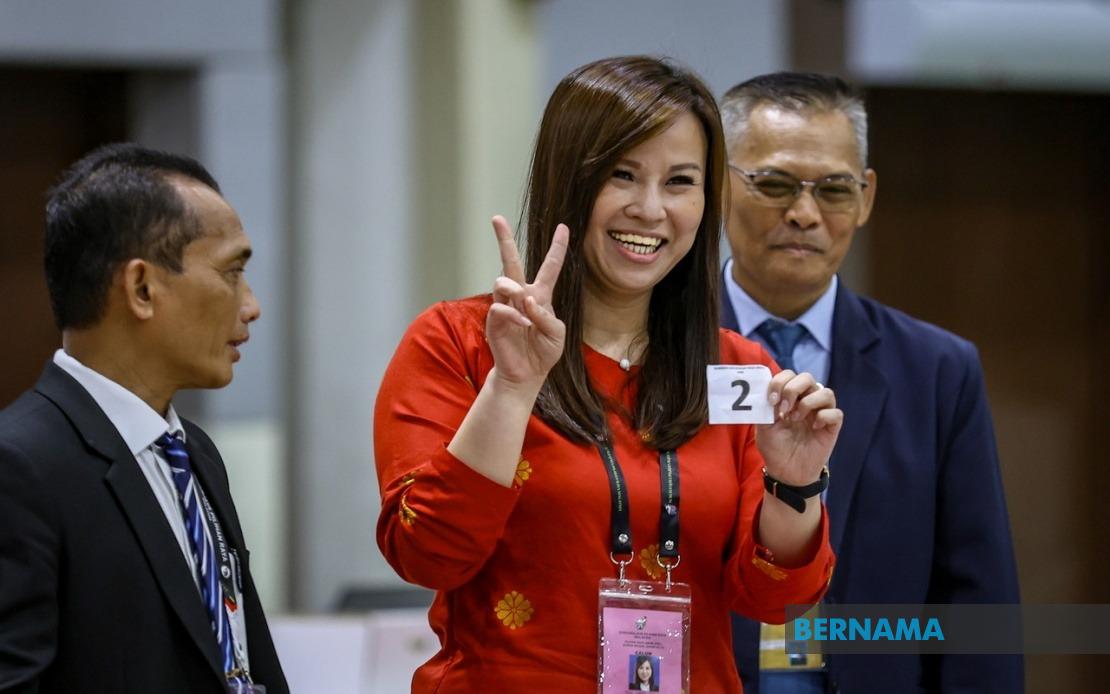
Sharon Teo has thrown her hat into the ring for the Permas state constituency in Johor's 16th state election, anchoring her campaign on two core pillars: improving physical infrastructure and enhancing public welfare services. The Pakatan Harapan candidate, who leads the Johor Amanah Women's Youth chapter, has spent recent weeks engaging voters directly and consistently hears the same grievances being raised in coffee shops, neighbourhood suraus, and community centres across the sprawling constituency.
During nomination proceedings at Dewan Muafakat in Taman Mawar, Teo emphasised that deteriorating road conditions represent a critical safety concern demanding immediate remedial action. Rather than framing infrastructure as a narrow technical issue, she has positioned it as a matter of personal security for families navigating daily commutes and delivering children to school. This framing resonates particularly in growing suburban constituencies where inadequate maintenance of secondary and tertiary roads has become a source of frustration, with potholes and uneven surfaces creating hazardous conditions during monsoon seasons.
Teo brings relevant political experience to her candidacy. She previously worked as a political aide within the Pulai parliamentary constituency, serving under Salahuddin Ayub during his tenure as Amanah deputy president. That background provides her with direct exposure to constituency management and the mechanics of delivering government services, though her previous work operated at the federal level rather than state administration. She has signalled that a comprehensive manifesto detailing her specific vision and policy proposals for Permas constituents will be released in the coming days, suggesting a methodical campaign rollout rather than ad-hoc announcements.
Defending the seat, incumbent Baharudin Mohamed Taib of Barisan Nasional captured the Permas mandate in the 2022 state election and is now preparing for a significantly more complex political environment. Unlike five years ago when two-cornered contests dominated Malaysian electoral politics, he must now contend simultaneously with three opposing candidates. Baharudin has adopted a cautious posture, publicly acknowledging that each competitor possesses distinct strengths and cannot be dismissed lightly. His rhetoric emphasises the difficulty of the task ahead, framing the election as requiring sustained effort rather than a comfortable defence of an established advantage.
Intriguingly, Baharudin has indicated he will not produce a personal campaign manifesto, instead relying on the broader Barisan Nasional platform. This approach suggests either confidence in the ruling coalition's institutional machinery or a preference to avoid staking out positions that might alienate different voter blocs within a diverse suburban electorate. By tethering his campaign to party-level commitments rather than constituency-specific pledges, he maintains flexibility but potentially sacrifices the opportunity to craft a distinctive local narrative.
The Permas contest has evolved into a genuine four-cornered affair, with T. Vela representing Perikatan Nasional and Dr Zamil Najwah standing for the newer Parti Bersama Malaysia. The presence of multiple challengers fundamentally reshapes electoral mathematics in the constituency, as vote fragmentation becomes a decisive factor. Neither Teo nor Baharudin can simply assume they will consolidate their respective support bases; swing voters and first-time voters become disproportionately important in determining outcomes when the field is splintered.
Permas occupies a strategic location within the broader Pasir Gudang parliamentary constituency, a region that has undergone substantial demographic transformation over the past decade. With 113,963 eligible voters registered for this state election, it represents a medium-sized constituency by Malaysian standards. The composition reflects Johor's evolving political character: a mixture of established communities and newer residential developments, creating a voter demographic spanning different age cohorts, income levels, and geographic attachments to the constituency.
The constituency's location within Pasir Gudang carries particular significance for understanding broader electoral trends in Johor. Pasir Gudang itself has been a hotly contested parliamentary seat, frequently shifting between ruling and opposition control. Such volatility at the parliamentary level often transmits downward to state contests, suggesting that Permas voters may be genuinely persuadable rather than locked into entrenched partisan allegiances. This fluidity creates opportunities for candidates able to articulate fresh visions while simultaneously presenting themselves as competent administrators.
Road infrastructure in suburban constituencies such as Permas represents more than merely a technical issue; it embodies voter frustrations with the pace of development and government responsiveness. When potholes persist, when traffic lights malfunction, and when drainage systems fail during heavy rainfall, constituents interpret these failures as emblematic of broader governance shortcomings. By elevating road quality to campaign priority status, Teo is tapping into a readily mobilisable grievance that cuts across typical political dividing lines. Voters frustrated with current conditions represent potential recruits to her campaign regardless of their historical voting patterns.
The welfare component of Teo's platform addresses economic vulnerabilities and access to government assistance. In suburban constituencies experiencing rapid population growth, social support systems frequently struggle to keep pace with demand. Community welfare programmes targeting elderly residents, single mothers, persons with disabilities, and low-income households often operate below capacity or with insufficient resources. By committing to enhanced welfare provision, Teo implicitly critiques current adequacy levels while positioning her candidacy as responsive to constituent material needs.
Pakatan Harapan's strategic selection of Teo as the coalition's standard-bearer in Permas reflects broader efforts to deepen the opposition's presence in Johor, a state the coalition has contested but not yet decisively cracked. By fielding a younger candidate with demonstrable party loyalty and relevant constituency experience, PH signals seriousness about the contest while managing expectations about the difficulty of capturing what remains a Barisan-leaning state. Teo's profile as a women's youth leader also serves to highlight generational change and feminine leadership within the Amanah party structure.
With polling scheduled for July 11 and early voting occurring on July 7, the campaign has entered its decisive phase. The compressed timeline means that both established and emerging candidates must efficiently communicate their messages while differentiating themselves in an increasingly crowded field. For voters accustomed to two-candidate races, the four-way contest requires more deliberate engagement with alternative options rather than defaulting to habitual choices. This structural feature of the 2024 Johor election creates genuine unpredictability and genuine opportunities for challengers willing to mobilise voters effectively.

