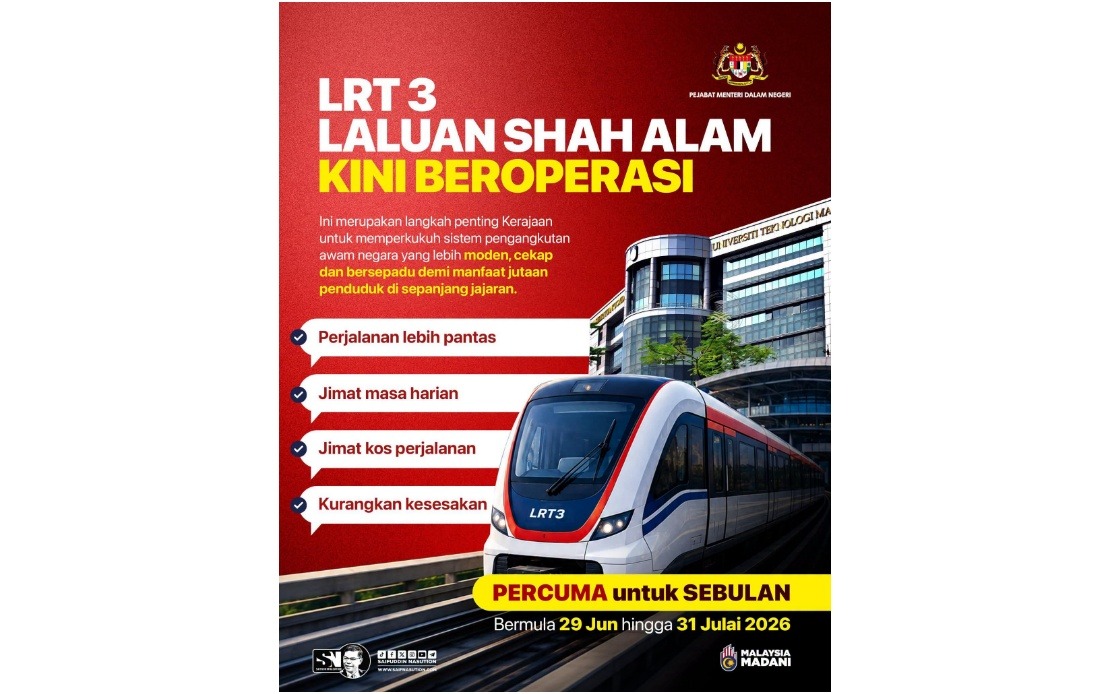
The Shah Alam Line LRT3 stands as a tangible demonstration of the MADANI Government's determination to reshape Malaysia's public transport landscape, according to Home Minister Datuk Seri Saifuddin Nasution Ismail. Speaking from Shah Alam, the minister framed the new rapid transit line as a critical component of the administration's broader vision for enhancing citizen mobility and quality of life across the nation's most densely populated regions.
The opening of LRT3 comes at a time when the Klang Valley faces mounting pressure from traffic congestion that has become a defining feature of commuter life for millions of Malaysians. The new line directly addresses bottlenecks along one of Southeast Asia's busiest transport corridors, providing residents with an alternative to road-based travel that has historically been the default option. By introducing another rail option into an increasingly saturated transport ecosystem, the government aims to create a more distributed network that can absorb demand without overwhelming any single infrastructure component.
Saifuddin emphasised that the initiative extends beyond mere capacity expansion. The Shah Alam Line LRT3 functions as part of an integrated system incorporating feeder bus services operated by Prasarana Malaysia Bhd, creating a multimodal approach that connects residential areas, employment hubs, and educational institutions. This layered design reflects contemporary urban planning principles that prioritise connectivity over isolated infrastructure investments, allowing commuters to plan journeys that combine rail and bus services seamlessly.
The economic implications for daily commuters appear substantial. By shifting from private vehicle use to public transport, workers, students, and others can redirect substantial portions of their household budgets previously allocated to fuel, parking, and vehicle maintenance towards other priorities. For a middle-income family in the Klang Valley, monthly savings from reduced driving could reach several hundred ringgit, compounding annually into meaningful financial relief.
Prime Minister Datuk Seri Anwar Ibrahim marked the operational commencement of LRT3 with an announcement of free fares extending from June 29 through July 31, a promotional period designed to acquaint potential users with the service and demonstrate its convenience. The government's calculation appears strategic: by eliminating the financial barrier during the initial phase, decision-makers hope to convert trial users into habitual commuters who will maintain ridership even after standard fares apply. This conversion dynamic represents the true measure of the project's success beyond mere opening-day enthusiasm.
Saifuddin's public messaging specifically targeted residents of Shah Alam, Klang, Subang, and adjacent areas along the LRT3 alignment. This segmented approach recognises that adoption rates depend partly on awareness and familiarity within communities that stand to benefit most directly. By encouraging people to experience the service free of charge, the minister sought to overcome initial hesitation and demonstrate that making the transition from car-dependent lifestyles remains feasible even for those deeply accustomed to private transport.
The broader context reveals a government attempting to position public transport investment as central to its development narrative. The MADANI framework, emphasising people-centred governance and improved living standards, finds concrete expression through infrastructure projects like LRT3. These visible, tangible improvements offer voters evidence that policy commitments translate into functional improvements in their daily experience, a calculus particularly important in Malaysia's competitive political environment.
From a Southeast Asian perspective, LRT3's development signals Malaysia's continued confidence in rail-based transit solutions despite regional challenges in securing consistent funding and managing operational efficiency. The Klang Valley's rapid urbanisation mirrors patterns across Bangkok, Jakarta, and Manila, where governments struggle to provide transport capacity matching population growth. Malaysia's willingness to deploy substantial capital into LRT infrastructure suggests confidence that rail projects, despite their considerable upfront costs and complexity, ultimately deliver superior outcomes compared to road expansion alone.
The free-fare initiative also carries implicit messaging about government priorities. By subsidising usage during the promotional period, authorities signal that public transport constitutes a social good deserving public investment, rather than a purely commercial service that should operate entirely on user fees. This philosophical positioning matters for longer-term ridership trends and political support for future expansions.
Looking forward, the critical test lies in whether commuters converted during the free-fare window maintain their usage patterns once regular fares resume. Transport planners worldwide have observed that promotional pricing often creates inflated demand that contracts sharply once financial incentives disappear. Malaysia's success with LRT3 will depend on whether the service quality, frequency, and route coverage prove compelling enough to retain users based on fundamental utility rather than temporary cost savings.
For residents contemplating the shift from private vehicles, the July 31 deadline creates urgency to experience the service while costs remain zero. Saifuddin's invitation to leave cars behind represents more than casual marketing language; it acknowledges the psychological barriers many Malaysians face when considering alternatives to driving, particularly in suburban areas where car ownership remains culturally embedded as a marker of independence and status.
The project ultimately reflects a government betting that infrastructure modernisation can meaningfully reshape transportation behaviour in an affluent, motorised society. Whether LRT3 achieves the adoption rates necessary to justify its capital outlay and justify similar investments elsewhere in Malaysia remains an open question that will be answered gradually through ridership patterns, feedback, and the decisions individual commuters make as they weigh convenience, cost, and preference.

