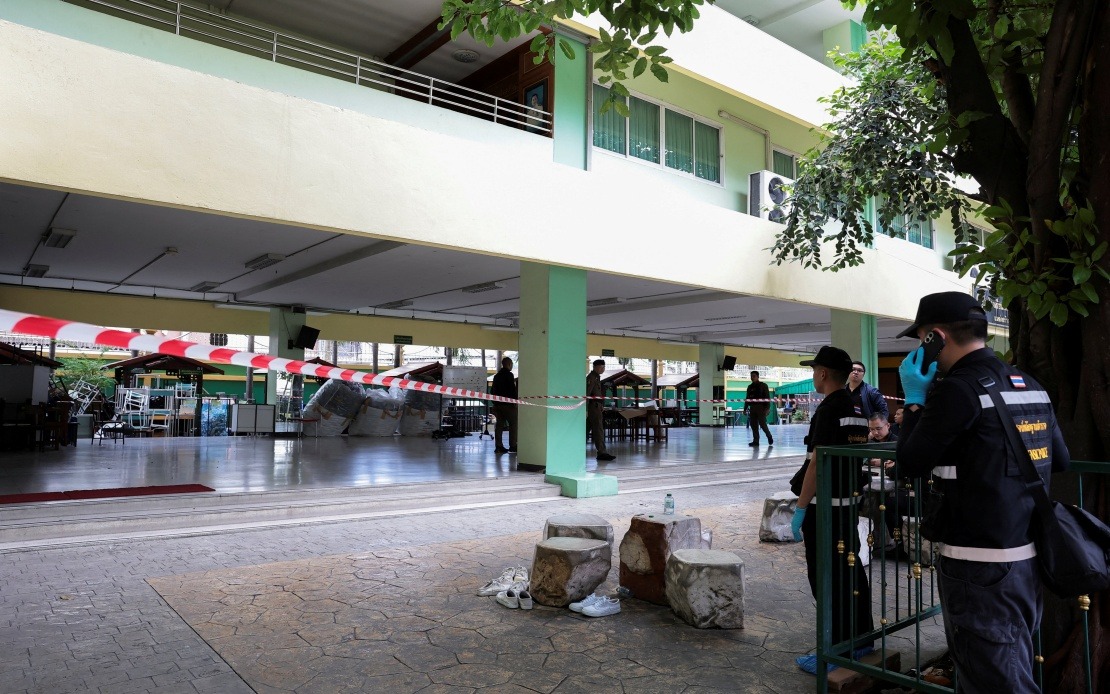
A school shooting in Nonthaburi province northwest of Bangkok has left seven people dead and at least 15 injured, marking another devastating act of gun violence in Thailand. The incident occurred at Debsirin Nonthaburi School in Bang Kruai district on Friday morning around 10 am, when a student opened fire on the premises. Among those killed were three teachers, three fellow students, and the shooter himself. The casualties highlight the persistent problem of firearm access in Thailand, despite government efforts to tighten regulations on gun ownership.
Lieutenant General Trairong Piwpan, deputy inspector-general and spokesperson for the Royal Thai Police, confirmed the death toll and provided initial details of the attack. He stated that seven people died at the scene of the shooting, while emergency responders transported 15 wounded individuals to hospital facilities for treatment. Of those hospitalised, two victims sustained injuries serious enough to require urgent medical intervention, underscoring the severity of the attack and its impact on the school community.
Police investigations quickly established that the firearm used in the shooting—a 9mm handgun with 34 rounds of ammunition—belonged to the shooter's grandfather rather than the student himself. This discovery raises troubling questions about gun storage practices among Thai families and the ease with which minors can access firearms kept in homes. The revelation also complicates the narrative around individual responsibility, as it suggests systemic gaps in how weapons are secured in private residences, a concern that extends beyond this single incident.
School authorities moved swiftly to protect remaining students and staff following the shooting. Teachers and students still at the school were evacuated to nearby Chanrat Wittaya School, where they received shelter and basic care. Parents and guardians were subsequently instructed to collect their children, transforming an ordinary Friday morning into a scene of chaos and trauma for families in the Nonthaburi area. The evacuation process, while necessary, added to the psychological toll on young people who witnessed or heard about the violence at their educational institution.
The national police chief recognised the psychological dimensions of the tragedy by ordering Police General Hospital to deploy trained psychologists to the affected school and surrounding areas. This response acknowledges that mass shooting incidents inflict not only physical injuries but deep emotional scars on survivors, witnesses, and the wider school community. Thailand, like other nations grappling with gun violence, has limited experience in coordinating large-scale mental health interventions following such traumatic events, making this directive a significant step toward comprehensive crisis management.
Prime Minister Anutin Charnvirakul, who simultaneously holds the interior ministry portfolio, issued a statement expressing sorrow over the incident and pledging government support for the injured. He ordered relevant authorities to provide urgent assistance to victims and deploy officials to coordinate response efforts. However, his remarks extended beyond condolences to encompass a broader policy argument, as he linked the shooting directly to the government's stance on firearm permits. Anutin stated that Thailand's decision not to renew permits for carrying and possessing firearms justified by precisely such incidents, positioning the tragedy as validation for stricter gun control measures.
This school shooting represents the second such incident in Thailand within a six-month period, indicating a troubling pattern rather than an isolated tragedy. In February, an 18-year-old man fired upon a school in Hat Yai, Songkhla province, killing the school director and wounding additional victims before authorities apprehended him. The recurrence of school shootings in Thailand suggests that existing preventive measures, legislative frameworks, and enforcement mechanisms remain insufficient to deter such violence. The February incident, too, involved a young perpetrator, pointing to particular vulnerabilities among adolescents who have access to firearms within family homes.
For Malaysian observers, Thailand's repeated school shootings carry cautionary implications regarding gun regulation and enforcement. Malaysia has implemented strict firearm licensing requirements and maintains one of Southeast Asia's lower rates of gun-related incidents, yet ongoing smuggling and illegal weapon possession remain concerns. The Thai experience demonstrates how inadequate oversight of private gun ownership, combined with insufficient background checks or storage requirements, creates environments where tragic outcomes become foreseeable. Thailand's policy discussions around firearm permits therefore offer a comparative lens through which Malaysian policymakers can evaluate the effectiveness of existing controls.
The broader Southeast Asian context amplifies the significance of these incidents. While Thailand officially maintains restrictive firearms laws, enforcement gaps and family-based weapon possession create dangerous loopholes. The incidents also reflect global patterns whereby school shootings perpetrated by students or young individuals typically involve guns obtained from family members rather than through illicit procurement channels. This reality underscores that limiting gun availability at the point of private ownership—through strict permitting, mandatory secure storage, and regular compliance audits—remains the most effective prophylactic measure available to governments seeking to prevent mass casualty events in educational settings.
Looking forward, Thailand faces mounting pressure to address not only the immediate humanitarian crisis but the underlying structural factors enabling such violence. Prime Minister Anutin's rhetorical linking of the incident to permit renewal policies signals potential movement toward stricter regulations, yet statements alone cannot prevent future shootings. Comprehensive approaches would need to encompass enhanced enforcement of existing laws, mandatory gun safety courses and secure storage requirements for all permit holders, improved mental health services for at-risk youth, and clear protocols for schools to identify and support students showing signs of distress or violent ideation. Thailand's response to this tragedy will define whether policymakers treat it as a catalyst for systemic reform or merely as an occasion for official expressions of regret.

