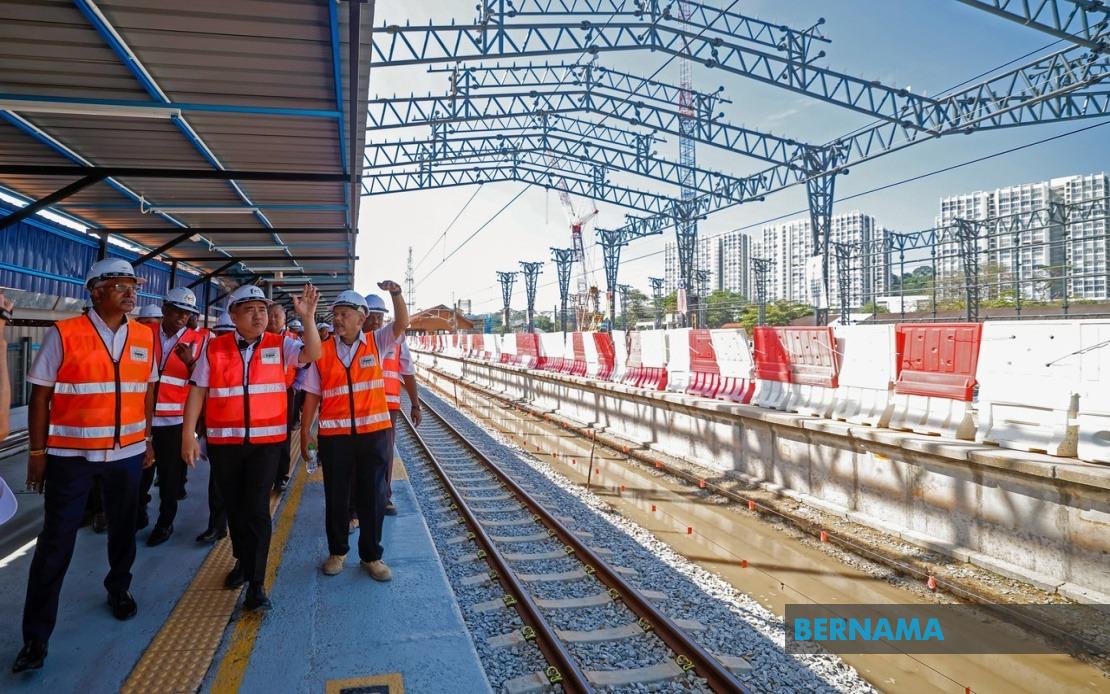
Seremban's ambitious transportation transformation is progressing steadily, with the integrated Seremban Sentral railway station now one-third complete and on track for delivery in early 2027. Transport Minister Anthony Loke confirmed during an inspection visit that the project has cleared its most labour-intensive preliminary phases, positioning the initiative to accelerate through its remaining construction milestones. The RM100 million undertaking represents a significant infrastructure commitment for Negeri Sembilan, blending heritage preservation with contemporary urban mobility needs.
The foundation work that consumed much of the project's opening years has yielded to faster-paced construction activities. Loke explained that the initial phase demanded extensive piling operations to ensure structural integrity, coupled with the intricate relocation of underground utilities including cables and electrical infrastructure scattered beneath the city centre. These foundational challenges, while time-consuming, are now substantially resolved, creating the conditions for installation of superstructure elements including the roof framework and glazing systems that will define the station's visual character. The project's complexity reflects the difficulty of developing modern transport infrastructure within an urban environment where existing services must remain operational.
The new station will constitute a remarkable spatial expansion compared to the heritage Seremban KTMB Station, which has served the community for over a century. Rather than demolishing this historic structure, the design integrates it into a contemporary transport complex, creating a dialogue between old and new architecture. The modern facility embraces a green building philosophy whilst incorporating Minangkabau architectural elements that reference the region's cultural heritage. This thoughtful approach demonstrates how Malaysian infrastructure development can honour historical significance whilst meeting contemporary operational requirements. The station's commercial spaces will generate ongoing revenue whilst attracting foot traffic that supports the surrounding urban ecosystem.
Capacity planning reflects confidence in Seremban's growth trajectory. The station infrastructure incorporates six platform positions, though initial construction will complete only three, with the remaining three reserved for future expansion. This phased approach allows the facility to accommodate approximately 30,000 daily passengers initially, with theoretical capacity reaching 120,000 passengers daily once fully developed. Loke's assessment suggests the infrastructure should satisfy regional transportation needs across the next three to five decades, a planning horizon that acknowledges potential urbanisation patterns and economic development in Negeri Sembilan. The flexibility embedded in the design represents prudent infrastructure planning that avoids both premature over-investment and capacity constraints.
Freight and passenger service frequency improvements depend substantially on completion of the Klang Valley Double Track Phase 2 upgrade project, which has achieved 55.8 per cent progress. The current reduction in afternoon Komuter services reflects temporary track closures necessary for construction advancement rather than systemic service deterioration. Once the double-track infrastructure completes, Malaysian railways can increase Komuter, ETS, and freight service frequencies, making regional rail travel more competitive against road transport. This integration between Seremban Sentral and broader Klang Valley improvements illustrates how metropolitan rail networks increasingly depend on coordinated development across multiple nodes and corridors.
Traffic management and accessibility received careful consideration in the station design. Twin entrance points positioned at Jalan Tunku Antah and the rear of the facility, supplemented by separate drop-off zones, distribute arrival and departure flows more evenly throughout the surrounding street network. This design strategy aims to prevent the traffic concentration that characterises single-entrance transport interchanges. For Malaysian cities struggling with urban congestion, such design innovations represent practical solutions that spatial planners increasingly recognise as essential for modern transport hubs.
Flood mitigation emerges as a critical operational consideration that demonstrates how climate adaptation intersects with infrastructure modernisation. The heritage Seremban KTMB Station renovation project, completed last month, incorporated upgraded electrical and wiring systems ensuring safe ongoing operation whilst also addressing the chronic flooding problem that previously disrupted service. The new sewerage system represents an engineering solution that diverts rainwater directly into Sungai Temiang rather than allowing water to accumulate within the station precinct. During monsoon seasons and intense rainfall events, this drainage improvement could prove transformational for service reliability, particularly as Malaysian weather patterns show increasing climate volatility.
The completed heritage station renovation project underscores the ministry's commitment to preserving cultural infrastructure whilst upgrading technical systems. The work involved meticulous attention to electrical infrastructure modernisation that ensures the 100-year-old building meets contemporary safety standards. This conservation approach respects the station's historical significance whilst rendering it functionally contemporary, a balance that becomes increasingly important as Malaysia's oldest urban infrastructure requires simultaneous heritage protection and functional renewal.
The Transit-Oriented Development (TOD) project planned behind Seremban Sentral represents the broader urban strategy anchored by this railway investment. Such mixed-use developments typically combine residential, commercial, and entertainment functions within walking distance of high-capacity transit, creating vibrant urban quarters that reduce automobile dependence. Seremban's TOD opportunity could catalyse additional private investment around the station, generating economic activity that justifies the public infrastructure investment whilst improving urban vitality. For Malaysian metropolitan areas seeking alternatives to car-centric development patterns, such TOD models offer proven templates for creating liveable, economically productive urban environments.
The project's significance extends beyond Seremban to broader regional connectivity patterns. Enhanced rail infrastructure in Negeri Sembilan improves accessibility to Kuala Lumpur whilst potentially encouraging commuter movements that distribute population and economic activity more widely across the Klang Valley periphery. As Malaysian transportation policy increasingly emphasises public transit over highway expansion, anchor facilities like Seremban Sentral become critical infrastructure investments that shape settlement patterns and economic opportunity distribution for decades. The station's completion in March 2027 will mark an important milestone in Malaysia's evolving transport landscape.

