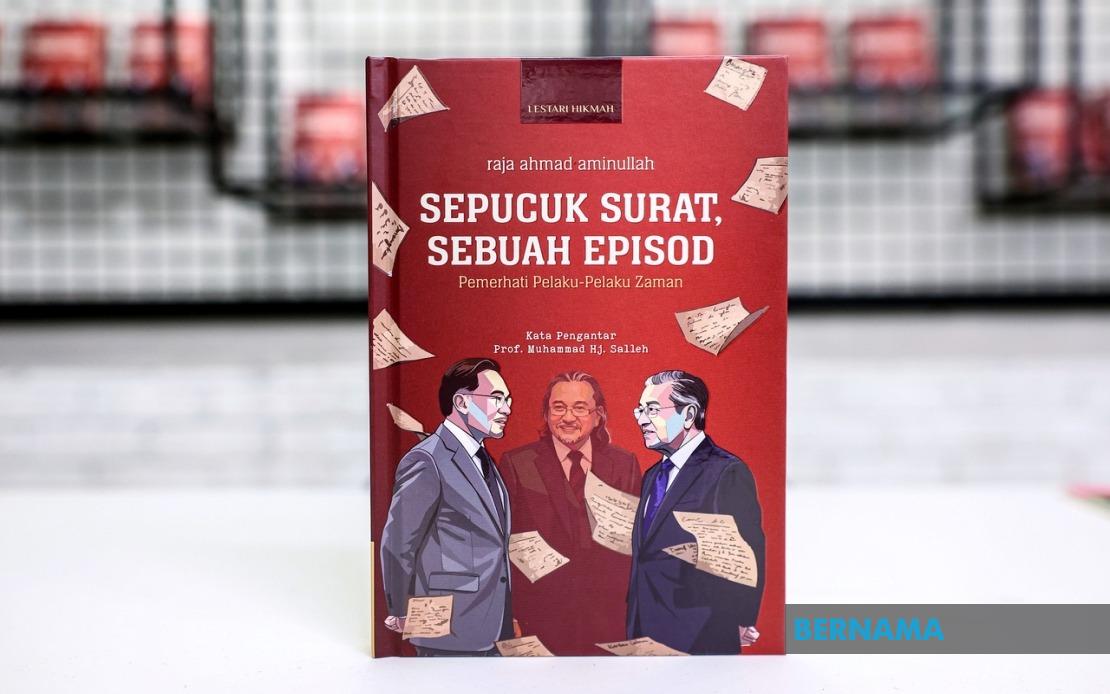
Malaysia's cultural landscape has been enriched by the release of 'Sepucuk Surat Sebuah Episod: Rakaman Pelaku-Pelaku Zaman', a curated collection of personal correspondence from celebrated figure Raja Ahmad Aminullah that provides readers with intimate glimpses into the lives and thoughts of individuals who have significantly influenced the nation's trajectory. The book launch, hosted by the National Book Council of Malaysia, drew together artists, scholars, literary figures and long-standing associates of the author in a gathering that underscored the broader significance of preserving and sharing such archival material.
Raja Ahmad Aminullah, affectionately referred to as Pak Engku, positioned the work as a deliberate departure from conventional political narratives, instead framing it as an exercise in socio-cultural documentation. Rather than adopting an explicitly ideological stance, the author emphasised that his primary motivation centres on chronicling his observations of society, the communities within it and the manifold social and cultural pressures affecting contemporary Malaysian life. This methodological choice reflects a growing recognition among cultural historians that personal correspondence often yields richer, more nuanced understanding of historical periods than formal political analysis alone can provide.
During his remarks at the launch event, Raja Ahmad clarified that the collection was not designed to privilege any particular political figure or movement. He deliberately distanced the work from becoming a biographical or hagiographical treatment of prominent personalities, instead positioning it as a repository of moments, anecdotes and reflections that span approximately a quarter-century of Malaysian history. By extracting himself from the narrative—describing himself as inconsequential to the larger historical record—the author invites readers to contemplate the substance of recorded interactions rather than to focus on his own editorial perspective or interpretive framework.
The scope of correspondents whose letters feature in the volume encompasses figures whose names dominate Malaysia's political and social landscape, including Tun Dr Mahathir Mohamad and Datuk Seri Anwar Ibrahim. However, Raja Ahmad's deliberate refusal to elevate any single personality reflects a conscious curatorial choice designed to prevent the book from becoming a vehicle for promoting particular political interests or revisionist historical accounts. Instead, the collection functions as a layered historical document that permits readers to draw their own conclusions about the personalities, motivations and worldviews represented within its pages.
For scholars of Malaysian history, cultural studies and political science, the publication offers methodological value extending beyond its immediate narrative content. Personal correspondence provides documentary evidence of informal thought, unguarded reflection and candid exchange that formal speeches, press statements and published memoirs often carefully obscure. Letters frequently contain the kind of contextual detail, emotional tenor and immediate reaction to events that shed light on decision-making processes, personal relationships and the intellectual concerns occupying prominent figures during specific historical moments. The temporal specificity of such material—rooted in a discrete historical period roughly spanning the late 1990s—renders it particularly valuable as Southeast Asia undergoes continued institutional and ideological transformation.
Raja Ahmad's emphasis on the pedagogical potential of the work signals an understanding that preservation of primary historical documents serves future generations in ways that conventional political analysis cannot. By positioning the collection as a resource from which lessons might be extracted and reflection encouraged, the author acknowledges that historical understanding requires sustained engagement with evidence rather than acceptance of predetermined interpretations. This approach has particular relevance for Malaysian readers navigating a period characterised by ongoing reassessment of the nation's political history and social development priorities.
The publication was facilitated by Lestari Hikmah, a publishing house evidently committed to producing culturally significant historical documentation. The book itself is a modest 169-page volume, suggesting a carefully curated rather than exhaustively comprehensive collection of correspondence. This restraint in length indicates that editorial decisions were made regarding which letters possessed sufficient historical or cultural significance to merit inclusion, implying that the published version represents refined rather than raw archival material. Such curation adds value by focusing reader attention on substantive rather than ancillary material.
From a practical accessibility standpoint, the dual publication format—softcover at RM30 and hardcover at RM80—positions the work within reach of general readers interested in contemporary Malaysian history whilst offering a premium version for academic institutions and serious collectors. The pricing structure reflects recognition that historical documentation serves multiple constituencies with varying resource constraints, from university libraries and research centres to individual readers pursuing personal intellectual interests. Distribution through conventional bookstore channels alongside online platforms broadens potential readership across both urban and geographically dispersed populations.
The launch event itself functioned as a form of cultural validation, with representation from Malaysia's literary and academic establishments indicating institutional recognition of the work's significance. Such gathering signifies that the preservation and publication of historical correspondence is increasingly valued within Malaysia's cultural establishment as legitimate and worthy of serious engagement. This development reflects a maturation of historical consciousness within the nation, moving beyond partisan political narratives towards more comprehensive and nuanced understanding of how individuals, institutions and social forces have intersected across recent decades.
For Malaysian readers seeking to understand the informal networks, personal relationships and unrecorded conversations that have shaped national development, this collection offers documentary evidence of the human dimensions underlying formal historical narratives. The letters contained within likely reveal patterns of thought, concern and aspiration among influential figures that contextualise the major political transitions, economic decisions and social policies implemented during the period in question. Such materials contribute to a more complete historical record than official accounts alone can furnish.
The broader significance of 'Sepucuk Surat Sebuah Episod' extends beyond its immediate commercial success or academic utility. The work represents an assertion that Malaysia's recent history possesses sufficient cultural weight and intellectual substance to warrant careful preservation and scholarly engagement. As the nation continues to reckon with its developmental trajectory and institutional evolution, access to authentic primary documents authored by key figures becomes increasingly valuable for informing contemporary policy discussions and historical understanding. Raja Ahmad's decision to make such materials publicly available fulfils an important archival function whilst affirming the enduring relevance of personal correspondence as historical evidence.

