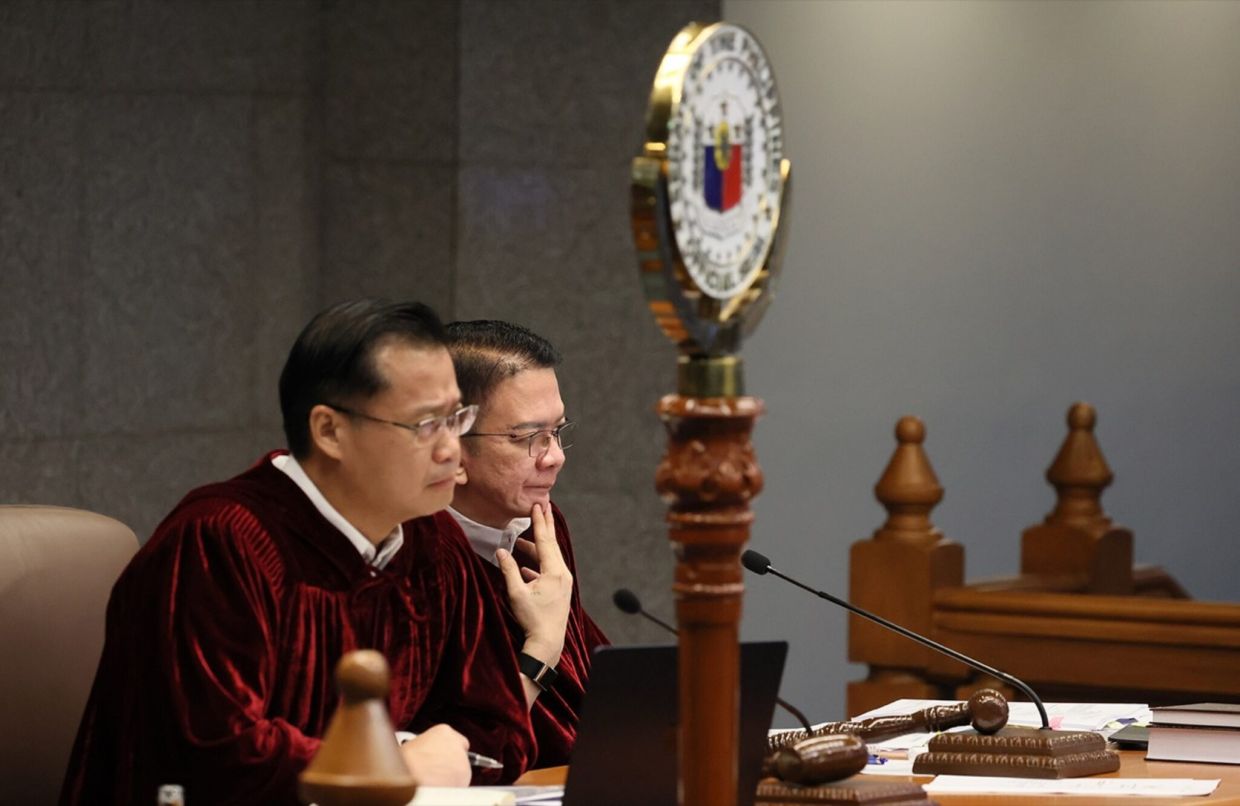
The Philippine Senate's impeachment court faces a consequential procedural decision as it prepares to vote on whether to subpoena Vice President Sara Duterte's confidential financial documents. House prosecutors have signalled strong confidence that the court will grant their request to access the Vice President's banking details, tax filings and records held by the Anti-Money Laundering Council, alongside those of her husband, lawyer Manases Carpio. The anticipated ruling represents one of the most strategically important moments in Duterte's impeachment trial, which had already entered its second week, with the prosecution asserting that these financial disclosures form the evidentiary foundation for establishing whether she accumulated wealth beyond what her legitimate income could explain.
The prosecution's case rests substantially on demonstrating that Duterte violated Article II of the impeachment charges, which targets unexplained wealth accumulation by public officials. Prosecutors frame the financial records as indispensable to their broader narrative, arguing that without access to banking transactions, tax declarations and anti-money laundering reports, they cannot adequately substantiate allegations that the Vice President engaged in undeclared business interests or misused her public office for financial gain. Spokesperson Benjamin Tolosa Jr. has publicly stated the prosecution's optimism regarding the subpoena's approval, emphasising that their legal foundation for demanding these documents rests on well-established constitutional precedent and statutory exceptions built into Philippine financial privacy law.
The legal terrain for this dispute has been partially mapped by historical precedent. Tolosa pointed to the 2012 impeachment proceedings against former Chief Justice Renato Corona, when the Senate similarly compelled production of banking records despite the ordinarily absolute protections afforded by banking secrecy legislation. The invocation of Corona's trial signals how prosecutors view this procedural question: as a settled constitutional matter where impeachment's public accountability function supersedes individual financial privacy. Republic Act No. 1405, the nation's foundational bank secrecy statute, explicitly carves out impeachment proceedings from its confidentiality mandate, a provision that prosecutors emphasise demonstrates legislative intent to subordinate privacy protections when the Senate sits as an impeachment tribunal.
Prosecutor Chel Diokno amplified this argument during earlier oral proceedings, contending that the Senate derives constitutional authority to compel disclosure independently of any statutory exception. He argued that the impeachment court's power flows directly from the Constitution itself, permitting the chamber to demand production of records necessary to fulfil its impeachment jurisdiction. Diokno specifically invoked both the bank secrecy law's impeachment carve-out and the Data Privacy Act's provisions permitting disclosure pursuant to valid judicial or quasi-judicial process. Notably, he drew the temporal scope of relevant evidence widely, arguing that financial records spanning from Duterte's tenure as Davao City vice mayor through her subsequent service as mayor remain probative because the impeachment complaint itself alleges wealth accumulation across her entire career as a public official. An Anti-Money Laundering Council report referenced in House proceedings documented that Duterte's financial activity exceeded three billion pesos during the seven-year period from 2007 through 2013.
The defence mounted a sophisticated constitutional rebuttal, with lead counsel Michael Poa arguing that the Senate's subpoena authority does not translate into unfettered discretion to compel disclosure without satisfying foundational due process safeguards. Rather than disputing whether the Senate possesses theoretical subpoena power, Poa concentrated his challenge on whether exercising that power in this context would violate constitutionally protected confidentiality interests and statutory schemes designed to shield financial information from casual disclosure. He characterised the prosecution's documentary request as an impermissible fishing expedition, pointing out that prosecutors formulated their subpoena demand only after impeachment complaints had already been filed and the trial had commenced. This temporal sequencing suggested to the defence that the prosecution lacked genuine specificity about what evidence they sought to obtain.
Poa also mounted a temporal challenge to the subpoena's scope, arguing that prosecutors overreached by seeking financial records spanning nearly two decades, including periods when Duterte served as Davao vice mayor. He cited a 2025 Supreme Court decision in Duterte v. House of Representatives, contending that impeachable offences must occur while the official occupies an impeachable position, thereby excluding her vice mayoralty from legitimate inquiry. The defence further distinguished between the bank secrecy law, which explicitly recognises impeachment as an exception permitting disclosure, and the Anti-Money Laundering Act and National Internal Revenue Code, which contain no equivalent impeachment exception. This distinction became crucial to the defence strategy: even if the Senate could overcome bank secrecy protections, they possessed no comparable authority to compel production of AMLC reports or tax records, which remained protected by separate statutory regimes. Additionally, the defence objected to inclusion of Carpio's financial records, noting that as a private citizen without impeachable status, his confidentiality interests merited protection.
Civil society organisations have mobilised to advocate for granting the subpoena, framing financial disclosure as essential to democratic accountability. The August Twenty-One Movement warned against repeating what it characterised as the controversial "second envelope" procedural vote during former President Joseph Estrada's 2001 impeachment trial, when senators voted to withhold certain evidence. That historical moment had subsequently generated public backlash and contributed to Estrada's eventual downfall, suggesting to advocacy groups that concealment of relevant evidence ultimately delegitimised the process itself. The movement implored senator-judges to prioritise truth and justice, asserting that disclosure would either vindicate Duterte if her finances proved untainted or establish guilt if they revealed accumulation patterns inconsistent with her official income. A coalition of faith-based organisations, including Kingdom Keepers led by activist priest Fr. Robert Reyes and social anthropologist Dr Melba Padilla Maggay, similarly urged disclosure, contending that public accountability demands that officials demonstrate they refrained from exploiting their positions for financial enrichment.
Duterte confronts four substantive articles of impeachment alleging misappropriation of confidential funds, unexplained wealth accumulation and threatening remarks directed toward President Ferdinand Marcos, first lady Liza Araneta-Marcos and former Speaker Martin Romualdez. The stakes for the Vice President extend beyond temporary political embarrassment: conviction would trigger removal from office and permanent disqualification from any future public position, effectively ending her political career. This high-consequence procedural landscape explains the intensity with which both prosecution and defence have contested the subpoena question, recognising that financial documentation could prove either transformative to the prosecution's case or entirely dispositive of certain charges. For Malaysian and regional observers, the trial exemplifies contemporary Asia-Pacific struggles to balance official accountability mechanisms against individual privacy protections in an era of expanding financial surveillance capabilities.
The Senate's forthcoming vote carries implications that extend beyond Duterte's immediate legal exposure. The decision will establish whether the Philippines' impeachment process incorporates robust financial transparency as a prosecutorial tool or whether privacy law exceptions remain narrow enough to shield public officials' monetary records from legislative inquiry. This procedural resolution may influence future impeachment proceedings and shape the contours of accountability mechanisms available to Congress. National Bureau of Investigation Director Melvin Matibag is expected to provide testimony regarding the agency's investigation into Duterte's alleged threats, with prosecutors indicating that his testimony will illuminate NBI findings suggesting the remarks represented not spontaneous utterances but components of a coordinated plan. The convergence of this evidentiary presentation alongside the subpoena decision creates a moment where the trial's trajectory becomes clearer, potentially determining whether prosecutors can construct a comprehensive narrative of wrongdoing or whether evidence gaps will undermine conviction prospects.

