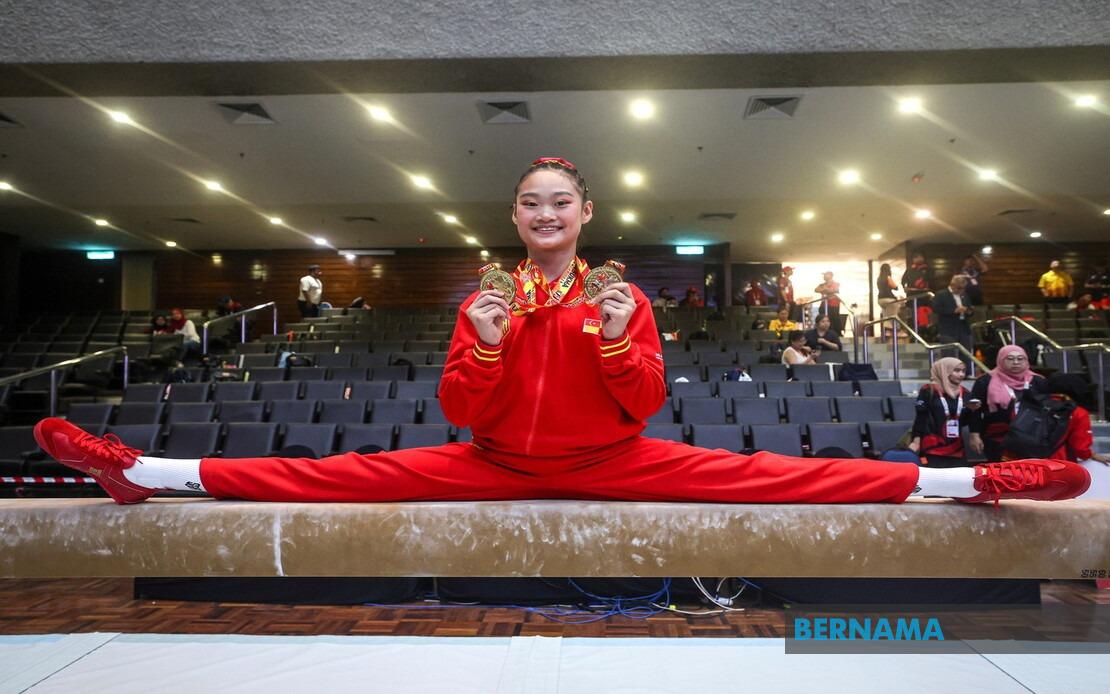
Selangor's Cadence Teh Zi Qi proved her credentials as Malaysia's emerging gymnastic talent by capturing a double gold medal haul at the SUKMA 2026 artistic gymnastics competition held at Universiti Kebangsaan Malaysia's Dewan Canselor Tun Abdul Razak in Bangi. The 17-year-old national athlete not only successfully defended her women's individual all-around title but also spearheaded her state's dominant performance in the team event, underlining Selangor's status as a powerhouse in the sport within Malaysia's competitive gymnastics landscape.
Cadence's all-around victory came with a commanding score of 48.550 points, a total that reflected her well-rounded execution across all four apparatus. Her performance was underpinned by a vault score of 12.050 points, uneven bars contribution of 11.400 points, balance beam achievement of 13.350 points, and floor exercise mark of 11.750 points. This comprehensive scoring demonstrates the depth of technical skill the young gymnast has developed across the discipline, a crucial requirement for competitive success at international levels.
The competition for the all-around title extended beyond Selangor's dominance, with strong showings from other states. Sarawak's Aurin Zulkarnain claimed the silver medal position with 44.500 points, a respectable performance that highlighted the competitive depth of Malaysian gymnastics. Behind her, the bronze medal was shared between Federal Territories' Annabelle Ho Syin Yee and Penang's Amanda Ching Lee Wern, both registering identical scores of 42.250 points. This three-way medal distribution across different regions suggests that gymnastics talent continues to develop across Malaysia's diverse states, creating a healthier competitive ecosystem for the sport.
In the women's team event, Cadence's individual brilliance was amplified through strong contributions from her Selangor teammates. Competing alongside Nicole Wong Ziyi, Airisha Zuraidi, Wong Zi Qi, Leong Yee Shean, and Haifa Izzazi Mohd Faizul, the Selangor contingent accumulated 169.300 points to claim the team gold medal. This commanding margin reflected not merely Cadence's individual strength but the quality of the broader gymnastic program in Selangor, which has clearly invested substantially in athlete development and coaching infrastructure.
Federal Territories mounted a credible challenge for the team title, securing the silver medal with 166.300 points, just 3 points behind the champions. The relatively narrow gap indicates that the competition between Malaysia's top gymnastic states remains competitive and well-matched. Johor rounded out the podium with the bronze medal, their 157.000 points placing them at a greater distance from the medal winners but still representative of a solid program.
Cadence's journey through the all-around competition was not without complications, as she candidly revealed after the finals. The gymnast experienced an uncharacteristic stumble early in the competition when she fell once on the uneven bars, an apparatus where she typically shows strength. Her initial nervousness appeared to affect her proprioceptive awareness during the bars routine, a mental challenge that many gymnasts encounter during high-pressure competitions. However, her resilience and experience enabled her to recover effectively across the remaining apparatus, a psychological dimension that often separates medal winners from their competitors.
Cadence's tactical adjustments during the competition reflected both her maturity as an athlete and her strategic thinking about the broader competitive calendar. Rather than pursuing maximum difficulty on every apparatus, she made the deliberate choice to reduce the complexity of her vault routine to a Tsukahara pike, a decision that likely prioritized execution quality and consistency over raw difficulty points. Simultaneously, she elevated her balance beam routine to the technical level she intends to showcase at the 2026 Asian Games, using the SUKMA competition as a strategic testing ground for her international preparations.
The gymnast identified two crucial development areas following her victory. First, she acknowledged the need to improve her nervous system management and emotional regulation during competitions, recognizing that the mental aspects of sport are as technically demanding as physical execution. Second, she emphasized the importance of maintaining focus across extended competition schedules, a skill that becomes increasingly vital as athletes progress to regional and continental competition levels. These self-analytical insights suggest a mature approach to athletic development beyond mere technical advancement.
Cadence's continued competitive schedule at SUKMA 2026 includes apparatus finals in the uneven bars, balance beam, and floor exercise, all scheduled across the following two days. These individual apparatus competitions will provide her with additional opportunities to accumulate medals and demonstrate dominance in specific events. For Malaysian gymnastics, Cadence represents a generational investment bearing fruit, as the young athlete's performances at SUKMA 2026 increasingly position her as a potential medal prospect for Malaysia at regional championships and potentially the Olympic Games.
The performances at SUKMA 2026 underscore gymnastics' growing prominence within Malaysia's competitive sporting landscape. The quality of performances and the competitive depth across multiple states suggest that investment in grassroots gymnastics programs and coaching development is yielding measurable results. For the broader Southeast Asian region, Malaysian gymnastics continues its upward trajectory, with athletes like Cadence beginning to establish the foundation for enhanced regional and international competitiveness. The next phase of Cadence's career will determine whether SUKMA 2026 represents a consolidation point or merely a waypoint on the path toward greater international achievement.

