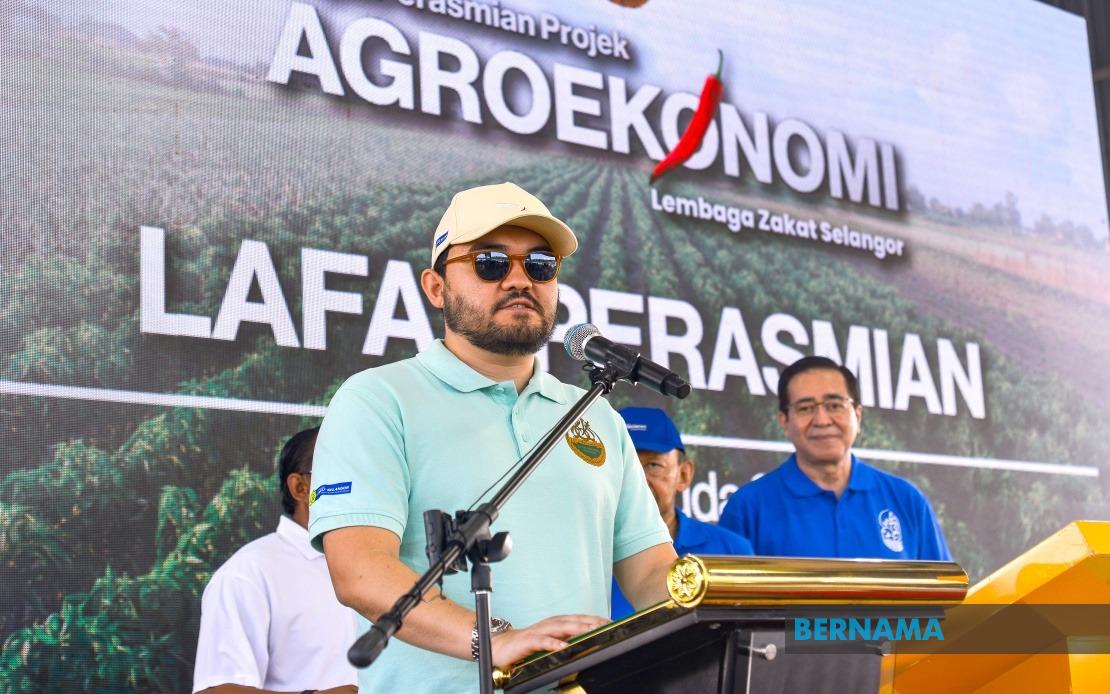
The Selangor Zakat Board has shifted its approach to supporting the asnaf community, moving beyond conventional cash assistance toward building sustainable livelihoods through agricultural entrepreneurship. Launched today by the Raja Muda of Selangor, Tengku Amir Shah Sultan Sharafuddin Idris Shah, the Agroeconomic Project represents a significant investment in economic self-sufficiency, marking a strategic pivot in how religious charitable contributions can catalyse structural economic empowerment rather than perpetuating dependency on welfare transfers.
The initiative spans 110 acres at Laman Agro Ehsan in Bukit Beruntung, with 76 acres allocated for intensive agricultural development focusing on fertigation-based chilli cultivation. The RM26 million commitment underscores the seriousness with which Selangor's zakat management is tackling poverty alleviation, moving away from temporary relief toward asset-building and skill acquisition. This model aligns with broader Islamic economic principles emphasizing productive investment of zakat funds to eliminate root causes of poverty rather than merely treating symptoms.
Forty-eight carefully selected asnaf participants will engage in a three-year structured development programme that combines technical agricultural training, ongoing crop management supervision, and mentored field experience. Each beneficiary manages a 0.5-acre plot cultivating 2,000 chilli plants, collectively producing 96,000 planting bags per cycle across all 48 plots. This standardized approach ensures consistency in productivity measurement and creates benchmarks for scaling the model across other districts or states seeking to replicate this approach.
Participant selection involved rigorous screening conducted jointly with the Kuala Langat Area Farmers' Organisation (PPKKL), ensuring recipients possess the motivation, aptitude, and commitment necessary for agricultural entrepreneurship. This collaborative vetting process distinguishes this programme from ad-hoc assistance schemes, establishing accountability mechanisms that increase the likelihood of programme success and financial viability. By involving local farmer organizations in selection, the board taps into existing agricultural networks and expertise while building institutional partnerships.
The income potential represents a transformative opportunity for participant households. Once crop management and production stabilize, participants could generate monthly incomes approaching RM4,000, substantially exceeding typical asnaf assistance levels and providing meaningful household economic advancement. For context, this income trajectory would position participating families above poverty thresholds and create capacity for savings, investment, and family development—outcomes that extend far beyond individual financial gain into broader community stability.
Beyond agricultural training and capital provision, the programme addresses a critical barrier to rural agricultural participation by providing fully subsidized accommodation at Prima Beruntung housing during the three-year programme duration. This removal of living cost pressures allows participants to reinvest agricultural earnings rather than consuming them for shelter, accelerating capital accumulation and reducing financial stress that often undermines agricultural productivity. The integrated housing support demonstrates comprehensive programme design that recognizes interconnected dimensions of rural poverty.
The financial architecture relies upon collaborative fundraising through wakalah contributions amounting to RM2.07 million from three major institutional partners: the Pilgrims Fund Board, RHB Islamic Bank Berhad, and Cagamas Berhad. This multi-stakeholder funding model distributes investment risk while building broader institutional commitment to asnaf economic development. Such partnerships create replicable templates for other zakat boards or charitable organizations seeking to mobilize private sector resources for development initiatives.
Participants themselves articulate the programme's transformative potential. Norfhadilah Mohd Shafiin, a 45-year-old mother of five, emphasizes that the initiative provides not merely income opportunities but knowledge transfer and confidence-building—psychological dimensions crucial for sustainable self-reliance. Similarly, Raimi Rusydi Rodi highlights skill acquisition and community cohesion among participants, suggesting the programme generates social capital alongside economic returns. These testimonies underscore that poverty alleviation operates through multiple reinforcing mechanisms rather than income transfer alone.
The Raja Muda's personal participation in the project launch—including formal opening remarks, commemorative plaque signing, cultivation area visits, and direct engagement with participants—signals high-level political commitment to the initiative. Such executive-level visibility enhances programme prestige, potentially facilitating future funding and policy support while demonstrating that asnaf development ranks among state leadership priorities. The symbolic and substantive dimensions of royal participation strengthen stakeholder confidence in programme durability and institutional support.
This Selangor initiative carries implications extending beyond the Klang Valley. Malaysian states facing rural poverty and agricultural sector contraction might examine this model's replicability within their respective zakat systems and local agricultural contexts. The three-year intensive support model, standardized plot allocation methodology, and integrated housing provision offer a scalable framework that other state Islamic religious departments could adapt. As Malaysia navigates agricultural modernization and rural economic transition, zakat-financed agro-entrepreneurship represents an underutilized mechanism for harmonizing Islamic charitable obligations with development priorities.
The project's emphasis on dignity through productive engagement rather than passive assistance reflects evolving best practices in Islamic social finance. By positioning asnaf recipients as agricultural entrepreneurs with agency and responsibility rather than welfare beneficiaries, the programme respects human dignity while building community assets. This philosophical reorientation—evident in the structured training, participant selection, and income generation emphasis—signals maturation in how Malaysian Islamic institutions conceptualize charitable obligation and poverty elimination. Success in Bukit Beruntung could establish a model influencing how other zakat boards across Southeast Asia approach asnaf economic empowerment, ultimately strengthening both Islamic institutional credibility and regional poverty reduction capacity.

