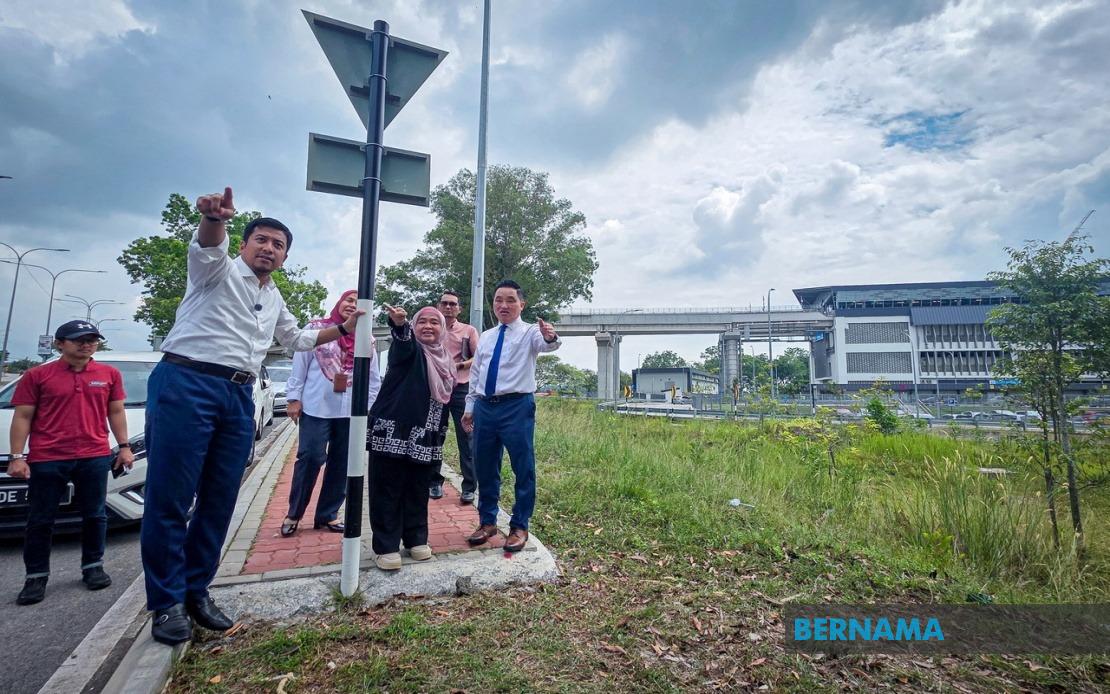
The Selangor State Government is moving swiftly to address infrastructure shortcomings affecting users of the Shah Alam Line LRT3, with state authorities targeting rapid completion of connectivity facilities that remain incomplete since the line's opening. State Local Government and Tourism Exco Datuk Ng Suee Lim outlined the government's action plan during an inspection of public access infrastructure, emphasising the administration's commitment to rectifying deficiencies that have emerged during the transit system's initial operational phase.
Two stations have emerged as priority focus areas in the remedial effort. Dato' Menteri Station and Shah Alam Stadium Station are both experiencing connectivity challenges involving pedestrian infrastructure such as walkways and zebra crossings that remain unfinished. These gaps have created inconveniences for commuters attempting to access the stations safely and efficiently, prompting the state government to intervene and coordinate with relevant agencies to accelerate completion timelines.
For Dato' Menteri Station, officials have identified administrative delays stemming from permit applications and related bureaucratic procedures as the primary impediment to finalisation. Responding to these obstacles, the Selangor administration has directed Prasarana, the transit operator, to conclude all outstanding connectivity work within a two-month window. This compressed timeline reflects the government's determination to eliminate access barriers that currently affect daily commuters using this station.
The situation at Shah Alam Stadium Station presents a more complex challenge, as completion depends on tender processes managed by developers operating in the vicinity. While resolution may require an extended timeframe compared to Dato' Menteri Station, the state government has committed to maintaining vigilant oversight throughout the development process. Datuk Ng acknowledged that newly opened infrastructure projects inherently contain imperfections, but emphasised that identifying and resolving issues once the system operates in real-world conditions represents a responsibility the government takes seriously.
Coordination mechanisms are being strengthened to expedite improvements across all affected areas. The Shah Alam City Council (MBSA) will monitor progress on infrastructure enhancements, while additional coordination meetings with relevant developers have been scheduled to ensure timely execution of necessary work. This multi-agency approach aims to eliminate delays and bureaucratic friction that might otherwise prolong the resolution process.
Beyond the two priority stations, the state government is casting a wider net to identify and address deficiencies throughout the LRT3 system. Local authorities maintaining stations within their respective jurisdictions have been instructed to conduct comprehensive reviews of connectivity infrastructure under their purview. This systematic audit process is designed to capture issues that may not have surfaced during initial inspections, ensuring no problems remain unaddressed across the broader network.
The government's acknowledgement of existing weaknesses contrasts sharply with defensive posturing often adopted by public agencies facing criticism. Datuk Ng's candid admission that imperfections exist, coupled with concrete steps to resolve them, suggests a pragmatic approach prioritising user experience over institutional face-saving. The willingness to involve grassroots representatives in the feedback process, instructing all council members and assemblymen to report identified problems, creates additional accountability channels that may accelerate problem identification and resolution.
The broader implications for Selangor's transport infrastructure extend beyond these immediate corrections. Successful completion of LRT3 connectivity work could establish a template for managing infrastructure deficiencies in other major projects, demonstrating how responsive governance can address the gap between project completion and operational excellence. The Shah Alam Line, which serves commuters across one of Malaysia's most economically significant regions, affects millions of users whose daily mobility depends on reliable, accessible public transport.
For Malaysian commuters and urban planners, the Selangor government's intervention illustrates both the challenges inherent in large-scale transit projects and the potential for mid-course correction when authorities prioritise user needs. The compressed timelines for remedial work suggest that with sufficient political will and resource allocation, infrastructure gaps need not persist indefinitely. However, the extended timeframe required for some improvements also highlights how contract structures and tendering processes can impede rapid resolution of public inconveniences.
The involvement of multiple stakeholders—Prasarana, MBSA, the Royal Klang City Council, and various developers—underscores the complexity of coordinating connectivity infrastructure across a modern rapid transit system. Effective management of these moving parts requires sustained attention and clear accountability, elements the state government appears determined to provide. As other regions in Southeast Asia undertake similar transit expansion projects, the Selangor experience offers cautionary lessons about the importance of ensuring connectivity infrastructure is complete before system launch, rather than relying on post-opening remediation.

