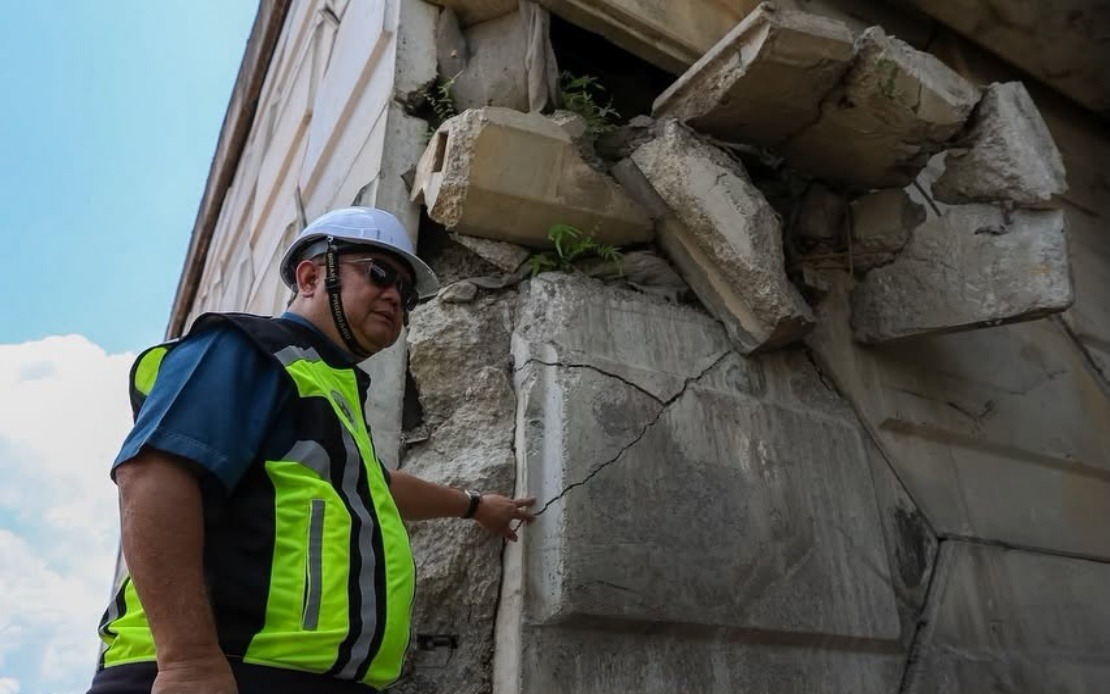
Works Minister Datuk Seri Alexander Nanta Linggi has pledged that the damaged Selangau-Mukah Interchange Flyover on the Pan Borneo Highway will resume operations only after comprehensive safety assessments and repairs are completed. The commitment came during a site visit in Sibu, where Nanta surveyed the damage to Ramp 1 of the interchange, which was struck by a palm oil tanker, necessitating the immediate closure of the affected route to protect public safety.
The collision compromised the structural integrity of the ramp, with technical evaluations confirming that part of the critical retaining wall structure sustained damage that required urgent intervention. Rather than attempting a rushed reopening, authorities determined that the most prudent course was to cease traffic flow and conduct detailed engineering assessments. This decision reflects growing recognition across Southeast Asia that infrastructure safety cannot be sacrificed for short-term convenience, particularly on major thoroughfares like the Pan Borneo Highway that connect numerous communities across Sarawak.
Nanta outlined a carefully managed reconstruction strategy that prioritises staged reopening once structural repairs progress. Sections of the interchange deemed safe following initial assessments will be returned to service sequentially, while portions still classified as hazardous will remain sealed off until restoration work concludes entirely. This phased approach balances the legitimate needs of regional commuters with the imperative of preventing catastrophic failure. The minister stressed that controlled structural repairs, supervised by certified engineers, will be the cornerstone of the remediation effort, ensuring that the affected site regains full stability before any segment reopens.
The Bintulu-Mukah-Sibu corridor has experienced considerable disruption due to the closure, imposing genuine hardship on residents, commercial operators, and regular travellers who depend on this vital route. Nanta acknowledged the frustration and inconvenience affecting the community, recognising that prolonged road closures create economic ripples throughout supply chains and daily commerce. However, he reiterated unambiguously that restoring safety must supersede public pressure for immediate reopening, a message particularly important in regions where infrastructure failures have previously resulted in loss of life.
In addressing public anxiety amplified by social media discussion and traditional news coverage, Nanta signalled that government agencies must take community feedback seriously. The minister's acknowledgment that public concerns—whether expressed online or through conventional channels—warrant consideration reflects evolving expectations for government responsiveness. For Malaysian readers accustomed to infrastructure challenges across the peninsula and East Malaysia, this transparency represents a shift toward more accountable governance around critical safety matters.
The minister identified three foundational priorities guiding the reconstruction programme. First, maintaining unwavering safety standards for all users of the Pan Borneo Highway remains non-negotiable, as a single structural failure could endanger dozens of lives. Second, the government will maintain rigorous oversight of the repair timeline to prevent unnecessary delays that would extend commuter suffering without corresponding safety benefit. Third, clear public communication regarding alternative routes, current closures, and reconstruction progress will be continuously updated, enabling users to plan journeys effectively.
The Pan Borneo Highway itself holds strategic significance for Sarawak's development, linking major towns and facilitating commerce across the state's interior and coastal regions. Damage to critical junctures like the Selangau-Mukah Interchange therefore carries implications beyond immediate users, affecting supply chains, tourism, and regional economic activity. This incident underscores the vulnerability of modern infrastructure to unexpected shocks and the necessity of rigorous maintenance protocols and rapid response systems for monitoring structural condition.
Nanta's assurance that he would personally oversee reconstruction progress demonstrates ministerial accountability, though sceptics might note that such high-level attention often follows public incidents rather than preventing them through proactive inspection regimes. Nonetheless, the commitment signals that this particular case will not be subject to bureaucratic delays or deprioritisation. For Malaysian and regional observers, this case exemplifies broader infrastructure challenges confronting rapidly developing nations, where aged or damaged structures must be balanced against operational demands.
The timeline for reopening remains undefined, contingent entirely on how swiftly engineers complete repairs and certify structural integrity. No specific date has been announced, reflecting the reality that construction timelines are difficult to predict when safety considerations take absolute precedence. Communities must therefore prepare for extended disruption while viewing it as a necessary cost of preventing a potential tragedy. The minister's measured approach, emphasising patience and systematic repair over hasty restoration, offers a model for other infrastructure crises in Malaysia and Southeast Asia where political pressure often conflicts with technical requirements.

