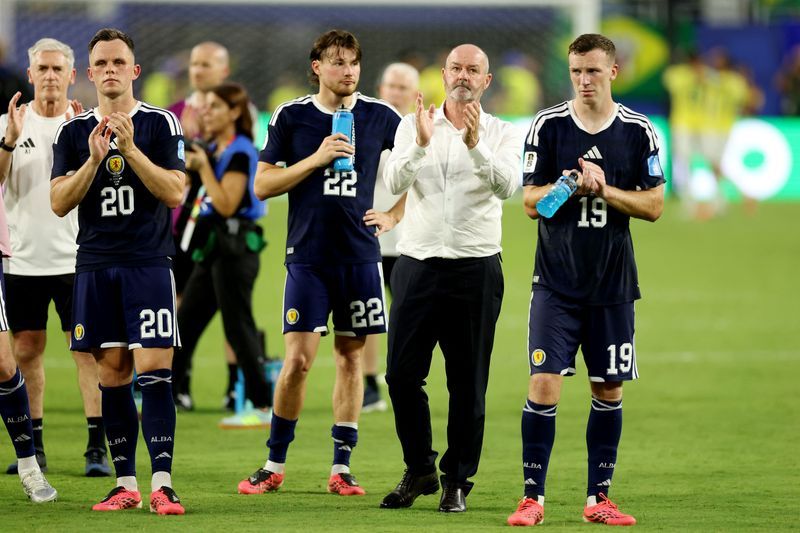
Scotland's hopes of progressing beyond the group stage at their first World Cup tournament in 28 years appear to have evaporated after a comprehensive 3-0 defeat to Brazil in Miami on Wednesday, with coach Steve Clarke openly acknowledging that his side will likely be heading home. Despite retaining a mathematical possibility of advancing as one of eight third-placed teams with the strongest records across the 12 groups, Clarke's candid assessment reflected a resignation that Scotland's performances simply have not matched the quality required to survive the tournament's opening phase.
The Scots accumulated three points from their group matches but currently occupy only the sixth-best position among third-place finishers. With 20 matches still to be played across other groups, Clarke evidently believes Scotland will be overtaken by at least two other teams with comparable records, effectively sealing their fate. His pragmatic evaluation of the mathematical situation underscored the reality that while elimination is not yet mathematically confirmed, the realistic pathway to the knockout rounds has effectively closed.
Clarke's post-match analysis was notably straightforward in his criticism of his team's defensive organisation against one of the tournament's heavyweight nations. He acknowledged that Brazil's clinical finishing capitalized on repeated Scottish mistakes rather than the visitors dominating through superior quality throughout the match. The Scotland manager characterised the result as fair, recognising that when a team of Brazil's attacking prowess is afforded multiple defensive opportunities, punishment invariably follows. This frank appraisal suggested Clarke's frustration was directed as much at preventable errors as at any systemic shortfall in his tactical approach.
Despite the severity of the scoreline, Clarke noted that Scotland's goalkeeper Angus Gunn made several crucial saves that prevented an even more damaging margin of defeat. The team created isolated chances and demonstrated moments of attacking intent, yet failed to convert these opportunities into meaningful outcomes. Clarke lamented that Scotland never produced the quality of play in the final third that would have troubled Brazil's defence, illustrating the gulf between attacking in fits and spurts against lethal opposition and maintaining sustained threatening play.
The Scotland manager's disappointment extended beyond the immediate tactical failing to encompass a broader concern about his players' inability to reach the standard they have demonstrated during qualification. Clarke emphasised that supporters and observers familiar with Scotland's recent trajectory understood the team was capable of performances far superior to what materialised against Brazil. This gap between potential and execution appeared to trouble Clarke more than the defeat itself, suggesting deeper concerns about consistency and resilience at the highest level.
Beyond the immediate match context, Clarke articulated systemic anxieties about Scottish football's competitive trajectory on the global stage. Having witnessed the physical intensity, athleticism, and technical prowess displayed by both Morocco and Brazil, he contended that Scottish football's developmental pathways require fundamental restructuring. Clarke's assessment highlighted a concerning gap in Scotland's capacity to produce young players capable of competing at World Cup intensity, positioning the current tournament exit as symptomatic of institutional challenges rather than isolated poor performance.
The former Chelsea fullback expressed particular disappointment that the squad had not demonstrated the developmental progress one might expect from a team that had fought through qualifying rounds to reach the tournament. His critique implicitly suggested that qualification itself, while representing genuine achievement, should have been accompanied by corresponding improvements in performance standards. This reflection pointed to questions about whether Scotland's qualifying campaign had concealed underlying vulnerabilities that only emerge against elite opposition.
Clarke remained careful to acknowledge the extraordinary commitment of Scotland's travelling supporters, whose vibrant presence throughout the tournament had earned widespread admiration. However, he cautioned against allowing fan enthusiasm to overshadow the primary objective or diminish focus on the disappointing results. The manager stressed that this group of players had accomplished the significant feat of bringing their supporters to the United States, reminding fans that without successful qualification, Scotland would be experiencing the familiar scenario of watching the World Cup from home.
This perspective attempted to provide context for the squad's efforts despite their ultimate failure to convert qualification into meaningful tournament progress. Clarke's framing suggested that while results had fallen short of expectations, the players deserved recognition for the effort required merely to reach the World Cup stage. He implicitly argued that the standard criticism of Scottish football—watching from the sidelines—made the current squad's qualification achievement noteworthy, even as their tournament performance proved inadequate against top-tier opposition.

